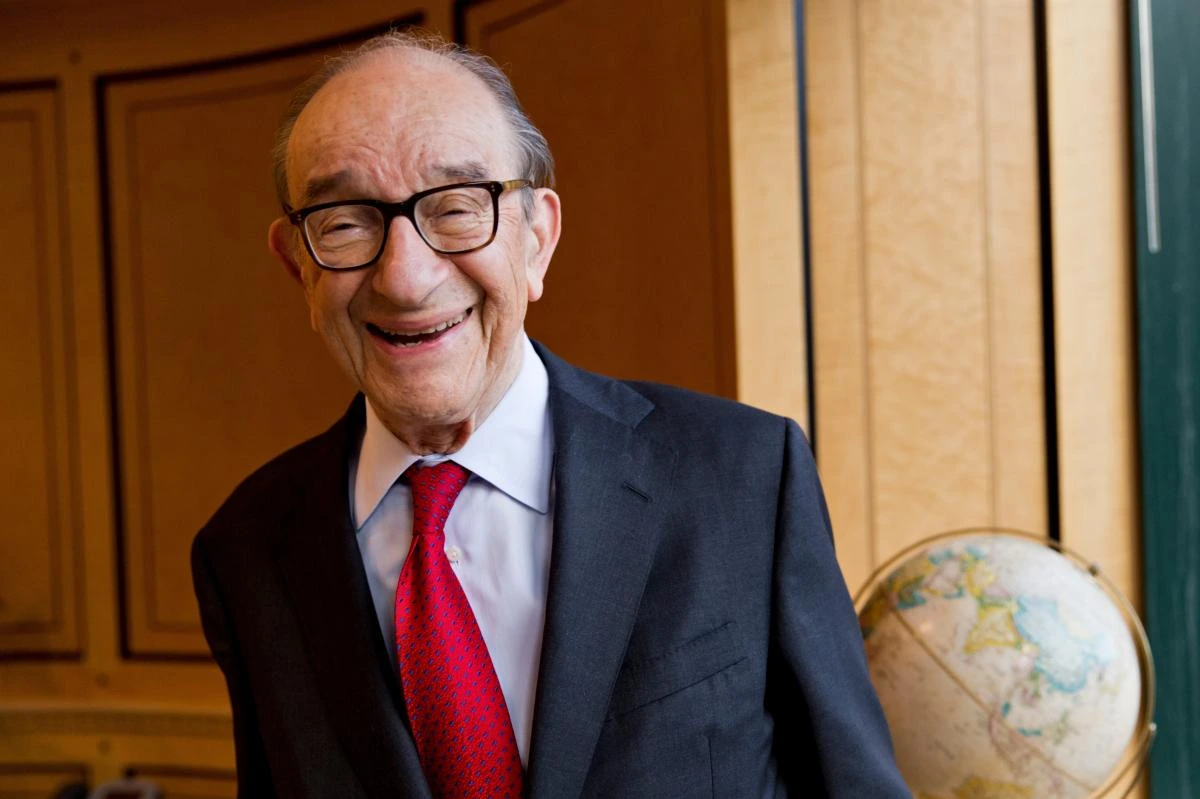
Alan Greenspan, the influential economist who led the U.S. Federal Reserve for nearly two decades and became one of the most powerful figures in global finance, has died at the age of 100.
Greenspan passed away on Monday from complications related to Parkinson’s disease, according to a statement from his wife, Andrea Mitchell.
“Alan passed away at our home this morning at the age of 100 from complications of Parkinson’s disease,” Mitchell said, describing him as a towering figure who helped shape the American economy under presidents from both major political parties.
Greenspan served as chairman of the Federal Reserve from 1987 to 2006, making him one of the longest-serving leaders in the institution’s history. During his tenure, he worked under four U.S. presidents: Ronald Reagan, George H. W. Bush, Bill Clinton, and George W. Bush.
From New York Musician to Economic Powerhouse
Born on March 6, 1926, in New York City, Greenspan displayed exceptional mathematical ability from a young age. Before embarking on a career in economics, he attended the Juilliard School, where he played jazz saxophone and clarinet.
After earning degrees in economics from New York University, Greenspan established himself as a respected economic consultant before entering public service.
His first major political role came as an adviser to Richard Nixon during the 1968 presidential campaign. He later served as chairman of the Council of Economic Advisers under President Gerald Ford.
Greenspan assumed leadership of the Federal Reserve in 1987 and was immediately tested by the stock market crash known as Black Monday.
His decision to provide liquidity to financial markets helped calm investors and established his reputation as a decisive central banker. The intervention later gave rise to the term “Greenspan put,” reflecting market expectations that the Fed would support financial markets during periods of instability.
During the 1990s, Greenspan oversaw a period of sustained economic growth fueled by technological innovation, productivity gains, and the expansion of the internet economy.
His 1996 warning about “irrational exuberance” in financial markets became one of the most widely cited comments in modern economic history.
His achievements earned international recognition, including France’s Legion of Honor and an honorary knighthood from Queen Elizabeth II. In 2005, he received the Presidential Medal of Freedom from President George W. Bush.
Criticism After the Global Financial Crisis
Despite widespread acclaim during much of his career, Greenspan’s legacy became more complicated following the 2007–2008 global financial crisis.

Critics argued that his support for financial deregulation and failure to adequately address risks in the housing market contributed to the conditions that led to the financial collapse.
In testimony before Congress after the crisis, Greenspan acknowledged that the scale of the economic turmoil had exceeded his expectations, describing it as a “once-in-a-century credit tsunami.”