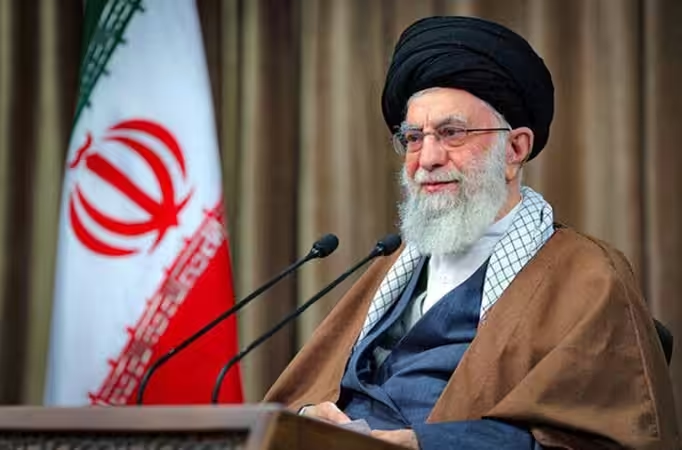
A senior Israeli official has told Reuters that Iran’s Supreme Leader, Ali Khamenei, has been killed in joint U.S. and Israeli strikes, marking a dramatic escalation in the conflict and potentially reshaping the political future of the Islamic Republic.
There was no immediate confirmation from Iranian authorities regarding Khamenei’s fate. The reported killing follows a wave of coordinated military strikes by the United States and Israel on key Iranian leadership and strategic sites in Tehran on Saturday.
Satellite imagery showed extensive damage and plumes of black smoke rising from a compound associated with the supreme leader.
Al-Khamenei Reign as Supreme Leader
Khamenei, 86, had served as Iran’s highest authority since 1989, succeeding Ruhollah Khomeini after the 1979 Islamic Revolution.
As supreme leader, he wielded ultimate authority over Iran’s political, military and religious institutions, overseeing both domestic governance and foreign policy direction.
Under his leadership, Iran consolidated its position as a central anti-U.S. force in the Middle East and expanded its regional influence through allied groups.
Israel has long viewed Khamenei as a destabilizing actor, citing his backing of regional militant movements including Hamas and Hezbollah. During a 12-day air war between Israel and Iran in June 2025, Israeli Defence Minister Israel Katz publicly threatened to assassinate him, saying the Iranian leader “cannot continue to exist.”
Khamenei’s tenure was marked by both consolidation and confrontation. While he endorsed the 2015 nuclear agreement negotiated under former President Hassan Rouhani, tensions surged after the United States withdrew from the deal in 2018 and reimposed sanctions.
Domestically, his government suppressed repeated waves of protests and marginalized reformist factions advocating détente with the West.

The office of supreme leader, established in the wake of the 1979 revolution and codified in Iran’s constitution, holds ultimate authority over the president and parliament. The 88-member Assembly of Experts, a clerical body vetted by a hardline oversight council, is formally responsible for selecting a successor.
If confirmed, Khamenei’s death would create an unprecedented leadership vacuum in Tehran, raising urgent questions about succession, internal power struggles particularly within the Islamic Revolutionary Guard Corps.