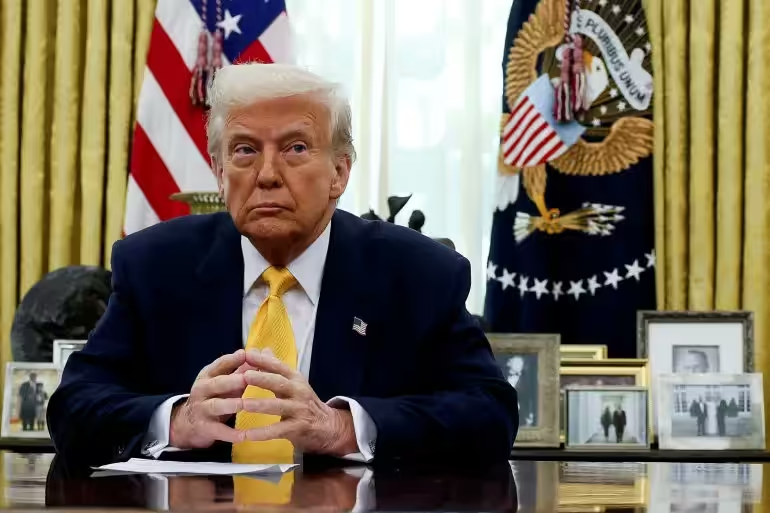
US President Donald Trump has announced the creation of a new “Board of Peace” to oversee the postwar rehabilitation and long-term reconstruction of Gaza, appointing former UK prime minister Tony Blair, private-equity executive Marc Rowan, and his son-in-law Jared Kushner as key members.
According to the White House, the board will function as an executive body guiding Gaza’s stabilisation following the devastation of Israel’s two-year war against Hamas. Trump will chair the board himself, making it a directly presidentially-led initiative rather than a multilateral or UN-anchored mechanism.
The appointments form part of Trump’s broader 20-point peace and reconstruction framework for Gaza, which places strong emphasis on governance reform, reconstruction, and large-scale capital mobilisation. The White House said each board member would oversee a defined portfolio critical to Gaza’s long-term recovery, including governance capacity-building, regional relations, reconstruction, investment attraction, and large-scale funding.
The board’s membership also includes senior US officials and international financial figures, among them US Secretary of State Marco Rubio, US special envoy Steve Witkoff, World Bank president Ajay Banga, and US national security adviser Robert Gabriel. Notably, the board does not include Palestinian or Arab political leaders, a decision likely to attract scrutiny from regional governments and international partners.
Blair and Kushner were both involved in earlier Trump-era Middle East initiatives, while Rowan leads Apollo Global Management, one of the world’s largest alternative asset managers, underlining the board’s explicit orientation toward private capital and institutional investment rather than donor-led aid alone.
Analysis: What This Could Mean in Practice
The composition of Trump’s Gaza “Board of Peace” signals a decisive shift toward a finance- and governance-led reconstruction model driven by Western political authority and private capital, rather than regional consensus or multilateral diplomacy. By placing private-equity leadership and former Western political figures at the centre—while excluding Palestinian representation—the initiative may accelerate funding mobilisation and project execution but risks a legitimacy deficit that could undermine local buy-in and long-term stability. For investors, the structure suggests a push toward large-scale, commercially structured reconstruction vehicles rather than traditional aid flows; for regional politics, it is likely to sharpen tensions over sovereignty, representation, and the future governance of Gaza, even as it seeks to impose order and capital discipline on a devastated enclave.