Business activity in Nigeria’s private sector grew at its fastest pace in six months in October 2025, driven by rising new orders and stronger customer demand, even as power outages and payment delays continued to hinder productivity.
According to the latest Stanbic IBTC Bank Nigeria Purchasing Managers’ Index (PMI) compiled by S&P Global, the headline PMI climbed to 54.0 points in October from 53.4 in September, marking the 11th consecutive month of expansion above the 50.0 threshold.
The report showed that growth was broad-based across manufacturing, agriculture, construction, and services, with manufacturing posting the fastest rise in output.
Firms cited the introduction of new products and increased diversification as key factors behind higher sales and stronger performance across sectors. This indicates improving domestic demand conditions and a gradual rebound in business confidence despite operational bottlenecks.
Inflation Pressures Ease as Prices Stabilize
Although companies continued to raise their selling prices in response to higher input and wage costs, inflationary pressures eased significantly compared to previous years.
The survey noted that output charges rose at the second-slowest rate since April 2020, signaling greater price stability in the private sector. Input cost inflation edged slightly higher due to increased staff and purchase costs but remained weaker than levels recorded in 2023 and early 2024.
Job Creation Slows Amid Operational Disruptions
Employment expanded for the fifth straight month in October as firms sought to meet rising demand, though the pace of job growth slowed from September.
Many businesses struggled with electricity shortages and delayed client payments, leading to a build-up of uncompleted orders. While higher staffing levels helped some companies manage workloads, others experienced productivity declines due to frequent power interruptions.
Supply Chain Efficiency and Business Confidence
Despite these disruptions, purchasing activity and inventory levels increased, suggesting firms were preparing for future growth. Supplier delivery times improved, reflecting more efficient supply chains and easing logistical pressures.
However, business confidence weakened for the fourth consecutive month, hitting its lowest level since May. Nearly half of respondents still expect output to rise in the next 12 months, supported by marketing campaigns and export opportunities, though concerns remain about energy costs, inflation, and policy uncertainty.
Outlook: Stable Naira, Lower Inflation to Support Growth
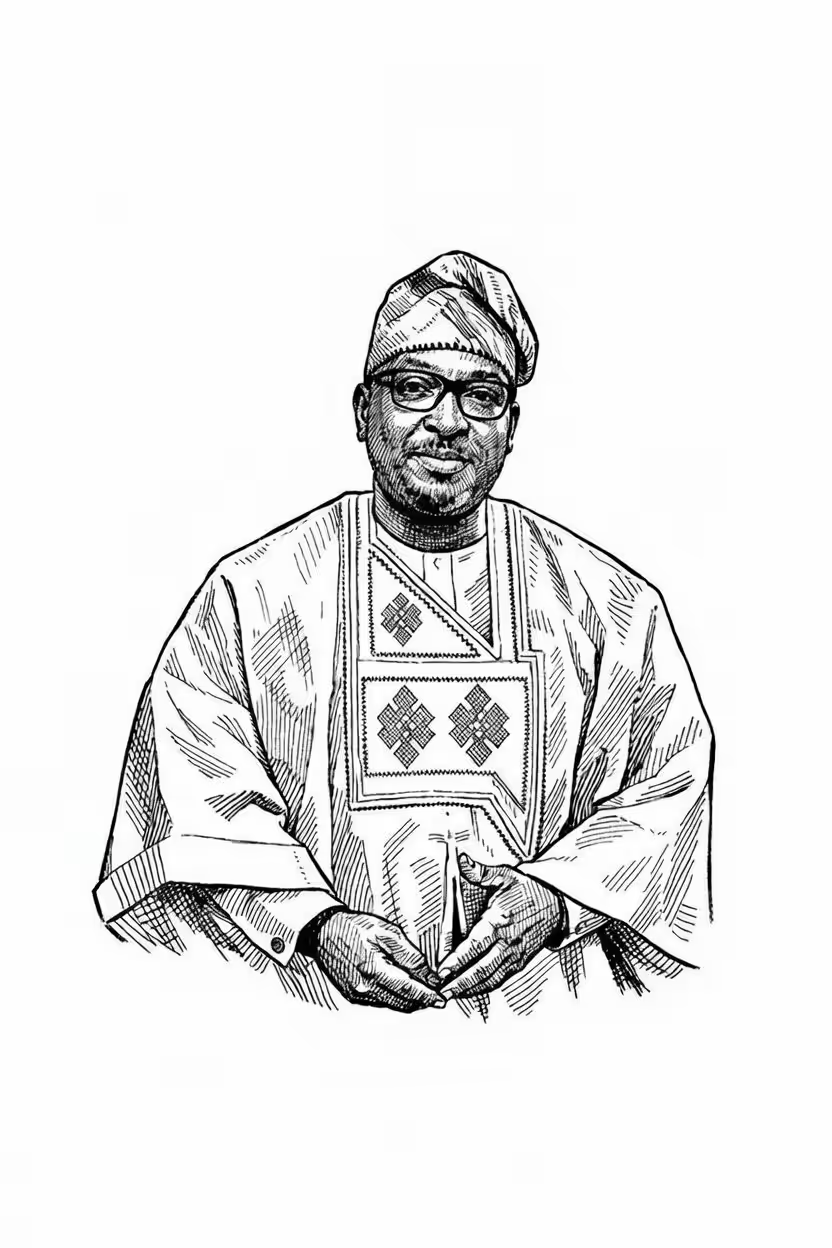
Commenting on the report, Muyiwa Oni, Head of Equity Research for West Africa at Stanbic IBTC Bank, said Nigeria’s private sector began the final quarter of 2025 “on a strong note,” buoyed by higher output and new orders, supported by moderating inflation and a stable exchange rate.
Oni forecasted headline inflation to ease to between 15.8% and 16.2% in October, and further to around 14.3% to 14.6% in November, helped by lower food prices during the main harvest season.
He noted that while fuel prices remain high due to production challenges at the Dangote Refinery, the naira’s relative appreciation should ease non-food inflation pressures.
Oni added that lower inflation, stable exchange rates, and potential interest rate cuts would strengthen real sector growth, projecting Nigeria’s economy to expand by about 4.0% in 2025, led by the manufacturing and services sectors.
The PMI survey, endorsed by the National Bureau of Statistics (NBS) and based on responses from about 400 firms across various industries, provides an early indicator of private sector health.
October’s data highlights that despite infrastructure inefficiencies and cash flow constraints, Nigerian businesses remain adaptable and resilient, finding growth opportunities even amid power shortages and uncertain economic conditions.