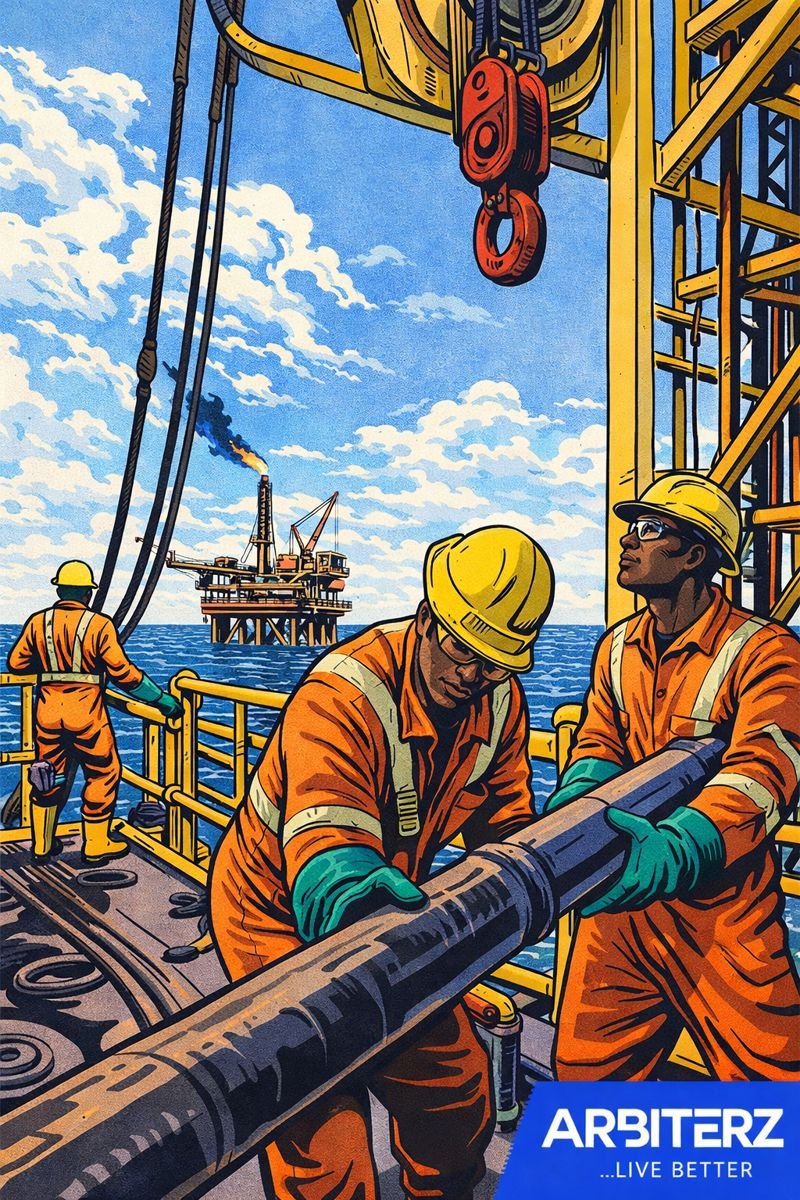
Nigeria’s oil industry has crossed a historic threshold. As reported by The Economist, 2025 marked the first time in the sector’s 70-year history that private Nigerian companies produced a larger share of the country’s oil and gas than foreign majors. The milestone is more than symbolic. It reflects a structural reordering of Africa’s largest oil industry—driven by policy reform, improving security in the Niger Delta, and a decisive transfer of assets from international oil companies to domestic operators under President Bola Ahmed Tinubu.
Only a few years ago, Nigeria’s upstream sector appeared stuck in decline. Production fell to a two-decade low in 2022 as oil theft surged, pipelines were repeatedly sabotaged, and investor confidence ebbed. A licensing round for exploration acreage drew little enthusiasm, reinforcing the view that Nigeria had become a high-risk, high-cost jurisdiction. Global oil companies retreated onshore, concentrating capital in deepwater projects or exiting the country altogether.
The mood today is different. Nigeria’s latest licensing round, launched in December 2025, has attracted renewed interest from majors such as Chevron and TotalEnergies. Officials estimate that bids for onshore and offshore assets could generate about $10bn over the next decade. Production has also recovered. In 2025 Nigeria averaged roughly 1.47m barrels of crude oil per day—its highest level in five years—with the government now targeting 3m barrels per day by 2030.
Yet the defining feature of the rebound is not the tentative return of foreign interest, but the rise of Nigerian operators.
The Nigerianisation of Nigerian Oil
Oil remains central to Nigeria’s economy, accounting for more than 80% of export earnings. But over the past decade, insecurity, regulatory uncertainty, and high operating costs steadily eroded competitiveness relative to peers such as Angola and new African producers like Namibia. By the early 2020s, the Niger Delta had become synonymous with theft, shutdowns, and community conflict.
Since taking office in 2023, Tinubu—a former oil executive—has prioritised restoring output and confidence. His administration has tightened security coordination in the Delta, streamlined contracting processes, and deployed targeted fiscal incentives aimed at lowering breakeven costs. These efforts have complemented reforms embedded in the Petroleum Industry Act (PIA) of 2021, which clarified fiscal terms and formalised host-community participation.
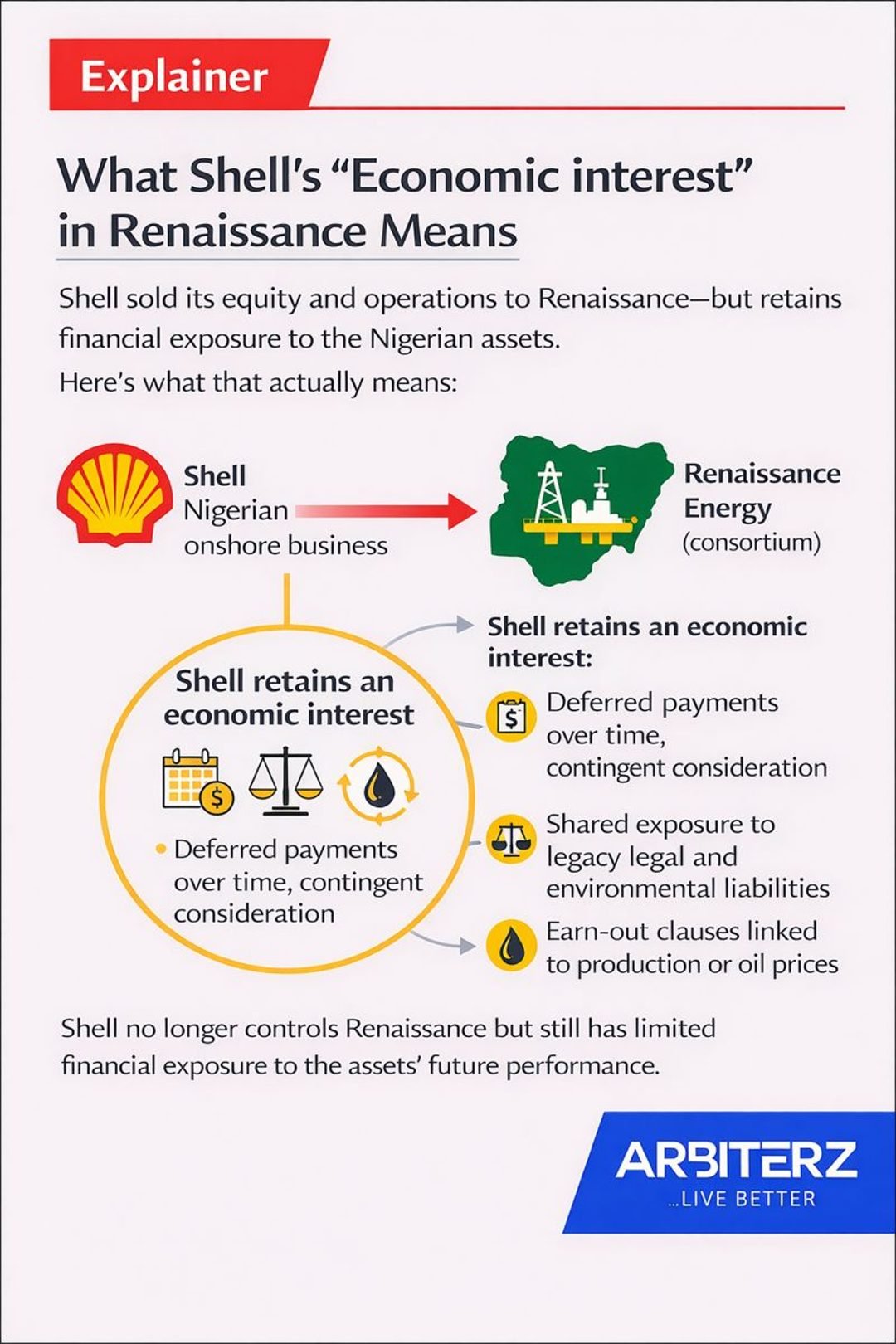
The results are increasingly visible. A wave of divestments by international oil companies has transferred control of much of Nigeria’s onshore production to local firms. Renaissance Energy, a consortium dominated by Nigerian interests, completed the takeover of Shell’s onshore subsidiary in 2025 in a transaction valued at approximately $2.4 billion, including cash consideration and assumed liabilities—the largest upstream divestment in Nigeria’s history.
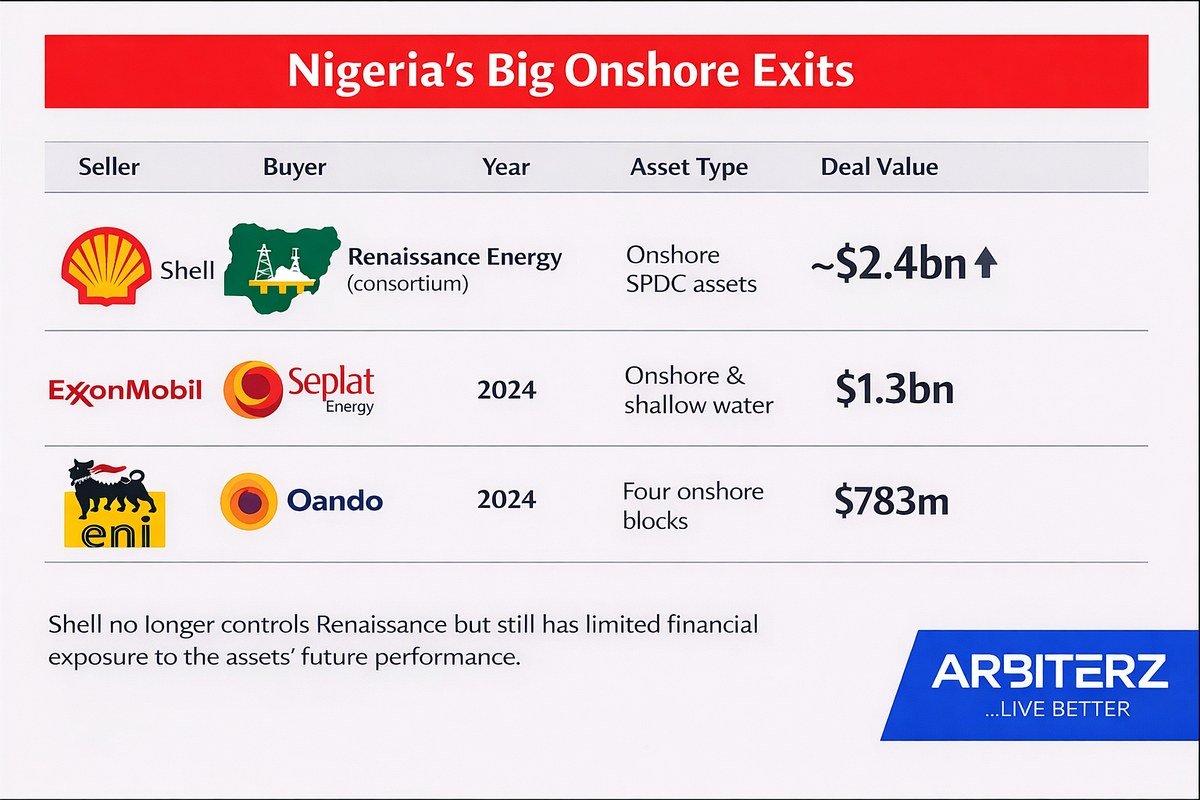
That deal eclipsed what had previously been considered the benchmark transaction: Seplat Energy’s $1.3 billion acquisition of ExxonMobil’s onshore and shallow-water assets in 2024. Oando followed with the $783 million purchase of four onshore blocks from ENI, pledging to invest $2 billion by the end of the decade.
Ownership changes have not been limited to asset transfers. In late 2024, Heirs Energies became Seplat’s largest shareholder through a transaction valued at nearly $500 million, reinforcing domestic control even where assets remain listed and internationally financed. The deal underscored a broader trend: Nigerian capital is not only buying assets, but consolidating influence across the sector.
By 2025, domestic operators collectively produced more oil and gas than foreign firms. Onshore Nigeria has, in effect, become a local industry.
Why locals are gaining ground
Nigerian executives argue that indigenous firms are structurally better suited to local operating realities. Smaller balance sheets impose cost discipline and faster decision-making. Local ownership can also ease relations with host communities whose consent is essential for uninterrupted production.
Security indicators support this claim. Seplat reports that pipeline losses—peaking at 10–15% of output during 2020–21—have remained below 5% since 2022. Heirs Energies says output at an oilfield it acquired from Shell, ENI, and Total in 2021 has doubled, with incidents of sabotage and theft largely eliminated. The PIA’s requirement that operators contribute 3% of operating expenditure to host-community development funds has helped align incentives, while locally coordinated security arrangements have reduced vandalism.
Cost structures have also improved. Industry estimates put breakeven prices for many Nigerian onshore producers at $30–40 per barrel, allowing them to operate profitably even in a relatively soft oil-price environment. For the Tinubu administration, this combination—lower costs, improved security, and local risk-taking—underpins the strategy to revive output without relying solely on capital-intensive offshore projects.
The limits of the rebound
The local-led recovery, however, faces hard constraints. Maintaining production, repairing ageing infrastructure, addressing environmental damage, and developing new reserves all require sustained capital investment. Outside Seplat—listed in Lagos and London—most Nigerian producers struggle to access long-term financing.
Western banks remain cautious about Nigerian oil exposure, citing environmental liabilities and political risk. Domestic banks, still recovering from currency volatility, have limited capacity to fund large upstream projects. Chinese and Middle Eastern lenders may fill part of the gap, but not all of it. Regulators, too, have expressed concern about whether smaller firms can shoulder the financial and environmental liabilities attached to ageing assets.
Industry insiders expect consolidation. Some operators will be absorbed by stronger players; others may exit. The danger is that production gains stall if capital shortages prevent reinvestment.
Betting on gas
In the longer term, the firms most likely to endure may be those pivoting toward natural gas. Nigeria holds Africa’s largest proven gas reserves, and global demand—driven by energy-transition dynamics and industrial growth—is rising. Tinubu’s government has positioned gas as a strategic priority, offering tax incentives and regulatory support.
If successful, the shift could have wider economic benefits. Gas provides cheaper, cleaner power for domestic industries—from fertilisers to steel—supporting manufacturing and reducing import dependence. For decades, critics argue, Nigeria’s oil industry was designed around export infrastructure and the balance sheets of international oil companies. A more domestically anchored gas sector could finally align energy production with local economic development.

A fragile turning point
Nigeria’s oil industry in 2025 looks markedly different from that of just a few years earlier. Output is recovering, security has improved, and domestic firms have taken the lead for the first time in the country’s oil history. The shift reflects genuine progress under Tinubu’s administration and a rebalancing long thought unlikely.
Whether it proves durable will depend on capital. Without deeper pools of long-term finance and stronger environmental performance, today’s locally driven rebound risks stalling. For now, however, Nigeria has crossed a historic line: its oil industry is no longer dominated by foreign majors. The challenge is ensuring that local leadership translates into lasting growth rather than a brief resurgence.