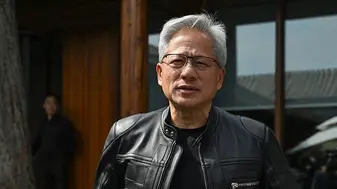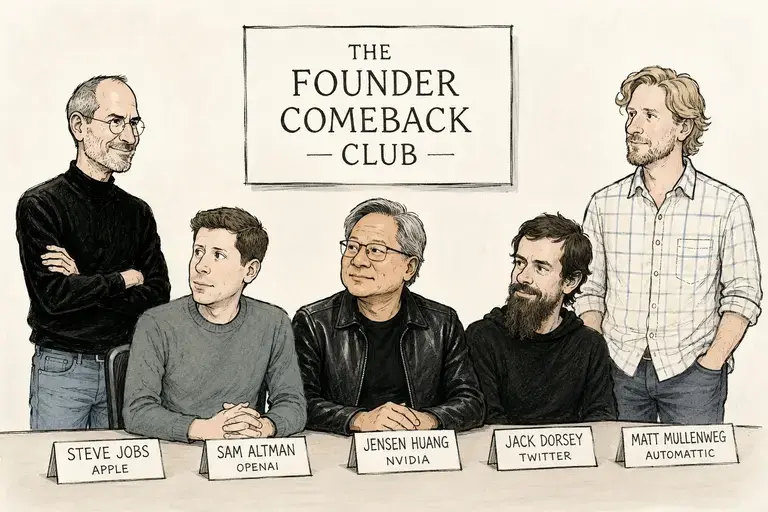
Nvidia co-founder Jensen Huang’s return as chief executive has placed him among a small group of technology and business founders who have reclaimed leadership after being pushed out, sidelined or stepping away from the companies they built.
Huang’s comeback has drawn comparisons with some of the most dramatic leadership reversals in corporate history, including the return of Apple co-founder Steve Jobs and OpenAI chief executive Sam Altman.
Other prominent examples include Twitter co-founder Jack Dorsey, Automattic founder Matt Mullenweg and brokerage entrepreneur Charles Schwab.
Steve Jobs – Apple
One of the best-known corporate comebacks involved Steve Jobs, who returned to Apple more than a decade after leaving the company following a power struggle.
Jobs co-founded Apple in 1976 with Steve Wozniak and Ronald Wayne. In 1985, disagreements over the company’s direction and management led to a confrontation with then-CEO John Sculley and the board.
Jobs lost his operational responsibilities and subsequently resigned, leaving to establish computer company NeXT.
Apple later acquired NeXT in a deal announced in December 1996 and completed in February 1997. The acquisition brought Jobs back into the company as an adviser.
Following the departure of CEO Gil Amelio, Jobs became Apple’s interim chief executive in September 1997. He subsequently led the company through a major transformation, overseeing the launch of products including the iMac, iPod, iPhone and iPad.
Sam Altman – OpenAI
Sam Altman’s removal from OpenAI in November 2023 triggered one of the most dramatic governance crises in the technology industry.
The company’s board abruptly dismissed Altman on November 17, 2023, saying he had not been consistently candid in his communications with directors.
The decision prompted an immediate backlash from employees and investors. OpenAI co-founder Greg Brockman resigned as board chairman and later joined the push for Altman’s return.
Microsoft, OpenAI’s largest investor and commercial partner at the time, offered Altman a position leading a new artificial intelligence research team.
The crisis intensified when more than 700 OpenAI employees signed an open letter threatening to leave the company unless the board resigned and reinstated Altman.
On November 21, four days after his removal, OpenAI announced an agreement in principle for him to return as CEO under a reconstituted board.
Altman officially resumed the position on November 29, while Brockman also returned as president.
Jack Dorsey – Twitter
Twitter co-founder Jack Dorsey was pushed out as the company’s chief executive in October 2008, less than two years after the social media platform was established.
Dorsey, who served as Twitter’s first CEO, was replaced by fellow co-founder Evan Williams amid concerns about his management approach as the company expanded.
He remained involved as chairman and continued to hold a significant stake in the business. He also co-founded payments company Square, later renamed Block.
Nearly seven years after his departure, Dorsey returned as Twitter’s interim CEO in July 2015 following the exit of Dick Costolo.
The company confirmed him as permanent chief executive in October that year.
Dorsey led Twitter and Square simultaneously before stepping down from Twitter in November 2021. Parag Agrawal succeeded him, but was later removed after Elon Musk completed his $44 billion acquisition of the social media company in 2022.
Matt Mullenweg – Automattic
Matt Mullenweg’s return as chief executive of Automattic, the company behind WordPress.com, was one of the shortest leadership comebacks among the recent examples.
In September 2026, Automattic’s board voted to place Mullenweg, the company’s founder, on paid leave and appointed chief financial officer Mark Davies as interim CEO.
Mullenweg challenged the decision, telling employees in an internal Slack message that board members had acted against him without his agreement.
Two days later, he announced that he was back in control of the company. Automattic subsequently confirmed that he had returned as chairman and CEO with the board’s support.
The company said Mullenweg had been away for only 33 hours and 20 minutes.
The dispute had further consequences for the company’s leadership. TechCrunch reported that the directors involved in the attempted removal subsequently departed and that Mullenweg rebuilt the board.
Charles Schwab – Charles Schwab Corporation
Charles Schwab founded the brokerage business that bears his name and returned as its CEO in 2004 after the board removed David Pottruck from the position.
Pottruck had been leading the company when the board decided to replace him. Rather than appointing an external executive, the directors turned to Schwab, who had founded the business.
Schwab’s second stint as chief executive lasted until 2008, when Walt Bettinger took over.
Mark Pincus – Zynga
Mark Pincus, founder of social gaming company Zynga, also returned to the CEO position after handing over the job to an outside executive.
Pincus established Zynga in 2007 and led the company until 2013, when former Electronic Arts executive Don Mattrick became CEO.
Pincus stepped aside as the company brought in a new leader, but returned to the top job in April 2015.
Other Notable CEO Comebacks
Howard Schultz – Starbucks: Schultz, the founder who helped build Starbucks into a global coffee chain, served as CEO in three separate periods. He first led the company from 1985 to 2000, returned in 2008 amid business difficulties and remained until 2017. He returned again as interim CEO in April 2022 following Kevin Johnson’s retirement, before handing over to Laxman Narasimhan in March 2023.
Michael Dell – Dell: Dell founded the computer company in 1984 and served as CEO until July 2004, when he handed the position to Kevin Rollins but remained chairman. He resumed the CEO role in January 2007 after Rollins left the position. His return later preceded the company’s expansion into enterprise technology, including its acquisition of EMC in 2016.
Bob Iger – Disney: Iger returned as Disney CEO in November 2022, replacing Bob Chapek, the executive who had succeeded him in 2020. Iger had led Disney for 15 years before stepping down as CEO and later serving as executive chairman. The board said his experience made him the preferred leader during a difficult period of industry transformation.
Larry Page – Google: Page, Google’s co-founder and first CEO, returned to the top job in April 2011 after Eric Schmidt stepped aside. Page had handed the CEO position to Schmidt in 2001, while remaining involved in the company. His second tenure included the creation of Alphabet, Google’s parent company, in 2015.

Michael Bloomberg – Bloomberg LP: Bloomberg returned to lead the financial information company he founded after completing his tenure as mayor of New York City. He had stepped away from the business in January 2002 to take office and returned in January 2014.
Pat Gelsinger – Intel: Gelsinger was not an Intel founder, but his return illustrates another type of corporate comeback. After spending 30 years at Intel and rising to become its chief technology officer, he left in 2009, later became CEO of VMware and returned to Intel as chief executive in February 2021.