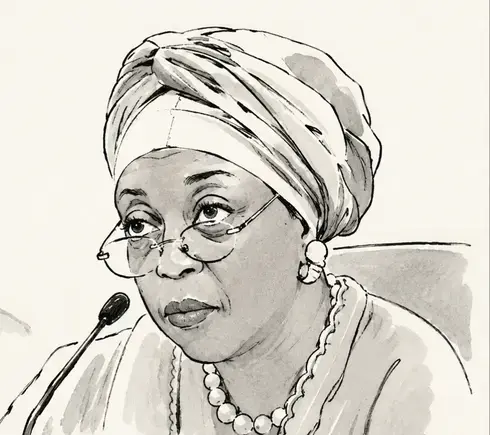
Former Nigerian Minister of Petroleum Resources Diezani Alison-Madueke has been acquitted of all bribery charges brought against her in the United Kingdom, ending one of the most closely watched international corruption cases involving a former Nigerian public official.
A jury at Southwark Crown Court in London found the 65-year-old not guilty on six counts: five charges of accepting bribes and one count of conspiracy to commit bribery. Her co-defendants, oil executive Olatimbo Ayinde and her brother Doye Agama, were also acquitted.
The verdict closes the UK criminal case against Alison-Madueke, but it does not end the debate over her tenure at the apex of Nigeria’s most important industry, nor does it settle the questions that have followed the country’s oil sector through the administrations of Presidents Goodluck Jonathan, Muhammadu Buhari and Bola Tinubu.
The Most Powerful Minister in Nigeria
When Diezani Alison-Madueke became Minister of Petroleum Resources in 2010, she inherited what many regarded as the most powerful portfolio in Nigeria.
The petroleum ministry controlled the country’s primary source of foreign exchange earnings and government revenue. Through its oversight of the Nigerian National Petroleum Corporation (NNPC), it influenced crude oil sales, fuel imports, licensing decisions, refinery policy, subsidy administration and relations with both international oil companies and indigenous producers.
At a time when oil accounted for roughly 70 percent of government revenues and more than 90 percent of export earnings, the petroleum minister occupied a position that rivalled, and in some respects exceeded, that of many other cabinet ministers.
Alison-Madueke’s influence extended beyond Nigeria. In 2014 she became the first woman to serve as president of the Organization of Petroleum Exporting Countries (OPEC), a symbolic milestone in an industry overwhelmingly dominated by men.
Yet her rise coincided with growing public anger over the governance of Nigeria’s oil sector.
Fuel Subsidy, Kerosene and the Politics of Oil
Three controversies came to define public perceptions of Alison-Madueke’s tenure.
The first was the January 2012 fuel subsidy crisis.
President Goodluck Jonathan’s government attempted to remove fuel subsidies, arguing that the system had become fiscally unsustainable and deeply corrupted by fraudulent claims. Petrol prices immediately doubled, triggering one of the largest protests Nigeria had seen since the return to civilian rule in 1999.
The administration maintained that subsidy reform was essential to redirect public resources toward infrastructure and social investment. Many Nigerians saw it differently. They viewed fuel subsidy as one of the few tangible benefits citizens received from the country’s oil wealth and regarded its removal as an unfair burden on households.
The second controversy involved kerosene subsidies.
Former Central Bank Governor Lamido Sanusi alleged that NNPC continued deducting subsidy payments on household kerosene despite a previous presidential directive ending the programme. Alison-Madueke defended the continuation of the subsidy as a necessary social intervention, but critics argued that the arrangement exemplified the opacity surrounding petroleum revenues and expenditures.
The third concerned oil contracts, crude swap arrangements and strategic alliance agreements.
Critics alleged that these arrangements benefited politically connected firms while reducing transparency in the management of national resources. Government officials argued that such structures were necessary to guarantee fuel supply and sustain operations in a difficult operating environment.
The Companies and Businessmen at the Centre of Controversy
During and after Alison-Madueke’s tenure, a number of businessmen became associated with investigations into Nigeria’s oil sector.
Among the most prominent were Kolawole Aluko and Jide Omokore, whose companies were alleged by American authorities to have benefited from contracts and business relationships linked to the former minister.
The U.S. Department of Justice pursued civil forfeiture actions against assets including luxury real estate and high-value property allegedly connected to proceeds of corruption involving Nigeria’s petroleum industry.
Alison-Madueke consistently denied wrongdoing. Importantly, civil forfeiture proceedings are distinct from criminal convictions and require different standards of proof.
Nevertheless, the allegations helped cement her status as a symbol of what many Nigerians viewed as the excesses of the oil boom era.
A Rivalry That Reflected a Deeper Problem
One of the defining features of the Jonathan administration was the uneasy relationship between Alison-Madueke and then Finance Minister Ngozi Okonjo-Iweala.
Although both served in the same cabinet, they often represented different institutional perspectives.
Okonjo-Iweala’s ministry focused on fiscal discipline, public finances and revenue transparency. Alison-Madueke oversaw the sector generating most of those revenues.
Disagreements emerged over subsidy payments, NNPC remittances and the accounting treatment of petroleum revenues. These disputes became public as questions mounted over billions of dollars in oil income that the Central Bank argued had not been remitted to government coffers.
The tensions highlighted a structural weakness that persists today: the ministry responsible for managing government finances does not directly control the country’s principal revenue-generating sector.
How Diezani Became the Face of Nigeria’s Anti-Corruption Debate
By the time Jonathan lost the 2015 presidential election, Alison-Madueke had become one of the most controversial figures in Nigerian public life.
For supporters of Muhammadu Buhari’s anti-corruption campaign, she represented everything that had gone wrong with the management of Nigeria’s oil wealth.
For others, she was a convenient political target whose prominence made her an easy symbol of wider institutional failures.
Shortly after leaving office, she became the subject of investigations in Nigeria, the United Kingdom and the United States.
How She Got Into Legal Trouble in London
British authorities began investigating Alison-Madueke in 2015.
The UK case ultimately centred on allegations that she accepted benefits from individuals seeking influence and commercial advantage within Nigeria’s oil and gas sector.
Prosecutors alleged that she enjoyed luxury accommodation, private travel, expensive hospitality and other benefits funded by industry figures.
The prosecution argued that these benefits constituted bribes.
Alison-Madueke rejected the allegations. Her legal team argued that she neither solicited nor accepted bribes and that she did not personally control the award of the contracts that prosecutors sought to connect to the alleged benefits.
Throughout the proceedings she maintained her innocence.
The Charges and the Acquittal
The charges brought before Southwark Crown Court consisted of five counts of accepting bribes and one count of conspiracy to commit bribery.
After hearing evidence over several weeks, jurors deliberated for more than 46 hours before returning unanimous not-guilty verdicts on all six counts.
Olatimbo Ayinde, an oil industry executive accused of bribery-related offences, was also acquitted.
Doye Agama, Alison-Madueke’s brother, who faced allegations relating to payments allegedly made to a church, was similarly cleared.
The verdict marks a major setback for British prosecutors and concludes one of the most prominent foreign corruption trials ever pursued by UK authorities.
Why Some Observers Were Not Surprised by the Acquittal
The acquittal has reignited debate among Nigerian lawyers, anti-corruption activists and former officials about whether the case had been weakened long before it reached a British courtroom.
Some observers point to the contrast with the case of former Delta State governor James Ibori.
The UK investigation into Ibori benefited from years of evidence gathering, substantial cooperation between British and Nigerian authorities and ultimately a guilty plea that led to imprisonment.
Critics argue that the Alison-Madueke case unfolded differently.
In particular, they point to decisions taken during the administration of former Attorney-General Abubakar Malami, which emphasised asset recovery and negotiated settlements in some cases rather than criminal prosecutions.
Supporters of this approach argued that recovering assets for the Nigerian people was more important than pursuing lengthy legal battles with uncertain outcomes.
Critics contend that such settlements can complicate later criminal prosecutions because they alter the evidential landscape available to prosecutors.
One argument increasingly heard among legal commentators is that it is difficult to persuade a British jury that a foreign public official committed bribery when the country where the alleged conduct occurred has not itself produced criminal findings on the underlying conduct.
As one former prosecutor observed privately after the verdict: “How can you prove a corruption case abroad when the predicate conduct at home has effectively been resolved through civil settlements and asset recovery?”
That view remains contested.
Former anti-corruption officials argue that asset recovery and criminal prosecution are separate legal processes and that prosecutors are expected to prove guilt beyond reasonable doubt regardless of whether other jurisdictions pursue civil remedies.
Nonetheless, the debate highlights the complexity of prosecuting transnational corruption cases more than a decade after the events in question.
Nigeria’s Oil Sector After Diezani
Perhaps the most remarkable aspect of Alison-Madueke’s legacy is that she remains Nigeria’s last substantive Minister of Petroleum Resources.
Since her departure in 2015, successive presidents have been unwilling to appoint another full petroleum minister with comparable authority.
President Muhammadu Buhari retained the petroleum portfolio himself throughout most of his presidency, relying on ministers of state to manage daily operations.
President Bola Tinubu has followed a similar model.
The implication is striking: after Diezani, the presidency chose not to create another all-powerful petroleum minister.
Instead, control of the sector was drawn closer to the presidency itself.
What Happened to Her Policies Under Buhari?
The Buhari administration dismantled or reviewed several arrangements associated with the Jonathan era.
NNPC restructured crude swap agreements and pledged greater transparency in commercial transactions.
The administration’s most significant reform was the Petroleum Industry Act (PIA), signed into law in 2021 after two decades of debate.
The legislation transformed NNPC into NNPC Limited, established new regulatory agencies and sought to modernise fiscal and governance structures across the industry.
Yet Buhari did not immediately end fuel subsidies.
Indeed, subsidy costs ballooned during his presidency, consuming trillions of naira and becoming one of the largest burdens on public finances.
In that sense, the central dilemma of the Diezani era survived long after her departure.
Tinubu’s Break With the Past
President Bola Tinubu’s most consequential oil-sector decision came on his first day in office.
Declaring that “fuel subsidy is gone,” he ended a policy that had shaped Nigeria’s political economy for decades.
The decision triggered a sharp increase in fuel prices and contributed to inflationary pressures across the economy, but the administration argued that continuing subsidies threatened fiscal stability.
Tinubu’s government has also prioritised domestic gas utilisation, compressed natural gas adoption and efforts to attract investment into upstream production.
The objective is clear: move the sector away from subsidy-driven politics and toward investment-led growth.
Whether that objective can be achieved remains one of the defining questions of the current administration.
The Verdict and the Legacy
Diezani Alison-Madueke’s acquittal changes the legal record in the United Kingdom.
It does not, however, resolve the historical debate over her stewardship of Nigeria’s oil industry.
Her tenure remains associated with some of the most contentious issues in modern Nigerian economic history: fuel subsidies, missing oil revenues, opaque contracting arrangements and the struggle to reform NNPC.
The political significance of the verdict extends beyond Alison-Madueke herself.
After more than a decade of investigations, asset seizures, forfeiture proceedings and allegations across multiple jurisdictions, the most prominent criminal case against Nigeria’s former petroleum minister ended not with a conviction but with a complete acquittal.
For supporters of the verdict, that outcome demonstrates that prosecutors failed to prove their case.
For critics, it raises uncomfortable questions about whether one of the largest corruption investigations linked to Nigeria’s oil industry lost momentum long before it reached a jury.

Either way, the verdict marks the end of a major legal chapter.
The debate over Diezani Alison-Madueke’s place in Nigeria’s oil history is likely to continue for many years.