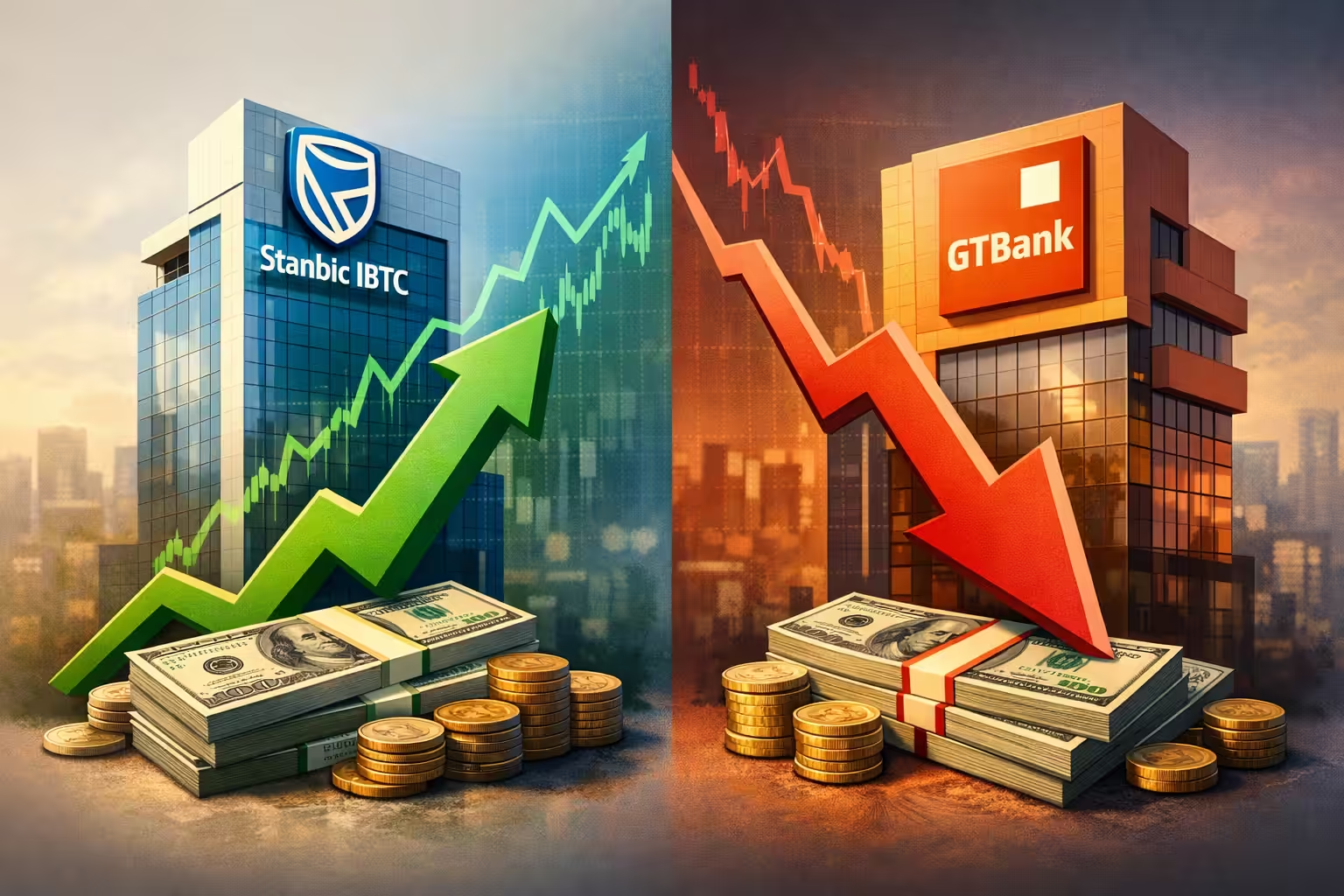
Nigeria’s banks are now adjusting foreign exchange rates for international card payments in real time, with Stanbic IBTC and GTBank moving in opposite directions — a sign of increasing FX market complexity.
Nigeria’s banks are continuing to reprice foreign exchange rates for international card transactions, with Stanbic IBTC Bank increasing its rate to ₦1,410 per dollar, while Guaranty Trust Bank (GTBank) has adjusted downward to ₦1,394 per dollar.
The latest rates, communicated to customers on March 30, apply to international payments made using naira debit cards, including online subscriptions, e-commerce transactions, and travel bookings.
A Rare Divergence: One Bank Up, Another Down
Unlike the steady upward trend observed in recent days, today’s pricing introduces a notable divergence:
- Stanbic IBTC: ₦1,405 → ₦1,410 (+₦5)
- GTBank: ₦1,401 → ₦1,394 (−₦7)
This opposing movement suggests that banks are responding not just to headline market rates, but to institution-specific FX liquidity positions and risk assessments.
GTBank’s downward adjustment may indicate:
- Improved access to FX liquidity
- Tactical repricing to remain competitive
- Short-term easing in its funding costs
Stanbic IBTC’s increase, by contrast, reflects continued caution amid uncertain FX supply conditions.
Increasing Dispersion in Bank FX Pricing
The spread between both banks has now widened to ₦16, one of the largest gaps observed in recent days.
This growing dispersion reinforces a key structural shift in Nigeria’s FX system:
- Banks now operate within a loosely coordinated but decentralised pricing environment
- FX rates for card transactions are no longer uniform across institutions
- Customers are effectively exposed to a mini-market of bank-specific FX pricing
What Today’s Moves Signal About the FX Market
Today’s mixed pricing direction highlights a more nuanced reality in Nigeria’s foreign exchange market:
- The market is not moving in a straight line
- Liquidity conditions may be improving for some institutions while tightening for others
- Pricing is becoming more dynamic, responsive, and fragmented
The evolving pattern of card FX rates reflects a deeper transformation in Nigeria’s monetary framework.
Where banks once relied heavily on centralised FX allocation, they now:

- Source FX more independently
- Price risk more actively
- Adjust rates frequently in response to market signals
The result is a system that offers greater access but less price certainty.
Implications for Consumers
For Nigerian users of international services, the message is clear:
- FX rates may change daily or even intra-day
- The cost of international payments is now fully market-linked
- Choosing a bank may have real pricing implications
FX Tracker Update
| Date (2026) | GTBank (₦/$) | Stanbic IBTC (₦/$) |
|---|---|---|
| Mar 13 | ₦1,385 | ₦1,395 |
| Mar 26 | ₦1,401 | ₦1,395 |
| Mar 27 | ₦1,401 | ₦1,405 |
| Mar 30 | ₦1,394 | ₦1,410 |