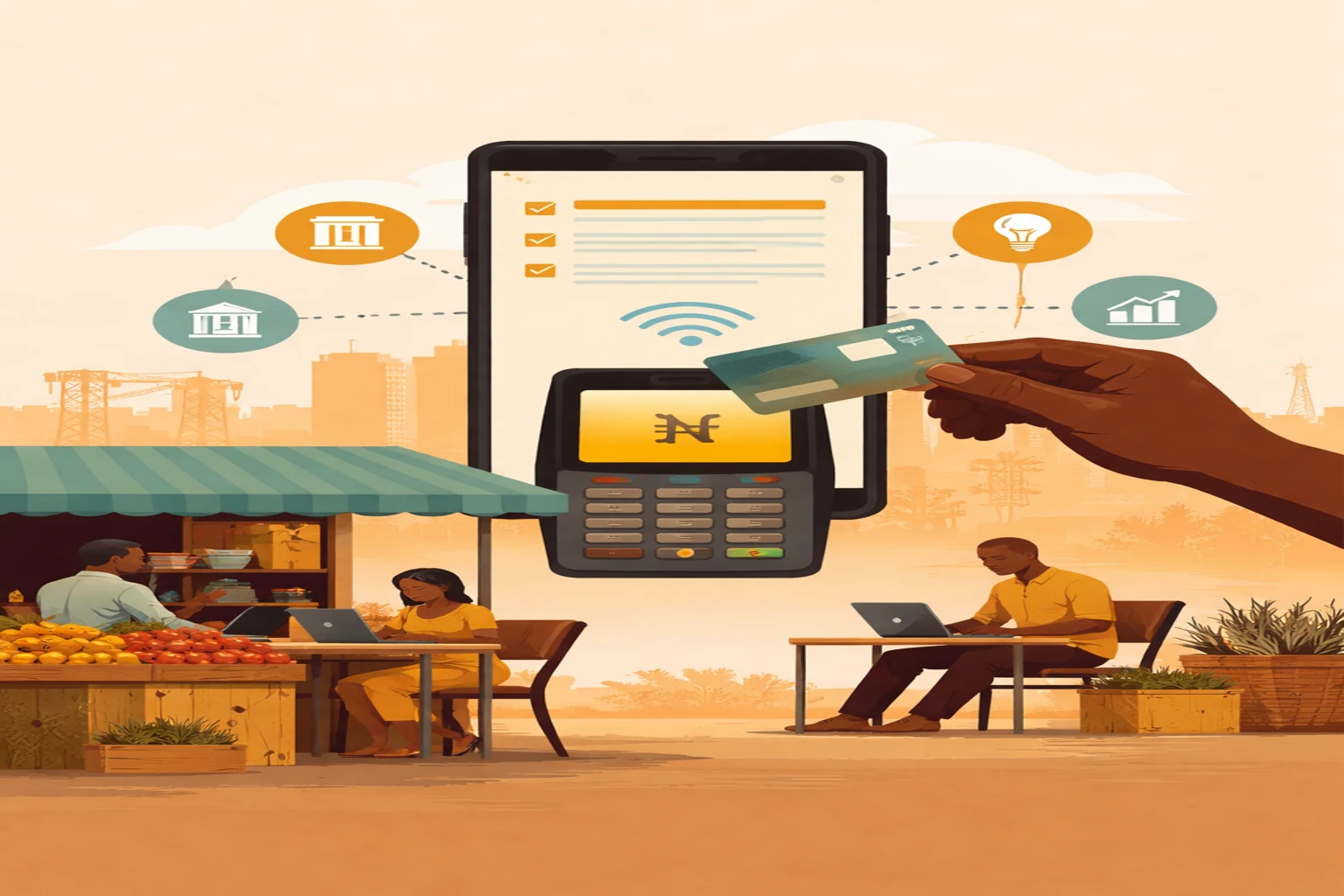
Across West Africa, where small businesses often struggle to obtain bank loans because they lack audited accounts or formal credit histories, digital payments are increasingly helping lenders evaluate businesses and expand access to credit.
New research from the World Bank finds that electronic payments—ranging from bank transfers and card payments to mobile money—generate transaction data that can help lenders better assess the financial health of businesses. By creating verifiable records of sales and cash flow, digital payment systems reduce the information gaps that have historically limited many firms’ access to credit.
The study, which examined nearly 49,000 firms across 101 economies, shows that companies that receive payments electronically are significantly less likely to be fully credit-constrained. On average, the probability of a firm being completely unable to access credit falls by about 3.3 percentage points when it receives payments digitally, a meaningful reduction relative to global levels of financing constraints.
Why Small Businesses Struggle to Access Credit in West Africa
Small and medium-sized enterprises (SMEs) across West Africa often face significant barriers when trying to obtain bank loans. One of the main challenges is the lack of reliable financial information about businesses. Many firms operate partly or entirely in the informal economy and do not maintain audited accounts, tax filings or detailed financial records that lenders typically rely on when assessing credit risk.
As a result, banks frequently find it difficult to determine whether a business generates sufficient and stable revenue to repay a loan. This information gap—often referred to as information asymmetry in financial markets—has long limited the availability of credit to SMEs in developing economies.
Digital payments are beginning to reduce this problem. Each electronic transaction creates a verifiable record of sales, payments and customer activity, providing lenders with valuable data that can help them evaluate businesses even when traditional financial documentation is unavailable.
How Digital Payments Help Lenders Evaluate Businesses
For banks and other lenders, one of the biggest obstacles to extending loans to small and medium-sized enterprises (SMEs) is the lack of reliable information. Many firms in developing economies operate without audited financial statements or detailed records of revenue and costs.
Digital payments help address this problem by leaving behind a clear trail of transactions.
When businesses receive payments electronically—from customers paying via bank transfer, card, or mobile wallet—the data can reveal key indicators such as sales volumes, cash flow stability, and customer demand patterns. Lenders can use this information to assess whether a firm has the capacity to repay a loan.
The World Bank study notes that incoming digital payments are particularly valuable for credit evaluation, because they provide direct evidence of revenue generation and business activity. Outgoing payments, such as supplier transfers, appear to be less informative for lenders.
Similar conclusions have emerged from fintech and mobile money research across Africa. Studies of mobile money platforms such as Kenya’s M-Pesa show that digital transaction histories can serve as an alternative source of credit data, allowing lenders to develop new credit scoring models where traditional credit bureaus have limited coverage.
These digital footprints—ranging from mobile money transfers to electronic merchant payments—provide financial institutions with evidence of business activity that can substitute for conventional documentation or collateral when evaluating borrowers.
Lenders Already Using Digital Payment Data
Across Africa, some of the most widely cited examples of payment-data-driven lending come from the mobile money ecosystem. In Kenya, digital credit products such as M-Shwari, developed by Safaricom and NCBA Bank, and KCB M-Pesa, created through a partnership between Safaricom and Kenya Commercial Bank, use customers’ mobile-money transaction histories to determine credit eligibility and loan limits. These platforms have collectively extended tens of millions of micro-loans to individuals and small businesses, demonstrating how digital payment data can substitute for traditional credit histories.
Global digital lenders operating in Africa have adopted similar approaches. Companies such as Branch International and Tala, which operate in several African markets, analyse smartphone and transaction data to build alternative credit scores for borrowers who lack conventional banking records. By relying on digital behavioural data and payment histories, these lenders have extended millions of small loans to individuals and micro-enterprises that previously had little access to formal finance.
Traditional banks are increasingly paying attention to these developments. Several African banks now collaborate with fintech companies to incorporate transaction data from payment processors, mobile wallets, and e-commerce platforms into their credit assessment models. In Nigeria, banks including Access Bank, Sterling Bank and Ecobank Nigeria have partnered with payment platforms such as Flutterwave, Paystack and Moniepoint to better understand merchant transaction flows and assess lending risk. Regional banking groups such as Ecobank and United Bank for Africa (UBA) are also expanding partnerships with fintech firms to integrate digital payment data into SME lending programmes across multiple African markets.
Ghana has also seen similar innovations. Digital lenders such as Fido Money Lending, Carbon Ghana, and Oze analyse payment flows, mobile-money activity, and merchant transaction histories to build credit scores for small traders and micro-businesses. Oze, for example, provides financial management tools for small businesses and uses transaction data from its platform to generate credit scores that partner lenders can use when issuing loans. Meanwhile, fintech lender Fido relies on mobile data and digital transaction histories to extend instant loans to individuals and small entrepreneurs operating in Ghana’s largely informal economy.
Nigeria illustrates how rapidly expanding digital payments can generate the kind of transaction data that lenders increasingly rely on. According to the Nigeria Inter-Bank Settlement System (NIBSS), electronic payments have surged in recent years as point-of-sale terminals, instant bank transfers and mobile payment apps spread across the country. Millions of merchants now accept digital payments through POS devices and fintech platforms, creating detailed records of daily business turnover. For lenders, these transaction flows provide an increasingly reliable way to estimate a firm’s revenue and repayment capacity. As Nigeria’s payment infrastructure continues to deepen—driven by fintech firms such as Flutterwave, Paystack, Moniepoint and Interswitch—banks and digital lenders are gaining access to a growing pool of data that can help unlock credit for small businesses that previously operated outside formal financial systems.
The World Bank’s findings suggest that as digital payments spread across West Africa, the region may gradually overcome one of the most persistent obstacles to business growth: the lack of reliable credit information. In economies where many firms still operate informally and traditional credit bureaus cover only a small share of businesses, the transaction data generated by mobile money, POS payments and digital banking platforms is becoming an alternative source of financial intelligence. For Nigeria, Ghana and other West African economies with fast-growing fintech sectors, the expansion of digital payments could therefore do more than improve convenience—it may also help build the data infrastructure needed to unlock credit for millions of small businesses.
Stronger Impact in Developing Economies
The research finds that the benefits of digital payments are most pronounced in economies with weaker financial infrastructure—conditions common across many African countries.
In lower-income economies, where credit bureaus and financial reporting systems are less developed, digital transaction records can serve as an alternative source of credit information. In such environments, lenders rely more heavily on payment data to evaluate firms.
The World Bank analysis shows that the impact of digital payments in reducing credit constraints is nearly three times larger in low-income economies than in high-income countries, underscoring their importance in emerging markets.
Similarly, firms operating in economies with large informal sectors—where many businesses lack formal documentation—benefit more from digital payment adoption, as electronic records help compensate for weak traditional financial data.
This pattern mirrors broader evidence on financial inclusion in Africa. Over the past decade, the expansion of mobile money and digital payments has been one of the main drivers of financial inclusion across sub-Saharan Africa, enabling millions of individuals and businesses to access formal financial services.
Small Firms Gain the Most
The study also highlights that digital payments are particularly valuable for smaller and younger firms, which are typically the most affected by financing barriers.
Because these businesses often lack long credit histories, lenders face greater uncertainty when assessing their creditworthiness. Electronic transaction data helps bridge that gap.
The World Bank finds the reduction in credit constraints associated with digital payments is strongest among:
- small firms with limited operating history
• businesses without audited financial statements
• firms with lower productivity or limited formal documentation
For these firms, digital payment records provide a form of “informational collateral” that can improve their chances of securing financing.
Evidence from SME studies across Africa reinforces this finding. Research on digital finance and mobile money adoption shows that transaction records from mobile banking and digital payments allow lenders to build credit profiles for firms that previously lacked financial documentation.
Implications for West Africa
Across West Africa, the rapid growth of mobile money, fintech platforms, and digital banking services is generating a growing pool of transaction data that could reshape SME financing.
Countries such as Nigeria, Ghana, and Senegal have seen sharp increases in electronic transfers and mobile payments in recent years as governments push cashless policies and fintech companies expand their services.
Platforms such as M-Pesa in Kenya, Fawry in Egypt and Interswitch in Nigeria illustrate how digital payment infrastructure is enabling small businesses to conduct transactions more efficiently while expanding access to financial services, including credit.
If lenders integrate this data more systematically into credit assessment models, digital payments could help address one of the region’s most persistent economic challenges: the lack of affordable financing for small businesses.

The World Bank study concludes that promoting electronic payment adoption and strengthening digital financial infrastructure could play a central role in helping lenders evaluate businesses more effectively and expanding credit access across developing economies.
By reducing information asymmetries between borrowers and lenders, digital payments may help financial institutions allocate credit more efficiently—allowing profitable firms to grow even in environments where traditional financial information remains scarce.