Iran’s President Masoud Pezeshkian said on Saturday that the country’s temporary leadership council had approved the suspension of missile and drone attacks on neighbouring states, provided those countries do not launch attacks against Iran.
The announcement came during a televised address in which Pezeshkian also apologised to neighbouring Gulf countries that had been struck during the past week of escalating regional hostilities triggered by U.S.–Israeli military strikes on Iran.
“I apologise … to the neighbouring countries that were attacked by Iran,” Pezeshkian said, adding that Tehran would no longer target them unless an attack against Iran originated from their territory.
The conditional halt represents the first explicit signal from Tehran that it may seek to prevent the conflict from widening across the Gulf, even as the war with Israel and the United States continues.
Retaliatory Strikes Across the Gulf
Over the past week, Iran has launched missile and drone attacks targeting U.S. military assets and allied infrastructure across the Middle East, including in Bahrain, Saudi Arabia and the United Arab Emirates.
Several Gulf states reported intercepting incoming projectiles, while regional aviation hubs—including Dubai International Airport—temporarily suspended operations amid missile alerts and security concerns.
The attacks were widely viewed as retaliation for the large-scale U.S. and Israeli strikes launched on February 28, which targeted Iranian nuclear facilities, military infrastructure and senior leadership figures.
Those strikes reportedly killed several senior Iranian officials and, according to Iranian authorities, disrupted the country’s command structure—an issue Pezeshkian suggested may have contributed to earlier attacks on neighbouring countries.
A Conditional De-Escalation
Analysts interpret Pezeshkian’s announcement less as a ceasefire and more as a calibrated attempt to limit escalation with Gulf states hosting U.S. forces.
Iran’s leadership appears to be signalling that its conflict is primarily with Israel and the United States, not the broader region.
By suspending attacks on neighbouring countries unless provoked, Tehran is likely trying to:
-
reduce the risk of a regional coalition forming against it,
-
reassure Gulf states worried about infrastructure and energy security, and
-
keep critical maritime and energy routes open, including the Strait of Hormuz.
Oil markets have been particularly sensitive to the conflict, with fears that disruptions to the Gulf shipping corridor could trigger sharp price spikes.
War Still Intensifying
Despite the conciliatory tone toward neighbouring states, Pezeshkian rejected U.S. calls for Iran’s “unconditional surrender,” describing them as unrealistic.
At the same time, Israeli and U.S. forces continue to strike Iranian military and nuclear sites, while Washington has approved additional military support for Israel as the conflict deepens.
Casualty estimates from the conflict already exceed 1,200 deaths in Iran and hundreds elsewhere across the region, according to officials cited in international reporting.
The war has also expanded beyond the immediate Iran–Israel theatre, with tensions involving Hezbollah in Lebanon and heightened security alerts across several Gulf states.
Strategic Implications
Iran’s conditional suspension of attacks highlights a two-track strategy by Tehran.
First, Iran appears determined to continue the core military confrontation with Israel and U.S. forces, framing the conflict as a direct strategic struggle rather than a broader regional war.
Second, the Iranian leadership is signalling that it wants to avoid opening multiple regional fronts that could overwhelm the country militarily or trigger a coalition of Gulf states against it.
For Gulf states—including Saudi Arabia, Qatar and the United Arab Emirates—the message is intended to reassure them that Tehran does not seek direct confrontation with their governments, despite targeting U.S. military assets in the region.
This distinction is important because many Gulf countries host American military bases, which Tehran regards as legitimate targets in a war with Washington. If attacks on Iran originate from those bases, Tehran has indicated it could retaliate even if the host country itself is not directly involved.
Whether Iran’s restraint holds will therefore depend largely on future military activity launched from Gulf territory.
Oil Market Implications if Fighting Ends Within a Week
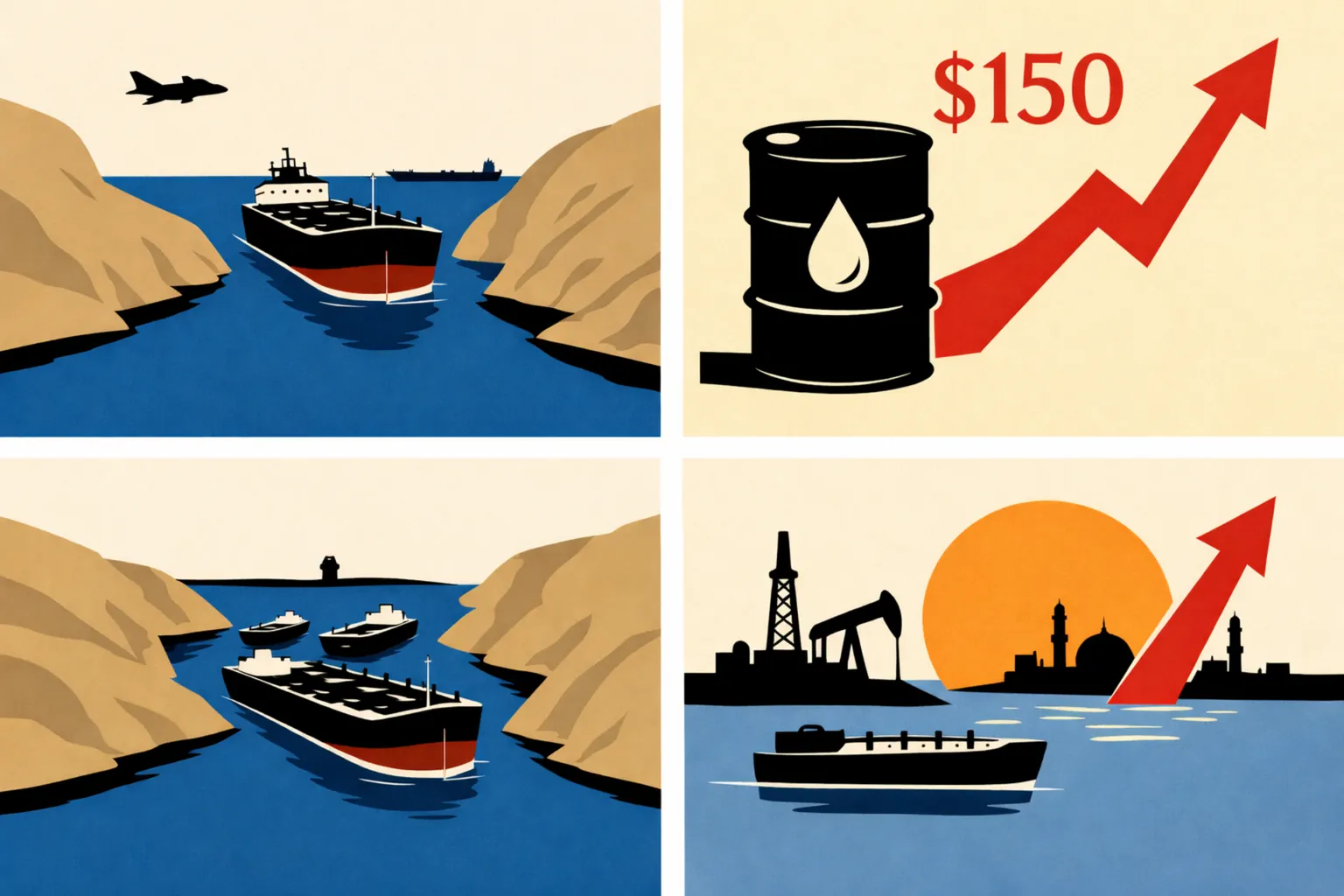
Oil markets have reacted sharply to the conflict because the Strait of Hormuz—through which roughly one-fifth of the world’s oil supply passes—lies directly adjacent to Iran.
During the first days of the conflict, risk premiums pushed Brent crude sharply higher as traders feared:
-
disruption to Gulf shipping routes
-
attacks on energy infrastructure
-
or an Iranian attempt to block the Strait of Hormuz.
Energy analysts from major banks including Goldman Sachs and JPMorgan have previously estimated that a prolonged closure of the Strait could push oil above $150 per barrel.
However, if the current wave of strikes subsides within roughly seven days, the impact on oil prices would likely follow a different trajectory.
Short-Term Scenario (War Ends Within 7 Days)
If hostilities ease quickly:
-
The geopolitical risk premium in oil markets would fall rapidly.
-
Brent crude could retreat by $8–$15 per barrel from wartime highs.
-
Prices would likely stabilise in the $75–$90 range, depending on global demand conditions.
In this scenario, traders would conclude that energy infrastructure and shipping routes were never seriously threatened, meaning the spike was largely speculative.
Prolonged Conflict Scenario
If fighting continues beyond a week, the calculus changes.
Markets would begin pricing in:
-
possible shipping disruptions in the Gulf
-
attacks on Saudi, Emirati or Qatari energy infrastructure
-
or insurance restrictions on tankers transiting Hormuz.
Under those conditions, analysts say oil could sustain levels above $100 per barrel, particularly if tanker traffic through Hormuz declines.
Implications for Oil-Dependent Economies
For oil-exporting economies—including Nigeria—the trajectory of the conflict matters significantly. A short-lived conflict that lifts oil prices temporarily would provide a brief fiscal windfall for producers.

But a prolonged war that destabilises energy markets could trigger global inflation, slower growth, and financial market volatility, ultimately offsetting the gains from higher crude prices.
For now, Tehran’s signal that it may suspend attacks on neighbouring states suggests an effort to prevent the conflict from expanding into a full-scale regional war that could disrupt global oil supplies.