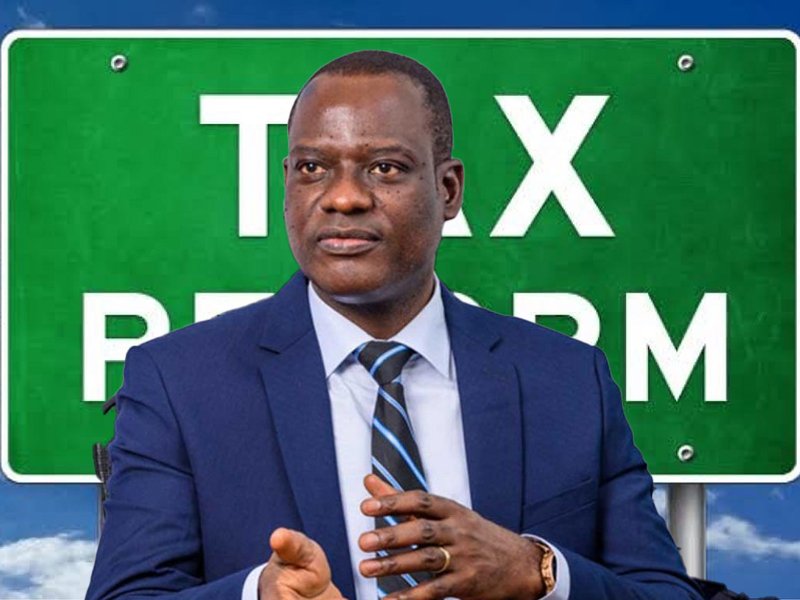
President Bola Ahmed Tinubu has nominated Taiwo Oyedele as Minister of State for Finance, signalling a further consolidation of fiscal reform at the heart of Nigeria’s economic management team.
The nomination, conveyed to the Senate for confirmation in a letter addressed to Senate President Godswill Akpabio, will see Oyedele replace Doris Uzoka-Anite, who has been redeployed to the Ministry of Budget and National Planning as Minister of State — her third portfolio in the administration.
The move places one of Nigeria’s most prominent fiscal reform architects inside the Federal Ministry of Finance at a time when revenue mobilisation, tax compliance, and fiscal consolidation remain central to government policy.
Architect of Nigeria’s Tax Overhaul
Until his nomination, Oyedele served as Chairman of the Presidential Committee on Fiscal Policy and Tax Reforms, the body responsible for proposing sweeping changes to Nigeria’s tax architecture.
Under his leadership, the committee advanced proposals aimed at:
-
Harmonising fragmented tax laws,
-
Simplifying compliance for businesses,
-
Expanding the tax net without overburdening productive sectors, and
-
Improving coordination between federal and subnational revenue authorities.
His appointment is widely interpreted as an effort to ensure policy continuity — moving reform from design to implementation within the core fiscal ministry.
At 50, Oyedele combines private-sector technical depth with academic and policy experience. An economist and accountant by training, he began his professional career after earning a Higher National Diploma in Accountancy and Finance from Yaba College of Technology. He later obtained a BSc in Applied Accounting from Oxford Brookes University.
His executive education includes programmes at the London School of Economics, Yale University, the Gordon Institute of Business Science, and the Harvard Kennedy School — credentials that underscore his global policy exposure.
PwC Career and Policy Influence
Oyedele spent 22 years at PwC, joining in 2001 and rising to become Fiscal Policy Partner and Africa Tax Leader. In that role, he advised governments and multinational corporations on tax strategy, fiscal reform, and regulatory alignment across African markets. His private-sector tenure positioned him at the intersection of public finance, corporate taxation, and cross-border investment flows — areas critical to Nigeria’s current reform agenda, particularly as the country seeks to boost non-oil revenues and strengthen investor confidence.
He also maintains academic affiliations, serving as a professor at Babcock University and a visiting scholar at the Lagos Business School, reinforcing his profile as both practitioner and policy thinker.
What the Appointment Signals
Oyedele’s nomination comes amid ongoing efforts by the Tinubu administration to stabilise public finances following major reforms in fuel subsidy removal and foreign exchange liberalisation.

Nigeria faces persistent revenue challenges, with tax-to-GDP ratios remaining among the lowest in Africa. The government has repeatedly emphasised tax reform, efficiency in revenue collection, and fiscal discipline as pillars of its economic recovery strategy. Bringing the chairman of the tax reform committee into the Finance Ministry suggests a deliberate attempt to accelerate implementation, close revenue leakages, and align tax administration with broader macroeconomic goals.
Uzoka-Anite’s redeployment to Budget and National Planning also indicates continued internal reshuffling as the administration recalibrates its economic team for the next phase of policy execution.
The Senate is expected to consider Oyedele’s nomination in the coming days.