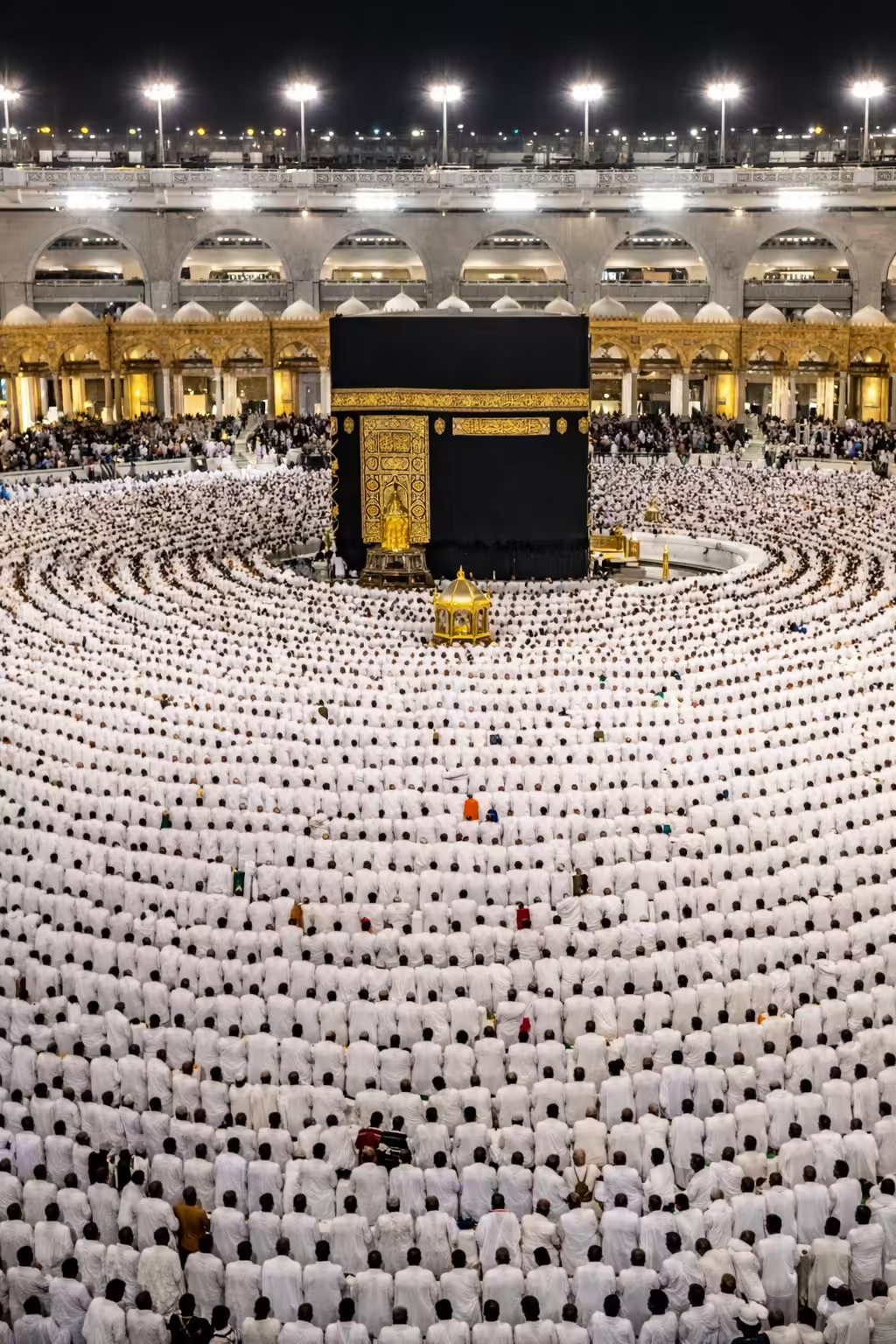
There is a moment, arriving at the Grand Mosque of Mecca, when words fail. The night air carries the scent of oud and rose water. Marble stretches cool and white beneath bare feet.
And at the center of it all stands the Kaaba — draped in its black and gold kiswah, ancient and immovable, as it has been for more than fourteen centuries.
On Saturday, February 21, 2026 — the 4th of Ramadan, 1447 AH — 904,000 people stood in that place in a single day. Nearly a million souls, circumambulating the house of God. It is a number that defies easy imagination. It is also a record.
What Is Umrah — and Why Does Ramadan Change Everything?
Umrah is often called the lesser pilgrimage. It is not obligatory in Islam the way Hajj is, but it carries an immense spiritual weight for the faithful.
Pilgrims enter a state of ihram — a condition of spiritual purity, marked by simple white garments for men and modest dress for women — and perform a series of rituals: the tawaf, circling the Kaaba seven times counterclockwise; sa’i, walking seven times between the hills of Safa and Marwa in remembrance of Hajar’s search for water for her son Ismail; and the cutting of hair, symbolising renewal and release.
Unlike Hajj, which is bound to specific days of the Islamic lunar calendar, Umrah can be performed at any time of year. But Ramadan draws the faithful like gravity.
The Prophet Muhammad, peace be upon him, is reported to have said that performing Umrah during Ramadan is equivalent in reward to performing Hajj with him.
That single hadith has moved millions of hearts across centuries — and never more powerfully than today.
The previous single-day record for Umrah pilgrims, set on March 7, 2025, stood at 500,000. In less than twelve months, that number was nearly doubled. This is not merely a logistical achievement. It is a testament to longing.
The Sacred Geography: What 904,000 People Share
The Grand Mosque — Al-Masjid Al-Haram — is the largest mosque on earth.
Across its multiple levels, outdoor courtyards, and surrounding plazas, it can accommodate millions during peak times, though the intimacy of the Mataf — the white marble expanse directly surrounding the Kaaba — remains the spiritual heartbeat of the entire complex.
During this record-breaking Ramadan, Saudi authorities reserved the Mataf exclusively for Umrah performers throughout the day, a decision that speaks to the delicate balance between access and safety at one of the world’s most densely visited sites.
For those performing tawaf in this hallowed circle — no matter whether they come from Lagos or London, Jakarta or Jeddah — the experience collapses the distance between individual and divine.
The Kaaba does not face them; they face it. And in facing it together, hundreds of thousands of strangers become, for a few hours, one body.
The Architecture of Welcome: How Saudi Arabia Manages the Miracle
Receiving nearly a million pilgrims in a single day is a feat of logistics that modern pilgrimage management has refined over decades, and this Ramadan has seen those systems stretched — and tested — to new heights.
Worshippers arriving at King Abdulaziz International Airport are channelled onto public buses heading directly to the holy mosque.
Fourteen designated parking areas — nine within Mecca itself, and five more along approach roads — serve as staging grounds for the faithful arriving by private vehicle or coach. From these points, the city’s transport network absorbs and distributes the flow.
Around the mosque, the central area becomes pedestrian-only during extended windows around prayer times. Motorcycles and bicycles are banned.
Vehicles that impede pedestrian movement are towed. The directional logic is deliberate: every door, every corridor, every courtyard has a designated direction of movement, enforced not only by signs but by thousands of security and crowd management personnel.
For those who arrive to find the mosque at capacity — as inevitably some do during peak hours — authorities have designated nearby mosques and equipped prayer halls as overflow spaces, ensuring that no one who came to pray is turned away from the act of prayer itself.
The Rhythm of Ramadan Nights
For the millions who travel to Mecca during Ramadan, the experience extends far beyond Umrah rituals alone. The nights here have a particular quality. After the breaking of the fast at Maghrib, the city exhales.
Families spread dates and water in the mosque’s vast courtyards. The call to Isha prayer draws the crowd back together.
And then comes Tarawih — the long, voluntary night prayers unique to Ramadan — during which the Quran is recited in its entirety over the course of the month.
The last ten nights of Ramadan carry the greatest spiritual intensity of all.
Among them is Laylat al-Qadr — the Night of Power — described in the Quran as “better than a thousand months.” On these nights, the Grand Mosque becomes impossibly full.
Prayer spaces stretch from the innermost sanctuary out across the marble plazas and into the surrounding streets, a carpet of humanity prostrating in unison.
Authorities urge worshippers to move to available space wherever it can be found: courtyards, external prayer halls, any open ground facing Mecca.
The directive is practical, but its spiritual undertone is unmistakable — in the house of God, there is always room.
A Record That Belongs to Everyone
Numbers can deceive. They can make the sacred seem statistical.
But behind the figure of 904,000 is a woman from Morocco who saved for three years to make this journey.
A young man from Pakistan performing Umrah for the first time, fulfilling a promise made to his mother.
An elderly couple from Malaysia completing a lifelong dream together.
Each of them arrived, removed their shoes, and entered a space that has been entered by pilgrims since before the time of recorded history.
Each joined a circle that has never stopped turning.
And on the 4th of Ramadan, 1447, they were part of the largest single-day gathering in the history of Umrah.
Saudi Arabia’s Haramain Sharifain — the authority managing the two holy mosques — announced the record with quiet pride. But the record does not belong to infrastructure or administration. It belongs to faith.

To the pull of a black cube at the center of the world, and to the nearly one million people who, on a single blessed night of Ramadan, could not stay away.
Umrah can be performed throughout the year. During Ramadan, it carries particular spiritual significance in Islamic tradition. Pilgrims are advised to register through official Saudi channels and to follow all guidelines issued by the General Presidency for the Affairs of the Grand Mosque and the Prophet’s Mosque.