By Moses Akobi
In an effort to tackle Nigeria’s chronic teacher shortage and improve access to quality education, the Federal Government has launched Inspire Live(s)!, an online, real-time learning initiative.
This ambitious programme seeks to harness technology to deliver uninterrupted learning across basic and secondary schools, addressing a national deficit of over 1.2 million teachers.
While the initiative signals a commitment to modernising education, experts warn that without deliberate strategies to prioritise rural schools and disadvantaged communities, this innovation could inadvertently widen existing educational inequalities.
The challenges facing Nigeria’s education system mirror a global crisis. UNESCO estimates that tens of millions of additional teachers are needed worldwide to meet the Sustainable Development Goals, with sub-Saharan Africa and South Asia disproportionately affected. Nigeria exemplifies this acute challenge, and more.
Overcrowded classrooms, underqualified instructors, and uneven distribution of teaching resources have long compromised learning quality in the country. The shortage is particularly severe in STEM subjects and early childhood education. With a growing school-age population and delays in teacher recruitment, instructional quality continues to decline, hitting rural and underserved areas hardest.
Online Learning has Obvious Limitations
Online learning has emerged as a potential solution, capable of breaching geographical barriers, reducing costs, and enabling continuous, self-paced instruction. It offers flexibility, scalability, and affordability compared to the cost of ensuring high-quality in-person teaching. Globally, e-learning has been championed as a tool to democratise education.
Lower operational costs, reduced commuting expenses, and the convenience of home-based study make it attractive for learners and institutions. In theory, Nigeria’s embrace of online learning aligns with this global trend, signalling readiness for a digital future in education.
The Inspire programme aims to deliver real-time online classes to millions of students, mitigating the immediate impact of teacher shortages and ensuring uninterrupted learning. It should be explicitly positioned as a complement to traditional teaching, not a replacement.
Teachers remain indispensable for mentoring, contextualising content, and fostering critical thinking and character development. Technology must enhance, not supplant, the human interaction essential to education. Private school owners and state governments must resist the temptation to cut costs by reducing teacher recruitment. Instead, they should view the programme as a vital pedagogical tool to complement classroom instruction.
There is also a risk that online learning programmes in Nigeria will replicate the structural shortcomings of traditional classrooms by relying on static video lectures and text-heavy materials.
How interactive can a teaching session aimed at millions of learners at once really be? Effective learning has to be interactive and experiential; it thrives on mentorship, peer collaboration, and practical engagement. If Inspire fails to incorporate these interactive elements, it risks becoming another superficial intervention.
The Digital Divide: Infrastructure, Access, and Literacy
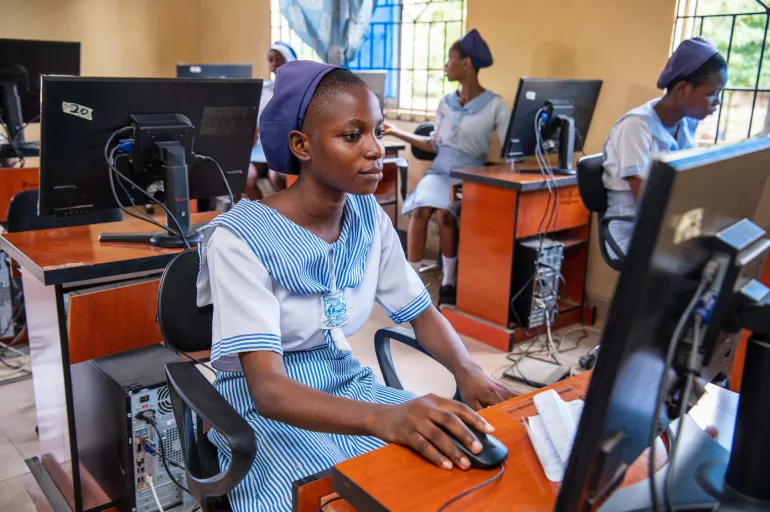
The success of any large-scale online learning initiative depends entirely on access to reliable digital infrastructure, an area where Nigeria faces persistent deficiencies. Rural and semi-urban communities contend with unsteady internet connectivity, erratic electricity supply, and prohibitive data costs (compared to income). These challenges can make it difficult if not impossible for these areas to take advantage of online learning programmes like Inspire, leading to a widening of existing inequalities rather than bridging them.
An online learning system launched without sustained infrastructure is destined to fail. Many public schools today, even in urban centres, lack basic ICT facilities, a deficit compounded in rural areas, some of which are not connected to the national electricity grid.
Yet these schools are expected to participate fully. Unless the government first establishes and maintains the structures to sustain this innovation, the programme risks being conceptually sound but practically flawed.
Furthermore, many students, particularly in underserved areas, possess low or negligible digital literacy skills. An effective online learning programme demands proficiency in navigating platforms, accessing resources, and engaging meaningfully in virtual discussions. Students lacking these competencies will experience stress and frustration, leading to high dropout rates and poor outcomes.
Introducing online material does not automatically translate into effective learning unless students, especially in rural settings, are first equipped with foundational ICT knowledge and skills.
This challenge spans the rural-urban divide and features a deep intra-urban divide. Within major cities, access to reliable infrastructure varies widely by neighbourhood and socio-economic class, meaning some urban students will still be disadvantaged.
Without targeted interventions, the programme could unintentionally create a greater chasm between privileged and underprivileged learners.
How to Avoid Leaving People Behind
The digital divide between urban and rural Nigeria is profound. While some urban schools benefit from ICT laboratories and reliable power, countless rural schools lack even basic instructional infrastructure. If Inspire prioritises administrative convenience over equity, it will widen the gap it claims to close.
Federal and state governments must adopt a rigorous bottom-up approach, starting with grassroots communities and the most underserved institutions. A concerted effort is needed to expand broadband coverage nationwide, deploy decentralised power solutions such as solar systems, and ensure affordable connectivity for schools.
The government could provide rural schools with robust devices pre-loaded with relevant content and access to download more when online. Students and teachers must be equipped with foundational ICT skills and pedagogical training before advanced platforms are rolled out. This must be a prerequisite, not an afterthought.
For students to benefit beyond school hours, reliable home access to the learning platform should be considered, raising further questions about affordability and equity. Policymakers must design strategies to prevent rural and low-income children from being left behind.
Practical options include community learning hubs equipped with shared devices, supervised access, and stable connectivity, alongside subsidised data plans tailored for low-income households.
Digital exclusion in modern education is an emergency. Exclusion from digital platforms equates to exclusion from quality learning and, ultimately, economic opportunity.
In conclusion…
The launch of Inspire is a useful step towards modernising Nigeria’s education system. However, its success depends entirely on deliberate, inclusive planning that confronts existing inequalities head-on.
Strategic partnerships with telecom providers to subsidise data costs, alongside solar-powered charging stations in off-grid areas, will be critical. Device-allocation schemes must target verified low-income households, and curriculum content must be adapted for offline usability to mitigate poor connectivity.
The Inspire project holds the potential to bridge significant gaps in teacher availability and expand access to quality learning. Yet without serious investment in infrastructure, universal digital literacy programmes, and an unwavering commitment to inclusion, it risks becoming another well-intentioned policy that falters in execution, deepening the divisions it seeks to overcome.

The Federal Government must lead with foresight, ensuring that no child, whether in Lagos or a remote village in Zamfara, is left behind.
Moses Akobi works on education policy research for EduIntel.