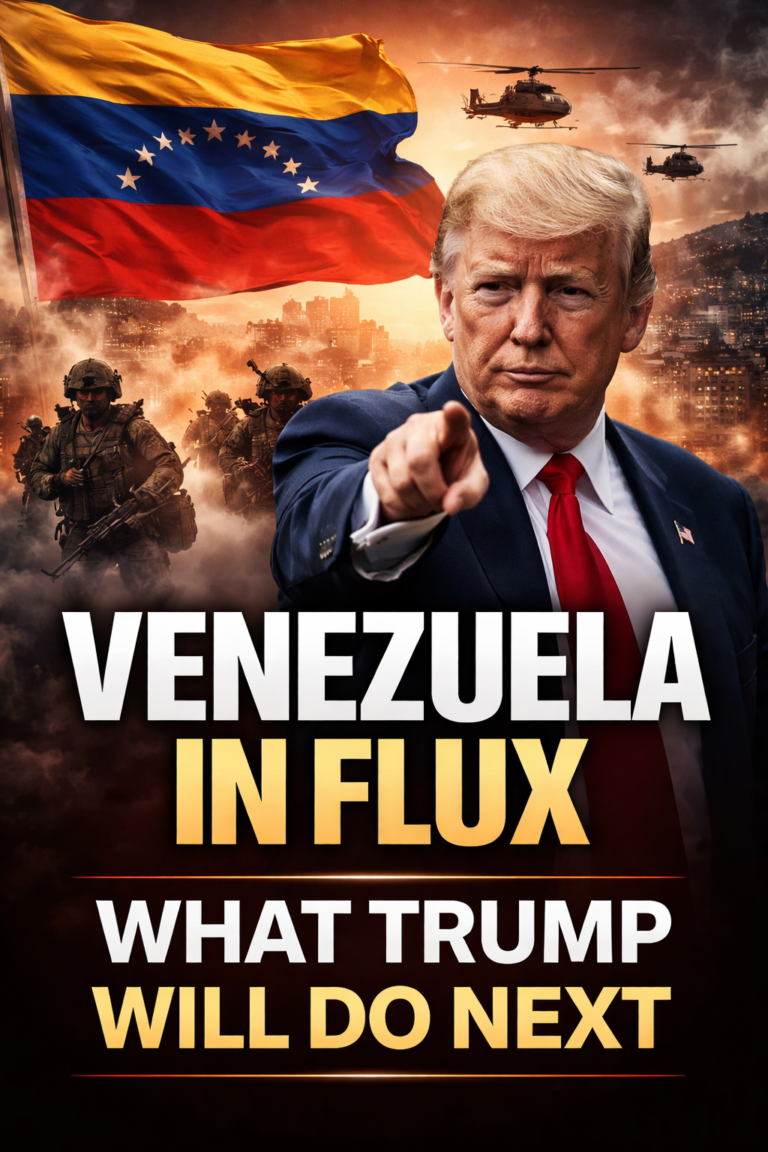
In a dramatic and unprecedented escalation, Donald Trump announced early Saturday that Venezuelan President Nicolás Maduro and his wife, Cilia Flores, had been captured by United States forces and flown out of Venezuela following a series of American strikes on key military installations in and around Caracas.
According to the US President, the operation formed part of a “large-scale strike” authorised by the White House and carried out in coordination with US law-enforcement and military agencies. While details of Maduro’s current whereabouts were not disclosed, the President said both he and the first lady had been removed from Venezuelan territory.
Explosions and Military Action in Caracas
The announcement followed reports of multiple explosions and low-flying military aircraft over Caracas at about 2 a.m. local time. Strikes were reported at the Fuerte Tiuna complex in western Caracas and the La Carlota Air Base near the city centre. Video footage circulating on social media showed plumes of smoke rising from the sites, while several neighbourhoods experienced power outages.
US officials indicated that the strikes had been ordered days earlier, but execution was delayed by weather and competing operational priorities. In response to the unfolding military activity, the Federal Aviation Administration imposed restrictions on US commercial flights in Venezuelan airspace, citing safety-of-flight risks.
Venezuelan Government Response
Venezuela’s government condemned the attacks as an illegal act of aggression and a violation of national sovereignty, accusing Washington of imperialist intentions aimed at seizing control of the country’s strategic resources, including oil and minerals. Authorities urged supporters to mobilise nationwide, activating emergency defence measures and implementing national defence plans.
In an official statement, the government declared a “State of External Disturbance,” reporting that areas beyond Caracas—including the states of Miranda, Aragua and La Guaira—were also struck in what it described as a coordinated offensive.
International and Regional Reactions
Regional leaders reacted with alarm. Gustavo Petro, President of Colombia, said his government was monitoring events with deep concern and called for dialogue to prevent further escalation. Cuba, one of Venezuela’s closest allies, strongly condemned the strikes, describing them as a “cowardly” act against a sovereign state.
Other international actors have yet to issue coordinated responses, though early reactions have stressed the need for de-escalation and raised the prospect of an emergency meeting of the United Nations Security Council.
Context: Months of Rising Tension
The intervention follows months of mounting tension between Washington and Caracas. In recent months, the Trump administration has accused the Maduro government of overseeing a narco-terrorist state and manipulating elections, expanded the US military presence in the Caribbean, conducted maritime strikes on vessels alleged to be involved in drug trafficking, and tightened sanctions and blockades on Venezuelan oil shipments.
US officials have framed these actions as necessary to combat drug smuggling and protect American security interests. Critics, however, have questioned both the legality and the strategic rationale of a direct military campaign against a sovereign state.
Verification and Uncertainties
Independent verification of Maduro’s reported capture and removal from Venezuelan territory remains limited. The claim currently rests on the US presidential announcement, and Venezuelan officials have not confirmed this aspect of the operation. International news organisations continue to seek corroboration as the situation develops.
Key Known Facts (as of latest reports)
-
Explosions and low-flying aircraft were widely reported over Caracas in the early hours of Saturday.
-
The US President publicly claimed the capture and evacuation of Nicolás Maduro.
-
Venezuela’s government declared national mobilisation and a state of external disturbance.
-
Flight restrictions were imposed over Venezuelan airspace due to ongoing military activity.
-
Regional leaders called for calm and urgent diplomatic engagement.