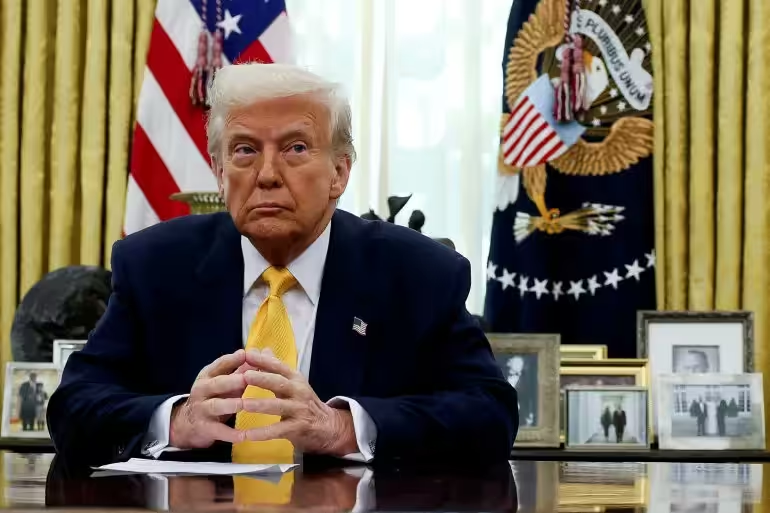
U.S. President Trump was just asked if his 100% tariff on China will stand and his answer was “No.”
Trump calls his 100% tariff on China “not sustainable.” He added “We have to have a fair deal.”
Overall, recent comments by Donald Trump regarding China tariffs have contributed to market volatility.
The market, including the Dow, has seen fluctuations and, at times, rebounded after tariff threats were walked back or downplayed.
After the Dow had plunged in response to a tariff threat, the index rallied when Trump eased his tone, sending the market higher.
The Dow Jones Industrial Average erased a 500-point decline to close up 44.3 points, or 0.10%, at 45,996.5, buoyed by President Trump’s denial of persistent high tariffs on China.
The index, tracked in real-time, opened near 45,365.7 amid overnight volatility, dipping to a low around 45,365.7 before 10:15 WAT.
A steady recovery followed, climbing to 45,751.6 by 14:30 WAT and peaking near 45,880.2 by 18:45 WAT, despite minor pullbacks to 45,622.9 and 45,494.3.
The late surge reflects market relief over trade policy, with the Dow’s resilience underscoring positive sentiment as trading progresses.
More recently, following threats of a 100% tariff on China on October 10, 2025, markets initially sold off before rebounding as concerns eased.
On October 13, 2025, the Dow futures rose after Trump signaled that the tariffs could ease, with a post on Truth Social saying “it will all be fine!”. His comments were a major factor in the market rebound.
However, the market has also seen recent weakness, with the Dow finishing down on October 16, 2025.

This is a recurring pattern, with markets fluctuating significantly based on the rhetoric around the U.S.-China trade situation.
The market reacts strongly to both the imposition and the potential relaxation of tariffs, with each shift affecting investor confidence and leading to market swings.