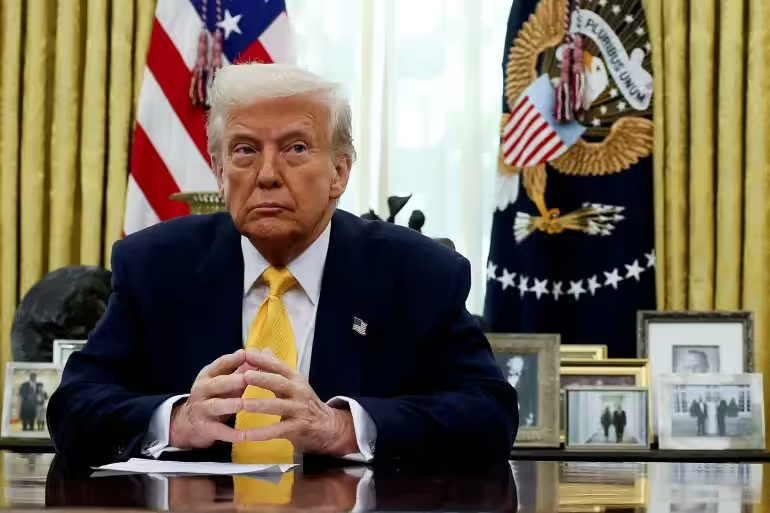
United States President Donald Trump has withdrawn Canada’s invitation to join his newly launched “Board of Peace”, escalating tensions with Ottawa after Canada’s prime minister sharply criticised US trade policies at the World Economic Forum in Davos.
The decision follows a speech by Prime Minister Mark Carney in Switzerland, where he warned against powerful nations using tariffs and economic integration as political weapons.
Carney also urged world leaders to acknowledge the collapse of the traditional rules-based global order — remarks that drew a rare standing ovation from the Davos audience.
Hours later, Trump announced on his Truth Social platform that Canada would no longer be welcome on the board, framing the move as a direct response to Carney’s comments.
In his post, Trump described the initiative as “the most prestigious Board of Leaders ever assembled” and said the invitation to Canada had been formally withdrawn.
Addressing Carney directly, Trump suggested the Canadian leader should show more appreciation for the United States, claiming Canada “lives because of the United States”.
The Board of Peace was officially unveiled in Davos and was initially conceived as a small group of global leaders overseeing the next phase of the Gaza ceasefire.
However, it has since expanded into a broader international body aimed at addressing major global conflicts, with Trump positioned as its chairman.
Canada had previously confirmed it received an invitation to join the board and had planned to accept. That position now appears off the table.
Carney, in his Davos address, said Canada could help demonstrate how so-called “middle powers” can cooperate to avoid being dominated by major global players.
He pointed to Canada’s recent trade agreement with China as evidence of a more independent economic path.
Trump has recently threatened trade retaliation against European nations opposing his proposal to bring Greenland — an autonomous territory under Denmark — under US control, further fuelling concerns among allies.
Mixed Response From US Allies
While Trump insists the board has attracted significant global interest, several close US allies have opted not to participate, at least for now. The United Kingdom, France and Italy have all indicated they are holding back.
Countries confirmed to be involved include Argentina, Bahrain, Morocco, Pakistan and Turkiye. Trump claims nearly 30 countries have either joined or expressed interest, though some leaders reportedly require parliamentary approval before committing.
Permanent members of the board are expected to contribute $1bn each to fund its operations, according to Trump.
Speaking in Switzerland, the US president said the board would operate alongside the United Nations and suggested it would wield significant influence once fully established.
A United Nations Security Council resolution has already endorsed the board, but UN officials clarified that any UN engagement would be limited to the framework of Trump’s Gaza peace plan.
As diplomatic tensions rise, Canada’s exclusion highlights growing friction between Washington and traditional allies — and raises questions about the future credibility and scope of Trump’s ambitious peace initiative.