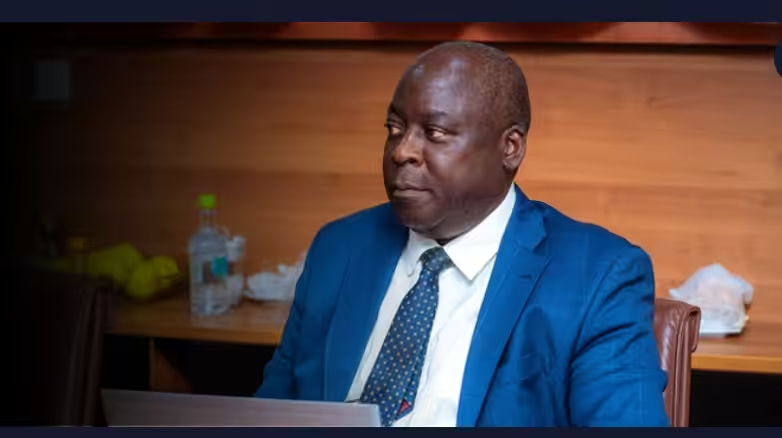
U.S. President Donald Trump designated Nigeria a “Country of Particular Concern” on Friday, citing what he described as mass killings of Christians by radical Islamists.
The declaration, announced via Truth Social on Friday, marks a significant escalation in US-Nigeria relations and puts Nigeria under heightened scrutiny for religious freedom violations.
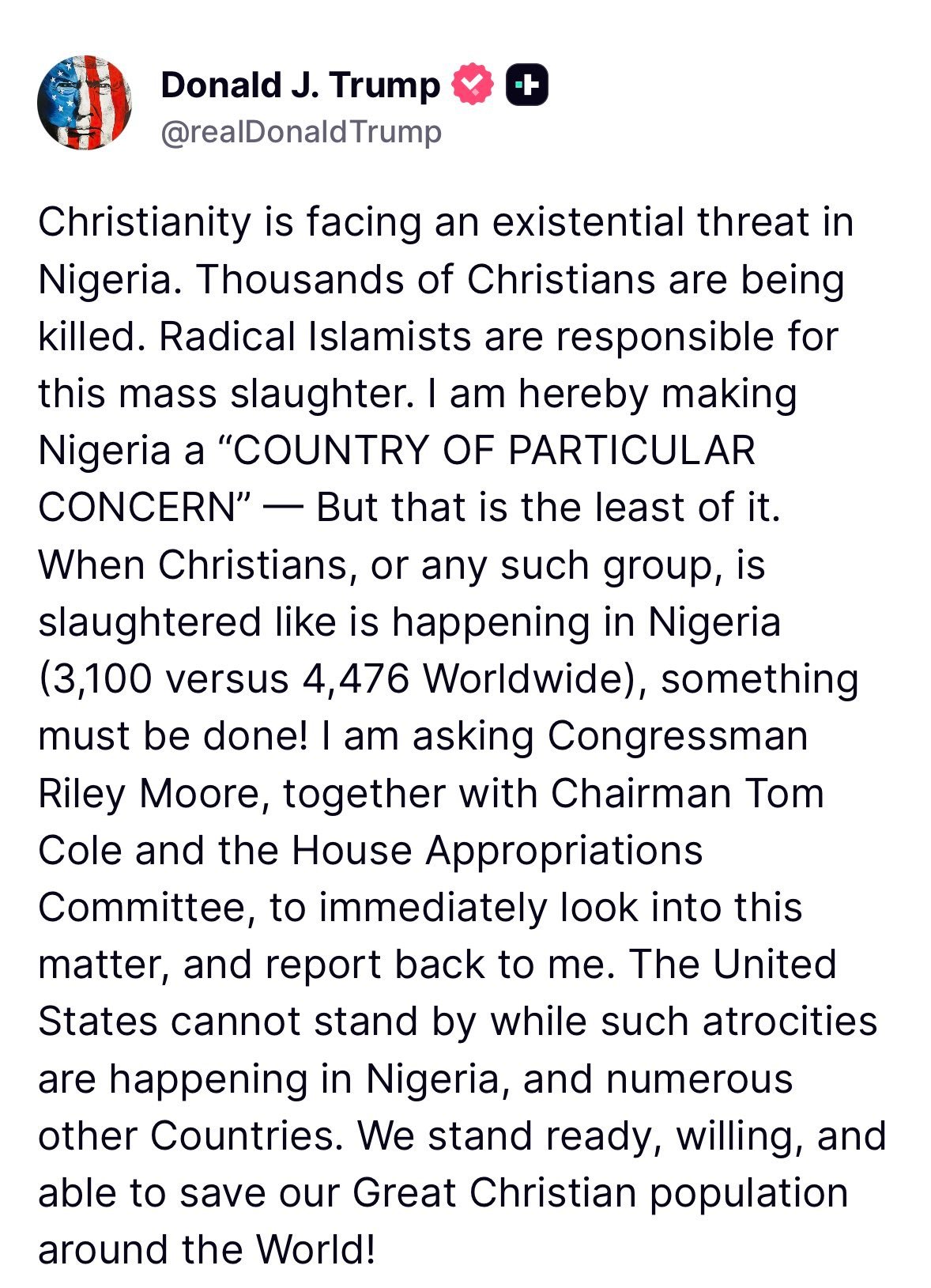
Trump used stark language in his announcement, claiming Christianity faces an existential threat in Nigeria. “Thousands of Christians are being killed,” he wrote, adding that “radical Islamists are responsible for this mass slaughter.”
The president provided specific figures, stating that 3,100 Christians have been killed in Nigeria compared to 4,476 worldwide.
He directed Congressman Riley Moore and House Appropriations Chairman Tom Cole to investigate immediately and report back to him.
“The United States cannot stand by while such atrocities are happening in Nigeria and numerous other Countries,” he declared in his statement.
The U.S. president emphasized America’s readiness to protect Christian populations globally. His call for immediate congressional review suggests possible sanctions or aid restrictions could follow depending on the investigation’s findings.
The Nigerian government has firmly rejected claims of systematic religious persecution. In September, Information Minister Mohammed Idris called such allegations “false, baseless, despicable, and divisive.”
Idris argued that portraying Nigeria’s security challenges as religious conflict grossly misrepresents reality. He emphasized that extremist groups attack citizens of all faiths, with Muslims, Christians, and non-religious Nigerians suffering equally.
Nigerian authorities presented data showing progress against terrorism. Between May 2023 and February 2025, security forces killed over 13,500 terrorists and rescued nearly 10,000 hostages, according to Idris.
The government also highlighted recent successes, including capturing top Ansaru leaders and securing over 700 convictions of Boko Haram suspects. “These criminals target all who reject their murderous ideology, regardless of faith,” Idris stated.
Massad Boulos, Trump’s Senior Adviser on Arab and African Affairs, appeared to contradict the president’s position during an October 17 visit to President Bola Tinubu in Abuja. “Those who know the terrain well know that terrorism has no colour, no religion, and no tribe,” Boulos said.
Boulos acknowledged that extremist groups like Boko Haram and ISIS have killed people of all faiths, often attacking Muslims more than Christians. “Any loss of life is one too many, and we should work together to end this,” he added, suggesting a more nuanced approach than Trump’s public statement.
The designation could strain bilateral ties between Washington and Abuja. Nigeria serves as a key US partner in West Africa for counterterrorism operations and economic cooperation.

Trump’s action may trigger review of military aid, economic assistance, and diplomatic engagement.
How U.S. Congress responds to Trump’s investigation order will likely determine the practical impact of this designation on one of Africa’s largest economies.