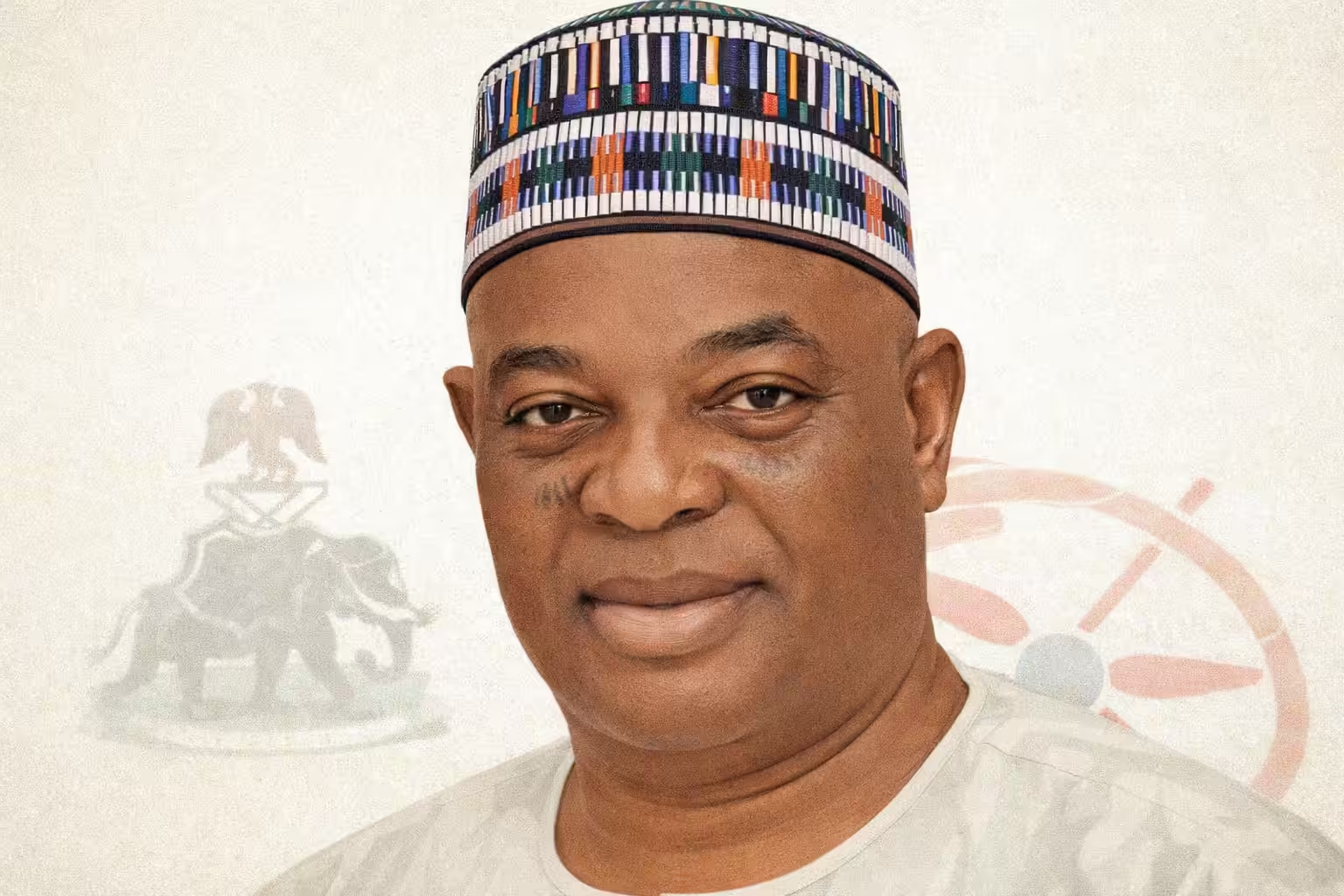
Tajudeen Baruwa has taken control of the national secretariat of the National Union of Road Transport Workers (NURTW) in Abuja, marking a decisive moment in a prolonged leadership battle that has split one of Nigeria’s most politically influential unions. Baruwa’s move effectively dislodges loyalists of Musiliu Akinsanya (MC Oluomo), whose faction had maintained control of the union’s administrative headquarters despite a series of court rulings.
Speaking to journalists at the secretariat after reclaiming control on Monday, Baruwa, flanked by supporters from across the country, said his actions were backed by two court judgments delivered in his favour.
Following the victory, he said the union formally notified the Nigeria Police Force, attaching copies of the court judgments to facilitate the recovery of its secretariat.
However, he noted that the responses were not encouraging, prompting the union to send another notice a few days ago, declaring its intention to take over the secretariat and resume duties in line with the court rulings.
“Their body language has not been encouraging despite repeated assurance that we are not going back to foment any trouble as we are a law-abiding union whose only mission is to get back what belonged to them.
“But today, as you can see, we are taking over in a peaceful manner, and it is not a forceful takeover but just carrying out the court’s orders.
“Again, please be aware that our coming here after two years is to occupy our office, having obtained judgments at both the lower court and the Appeal Court, but they refused to obey court orders after waiting for about two years. We decided to resume back at the office today without causing any violence, and here we are.
“Although the other faction attacked one of our members, who is now in the hospital, the situation is under control. We are still open to reconciliation as we are a lawful organization and not a troublemaker. No one is above the law.”
Who is Tajudeen Baruwa?
Tajudeen Baruwa is a long-standing figure within the National Union of Road Transport Workers, whose rise reflects the deeply structured hierarchy of Nigeria’s transport union system.
Before emerging as a national contender, Baruwa built his influence within the union’s operational base—motor parks, route coordination systems, and state-level structures that underpin the NURTW’s power. Like many leaders within the union, his authority is rooted not only in formal positions but in grassroots legitimacy among drivers, ticketing agents, and park managers.
Baruwa’s leadership profile is shaped by three defining elements:
- Institutional continuity: He is seen by supporters as representing the established constitutional order of the NURTW, particularly in contrast to what they describe as politically driven disruptions.
- Legal strategy: Unlike previous internal disputes often settled through negotiation or force, Baruwa has relied heavily on the courts—securing validation from both the National Industrial Court and the Court of Appeal.
- National network: His ability to mobilise supporters from across multiple states underscores a broad base within the union’s fragmented but powerful national structure.
His emergence as president—now affirmed judicially—positions him at the centre of a union that operates at the intersection of transport economics, urban governance, and grassroots political mobilisation in Nigeria.
Court Judgments Strengthen Tajudeen Baruwa’s Claim
Baruwa, who is contesting the NURTW leadership, had opposed the inauguration of MC Oluomo as the union’s new president.
The National Industrial Court of Nigeria (NICN), in its ruling in suit No. NICN/ABJ/263/2023, delivered by Hon. Justice O.O. Oyewumi, affirmed Tajudeen Baruwa as the duly elected President of the Union and prohibited interference in the operations of his executive.
In the same vein, the Court of Appeal in Abuja, in a judgment delivered on November 8, 2024, in the appeal marked CA/ABJ/CV/293/2024, confirmed Baruwa as the legitimate president of the National Union of Road Transport Workers. The decision upheld an earlier judgment of the lower court delivered on March 11, 2024, where Baruwa was recognised as the union’s president.
A three-member panel comprising Justices Hamma Akawu Barka, Nnamdi Dimgba, and Asmau Ojuolape Akanbi dismissed the appeal filed by Najeem Usman Yasin, Tajudeen Agbede, and others, ruling that the appeal lacked merit.
The appellate court also awarded ₦100,000 in costs against the appellants, who are widely regarded as loyalists of Musiliu Akinsanya (MC Oluomo).
NURTW Leadership Tussle
The struggle between Tajudeen Baruwa and the MC Oluomo faction underscores deeper tensions within the NURTW over control, legitimacy, and political alignment.
The union, which plays a central role in Nigeria’s road transport ecosystem, has historically been a powerful actor not just in logistics and revenue collection but also in grassroots political mobilisation.
Control of its national leadership—and by extension, its secretariat—carries significant implications for influence across motor parks nationwide and relationships with political actors at both state and federal levels.
What Next for Tajudeen Baruwa and NURTW?
With physical control of the Abuja secretariat now established, the immediate challenge for Tajudeen Baruwa is consolidation:
- Reasserting authority across state chapters where loyalties may remain divided
- Maintaining peace amid lingering tensions between rival factions
- Translating legal victory into operational control of the union’s nationwide structures
While the courts have spoken decisively, the durability of Baruwa’s leadership will depend on whether competing factions accept the rulings—or continue to resist them in practice.
NURTW’s Role in Lagos and National Politics
The National Union of Road Transport Workers (NURTW) occupies a unique position in Nigeria’s political economy, particularly in Lagos, where it functions as both a transport regulator within the informal sector and a powerful grassroots political structure. In Lagos, the union’s control of motor parks and transport routes gives it influence over daily cash flows from ticketing, loading fees, and levies—creating a steady revenue base that underpins its organisational strength. This economic role has historically translated into political leverage, as the NURTW is able to mobilise large numbers of drivers, conductors, and affiliated workers during election cycles.

Figures such as Musiliu Akinsanya (MC Oluomo) exemplify this intersection of transport unionism and politics. His rise within the Lagos transport ecosystem and subsequent prominence in political mobilisation highlight how leadership within the NURTW can serve as a pathway to broader political relevance. Nationally, the union’s structure—spanning all states—makes it one of the most extensive grassroots networks in the country. Its members are embedded in urban and intercity transport systems, giving it reach into both metropolitan and rural economies. This reach has made the NURTW a recurring actor in electoral logistics, campaign support, and informal governance arrangements at the local level.
Against this backdrop, the leadership contest involving Tajudeen Baruwa is not merely an internal union dispute. It is a struggle over control of an organisation that sits at the intersection of mobility, informal taxation, and political mobilisation in Nigeria’s largest city and beyond.