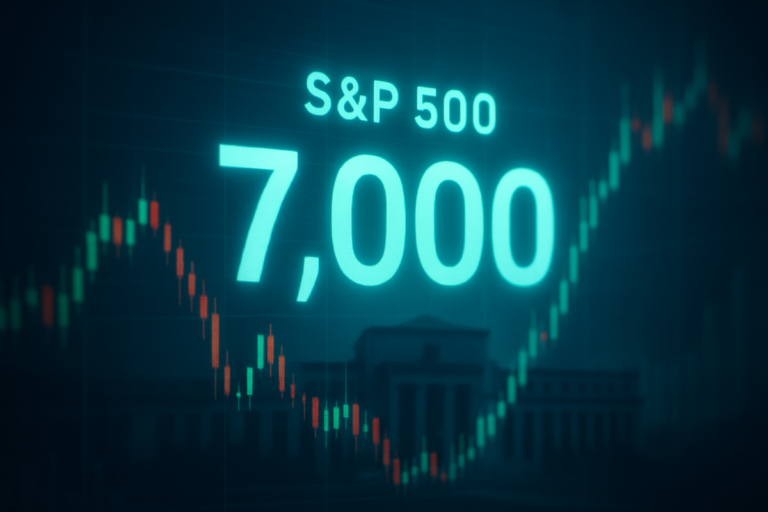
When the S&P 500 crossed the 7,000-point threshold this week, it marked more than a numerical milestone.
It confirmed that US equity markets are once again behaving like markets that believe in earnings, not just liquidity or speculation.
The index’s rise above 7,000 — after recovering losses triggered by Donald Trump’s tariff threats and broader geopolitical noise — reflects a deeper recalibration under way on Wall Street: investors are increasingly willing to look past political volatility and focus instead on corporate profitability, productivity gains from artificial intelligence, and a softening interest-rate outlook.
This is not the euphoric, stimulus-fuelled rally of the post-pandemic years. It is a more selective, earnings-led advance — and that distinction matters.
Earnings, Not Headlines, Are Back in Charge
A defining feature of the current rally is the market’s growing tolerance for political disruption.
Trump’s tariff rhetoric — including the episode that briefly rattled markets over Greenland — would, in previous cycles, have caused a more sustained sell-off. Instead, equities rebounded swiftly.
Why? Because earnings season has reasserted itself as the market’s anchor.
Major technology companies — including Microsoft, Meta, Tesla and Apple — are reporting results that justify their valuations, not merely promise future dominance.
Semiconductor equipment makers such as ASML have reinforced the same message, forecasting strong demand driven by AI-related capital expenditure rather than consumer hype.
Analysts at Deutsche Bank have described the current reporting period as one of the strongest earnings quarters since the 2008 financial crisis, excluding the mechanical rebound that followed the pandemic.
That assessment underscores a critical point: this rally is being underwritten by cash flow, not narratives.
AI Is Finally Showing Up in the Numbers
For much of the past two years, artificial intelligence was treated by markets as an option — expensive, exciting, but unproven. That perception is changing.
Companies are now demonstrating measurable productivity gains, improved margins, and rising order books linked directly to AI deployment.
This transition — from “AI as promise” to “AI as profit centre” — has given institutional investors greater confidence in extending the cycle.
Goldman Sachs’ US equity strategists argue that the combination of steady economic growth, resilient revenues among large-cap stocks, and AI-driven efficiency gains has extended the bull market’s lifespan.
Their year-end target of 7,600 for the S&P 500 implies further upside, but more importantly, it signals conviction that valuations remain defensible.
Interest Rates: The Quiet Tailwind
Another pillar supporting equities is the broad expectation that US interest rates have peaked.
Even as uncertainty surrounds who will eventually succeed Jay Powell as Federal Reserve chair, markets are increasingly convinced that the next major move in rates is downward.
Lower borrowing costs matter not just for valuation models, but for corporate behaviour.
Capital expenditure, mergers, and share buybacks become easier to justify when the cost of money falls — particularly for cash-rich technology and industrial firms.
The Trump administration’s rollback of certain post-financial-crisis capital requirements for large banks has also reinforced expectations of easier credit conditions, further supporting risk assets.
Why This Matters Beyond Wall Street
For global investors — including those in emerging markets such as Nigeria — the S&P 500’s move above 7,000 has broader implications.
First, it reinforces the gravitational pull of US assets at a time when many frontier and emerging markets are still grappling with currency volatility, inflation, and policy uncertainty. Capital tends to follow earnings visibility.
Second, it raises the bar for competing markets. To attract portfolio flows, other economies must now offer either superior growth prospects or compelling valuation discounts — and ideally both.
Finally, it underscores a structural shift: global equity leadership is increasingly concentrated in firms that control data, compute power, and advanced manufacturing.
This has long-term implications for how countries think about industrial policy, technology investment, and education.
A Rally with Limits — and Conditions
None of this means the rally is immune to shocks. A sharp escalation in trade wars, an abrupt inflation resurgence, or a disorderly bond market sell-off could still test investor confidence.
But the significance of the S&P 500 crossing 7,000 lies in how it happened: not on stimulus, not on panic buying, but on a reassertion of earnings power.
That is a healthier — if less spectacular — foundation for markets.

Why It Matters
The S&P 500 at 7,000 is not just a headline. It signals a market that has learned to live with political noise, demands proof from technology investments, and is positioning for a lower-rate world.
For investors globally, it marks a return to fundamentals — and a reminder that capital ultimately follows profitability.