Russian President Vladimir Putin arrived in New Delhi on Thursday for a two-day state visit aimed at strengthening economic and strategic cooperation, as both countries seek to rebalance their trade relationship in the face of shifting global pressures.
Prime Minister Narendra Modi personally received Putin at the airport—an uncommon gesture that underscored India’s continued commitment to its long-standing partnership with Moscow. The two leaders embraced on the red carpet before departing in the same vehicle. Modi will host Putin for a private dinner on Thursday, with formal summit talks scheduled for Friday. Several senior Russian ministers and a large business delegation are accompanying the president.
Trade Under Pressure After U.S. Tariffs
India and Russia have set a target to raise bilateral trade to $100 billion by 2030, after a surge from about $13 billion in 2021 to nearly $69 billion in 2024–25, driven largely by India’s increased imports of discounted Russian energy.
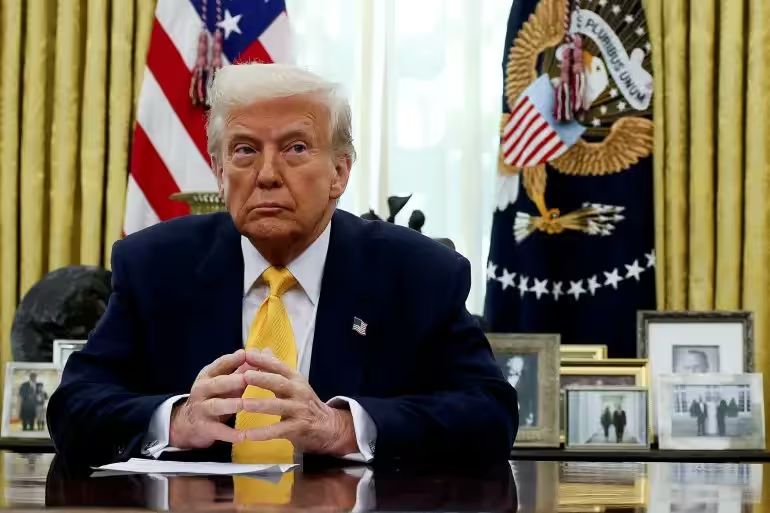
However, trade volumes dipped to $28.25 billion between April and August 2025, as India cut back on crude oil purchases following punitive U.S. tariffs and sanctions imposed by President Donald Trump’s administration. Washington has accused New Delhi of indirectly supporting Russia’s war effort in Ukraine by importing large quantities of Russian oil.
With Indian goods now facing a 50% tariff in the U.S.—half of it explicitly linked to its oil dealings with Russia—New Delhi is urgently seeking new export markets.
Russia Signals Strong Demand for Indian Goods
Deputy Kremlin Chief of Staff Maxim Oreshkin said in New Delhi that Moscow aims to expand imports of Indian products to correct the current imbalance, which is overwhelmingly tilted toward Russian energy exports.
“We have come for Indian goods and services. We want to significantly increase their purchases,” Oreshkin said, stressing that this shift was part of a “strategic choice” in the future direction of bilateral ties. India currently accounts for less than 2% of Russia’s total imports.
Indian Commerce Minister Piyush Goyal said New Delhi is pushing to diversify its export basket by boosting sales of automobiles, electronics, data-processing equipment, heavy machinery, industrial components, textiles, and food products to Russia.
“Russia has a huge demand for a wide range of industrial and consumer goods, presenting multiple untapped opportunities for Indian businesses,” Goyal said.

Growing Appetite for Indian Shrimp and Food Products
Russian Agriculture Minister Oksana Lut announced that Moscow is ready to increase imports of Indian agricultural products—including shrimp, rice, and tropical fruits—and that Russian companies are interested in Indian food-processing equipment. India, the world’s largest exporter of shrimp, currently accounts for 20% of Russia’s shrimp imports.
India’s shrimp exporters, heavily affected by the steep tariffs imposed by the U.S., are increasingly turning to markets like Russia to bridge declining shipments.