Nigeria’s trade profile is heavily defined by hydrocarbons, with crude oil and gas consistently leading its export basket.
Yet, across different markets, global, continental, regional, and sub-regional variations emerge that highlight both the dominance of petroleum and the potential of non-oil products in strengthening Nigeria’s trade footprint.
Global Trade
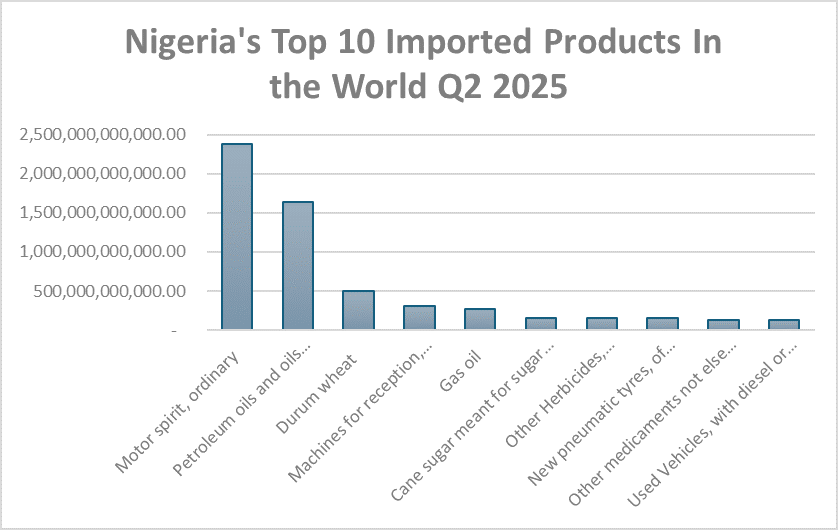
| Products | Value (₦) |
| Motor spirit, ordinary | 2,375,874,767,048.80 |
| Petroleum oils and oils obtained from bituminous minerals, crude. | 1,642,473,625,266.71 |
| Durum wheat | 503,716,687,854.00 |
| Machines for reception, conversion and transmission of voice, images or data. | 313,663,661,099.00 |
| Gas oil | 264,318,500,946.24 |
| Cane sugar meant for sugar refinery | 158,959,286,639.00 |
| Other Herbicides, antisprouting products and plantgr | 156,267,593,258.00 |
| New pneumatic tyres, of rubber of a kind used on buses or lorries | 147,859,833,532.00 |
| Other medicaments not else where specified | 134,580,985,737.00 |
| Used Vehicles, with diesel or semidiesel engine, of cylinder capacity >2500cc | 132,737,503,630.00 |
On the world stage, crude petroleum remains Nigeria’s largest traded product, valued at over ₦11.9 trillion. Other petroleum gases and natural gas follow closely, each exceeding ₦1.9 trillion.
Kerosene-type jet fuel and liquefied petroleum gases also feature prominently, underscoring the centrality of energy exports.
Interestingly, urea (₦615.7 billion) and cashew nuts in shell (₦352.6 billion) stand out as non-oil exports, signaling growing diversification in global markets.
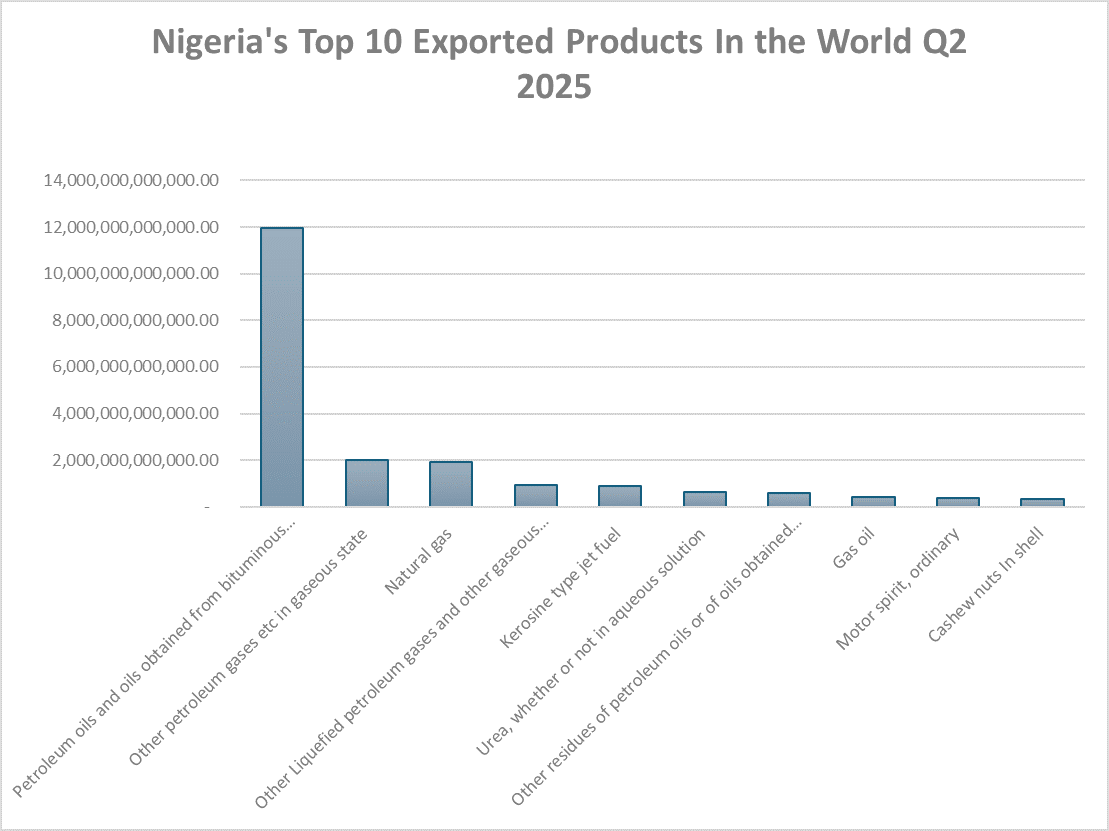
| Products | Value (₦) |
| Petroleum oils and oils obtained from bituminous minerals, crude. | 11,965,980,580,101.70 |
| Other petroleum gases etc in gaseous state | 1,991,460,483,847.73 |
| Natural gas | 1,932,676,132,113.62 |
| Other Liquefied petroleum gases and other gaseous hydrocarbons | 954,902,505,708.62 |
| Kerosine type jet fuel | 913,506,521,520.92 |
| Urea, whether or not in aqueous solution | 615,748,714,561.50 |
| Other residues of petroleum oils or of oils obtained from bituminous minerals | 594,025,265,841.20 |
| Gas oil | 403,998,131,619.40 |
| Motor spirit, ordinary | 371,535,807,439.57 |
| Cashew nuts In shell | 352,673,639,786.77 |
Africa
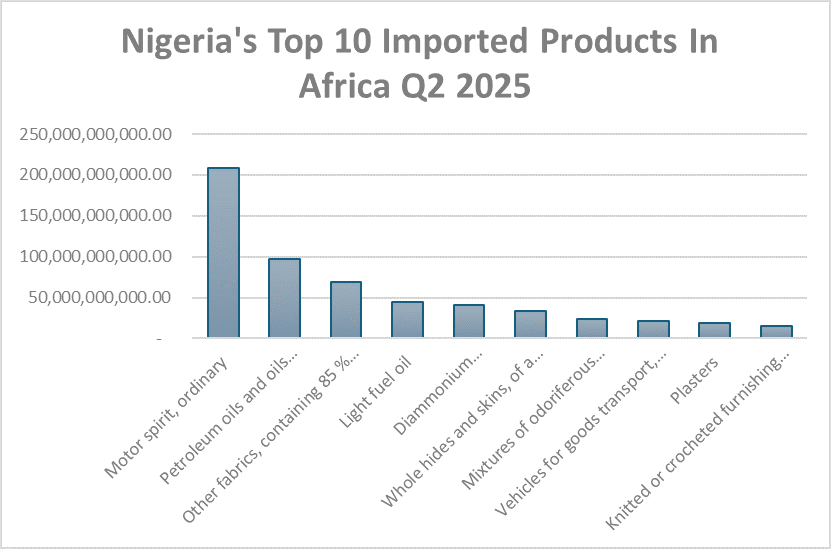
| Products | Value (₦) |
| Motor spirit, ordinary | 208,763,564,572.00 |
| Petroleum oils and oils obtained from bituminous minerals, crude. | 97,170,664,232.50 |
| Other fabrics, containing 85 % or more by weight of silk | 69,303,292,500.00 |
| Light fuel oil | 45,098,204,863.00 |
| Diammonium hydrogenorthophosphate (diammonium phosphate) | 40,685,426,086.00 |
| Whole hides and skins, of a weight exceeding 16 kg | 33,311,228,501.00 |
| Mixtures of odoriferous substances of a kind used in the food or drink industries | 23,261,798,127.00 |
| Vehicles for goods transport, petrol fuel=<5tonne,excl. dumpers,CKD Other | 21,431,969,543.00 |
| Plasters | 19,210,407,267.00 |
| Knitted or crocheted furnishing articles, nes | 14,869,152,692.00 |
| Petroleum bitumen | 14,426,569,561.00 |
In intra-African trade, crude oil again tops the list at ₦1.26 trillion, alongside jet fuel (₦408.7 billion) and gas oil (₦404 billion).
However, the presence of urea (₦101.1 billion) and electrical energy (₦88.3 billion) reflects Nigeria’s expanding role in supplying both agricultural inputs and power within the continent. Floating drilling platforms also feature, highlighting capital goods’ movement in the region.
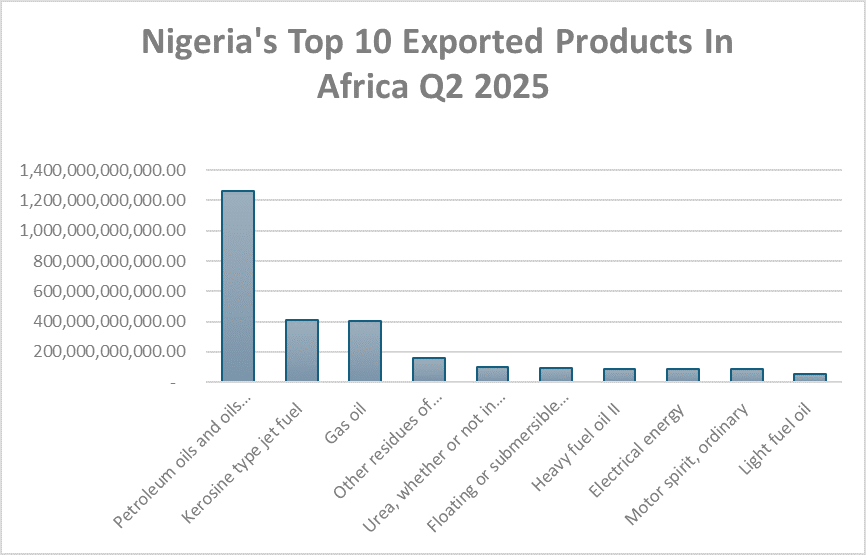
| Products | Value (₦) |
| Petroleum oils and oils obtained from bituminous minerals, crude. | 1,260,583,310,594.66 |
| Kerosine type jet fuel | 408,760,819,450.34 |
| Gas oil | 403,998,131,619.40 |
| Other residues of petroleum oils or of oils obtained from bituminous minerals | 157,506,118,238.26 |
| Urea, whether or not in aqueous solution | 101,097,813,870.33 |
| Floating or submersible drilling or production platforms | 90,430,750,015.00 |
| Heavy fuel oil II | 89,194,065,926.35 |
| Electrical energy | 88,291,375,969.25 |
| Motor spirit, ordinary | 85,833,075,171.51 |
| Light fuel oil | 54,190,588,605.23 |
West Africa
| Products | Value (₦) |
| Motor spirit, ordinary | 208,763,564,572.00 |
| Other fabrics, containing 85 % or more by weight of silk | 69,303,292,500.00 |
| Light fuel oil | 45,098,204,863.00 |
| Knitted or crocheted furnishing articles, nes | 14,869,152,692.00 |
| Petroleum bitumen | 14,426,569,561.00 |
| Cocoa powder, containing added sugar or other sweetening matter | 9,339,188,564.00 |
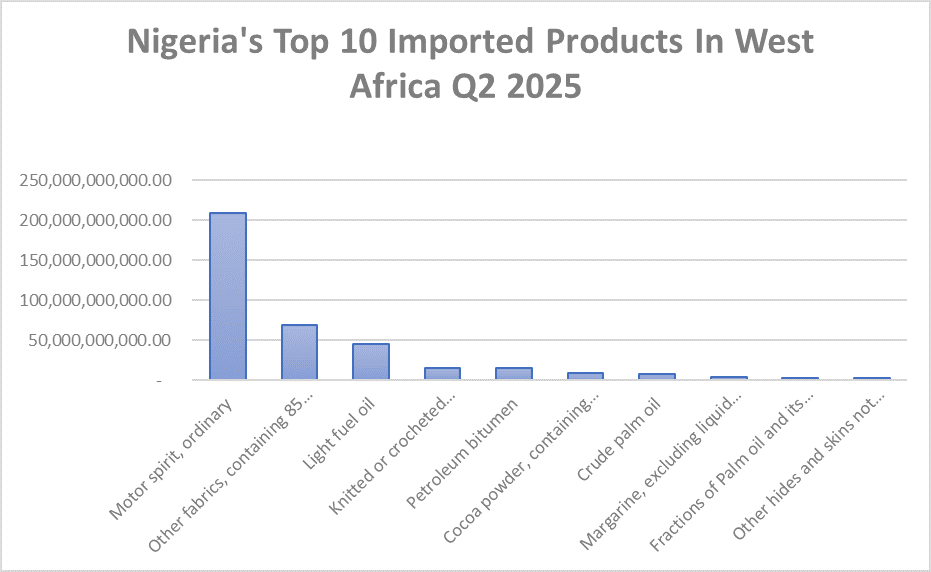
Regionally, Nigeria’s trade shifts slightly, with motor spirit (₦208.8 billion) leading, followed by crude oil (₦97.2 billion). Non-oil items such as silk fabrics (₦69.3 billion), hides and skins (₦33.3 billion), and food industry odoriferous mixtures (₦23.2 billion) emerge strongly.
This reflects West Africa’s demand for manufactured goods and agricultural raw materials, alongside petroleum products.
| Petroleum oils and oils obtained from bituminous minerals, crude. | 829,783,824,177.41 |
| Kerosine type jet fuel | 390,067,540,350.41 |
| Gas oil | 362,266,374,025.28 |
| Electrical energy | 88,291,375,969.25 |
| Motor spirit, ordinary | 85,833,075,171.51 |
| Urea, whether or not in aqueous solution | 55,693,036,402.10 |
| Cigarettes containing tobacco | 31,158,407,173.44 |
| Lightvessels, firefloats, floating cranes | 21,914,031,572.00 |
| Light fuel oil | 17,838,329,139.17 |
| Other excluding White cement | 10,356,287,035.75 |
ECOWAS
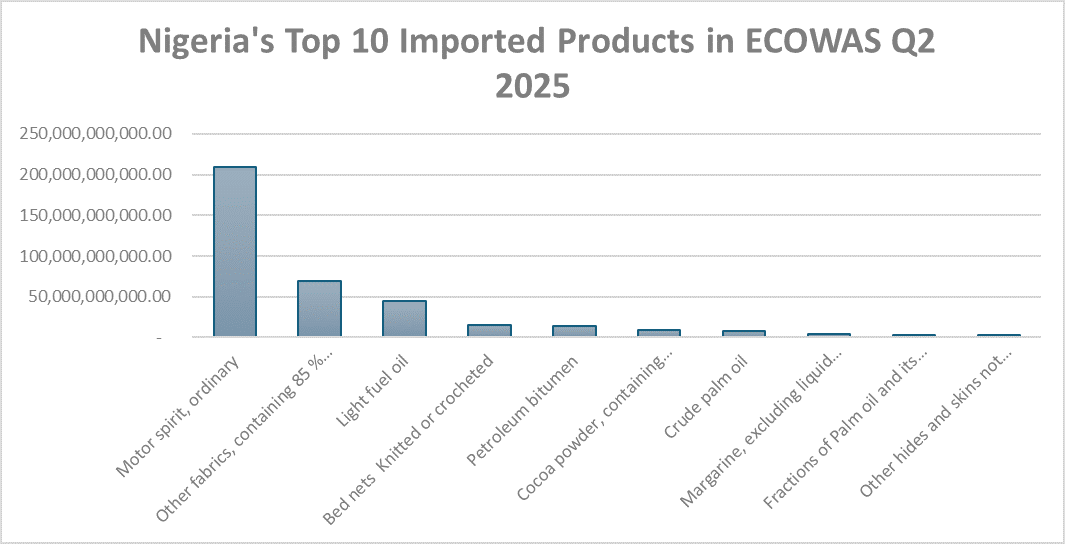
| Products | Value (₦) |
| Motor spirit, ordinary | 208,763,564,572.00 |
| Other fabrics, containing 85 % or more by weight of silk | 69,303,292,500.00 |
| Light fuel oil | 45,098,204,863.00 |
| Bed nets Knitted or crocheted | 14,869,152,692.00 |
| Petroleum bitumen | 14,426,569,561.00 |
| Cocoa powder, containing added sugar or other sweetening matter | 9,339,188,564.00 |
| Crude palm oil | 7,742,212,442.00 |
| Margarine, excluding liquid margarine | 3,570,209,481.00 |
| Fractions of Palm oil and its fractions, not fit for human consumption. | 2,951,008,173.00 |
| Other hides and skins not specified. | 2,613,615,079.00 |
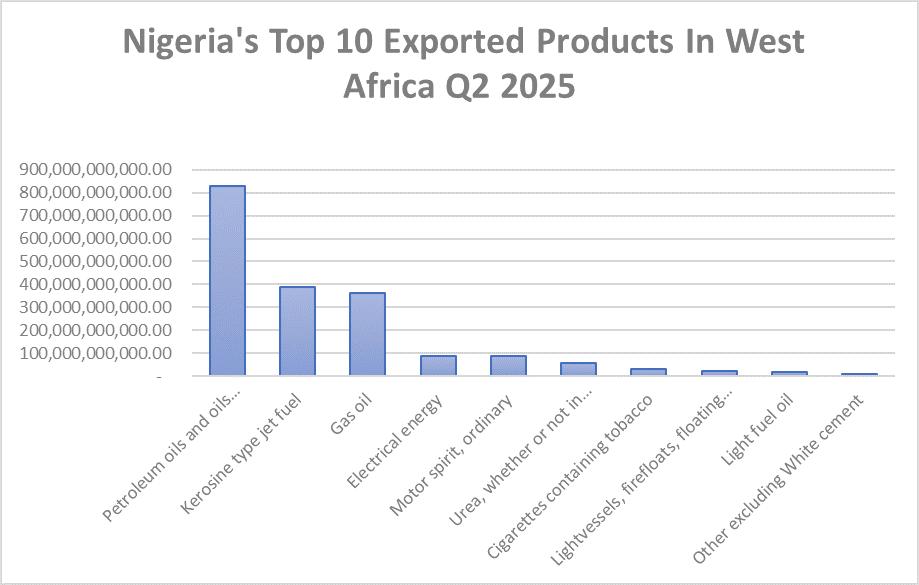
Within ECOWAS, petroleum oils remain dominant (₦829.8 billion), followed by jet fuel (₦390.1 billion) and gas oil (₦362.3 billion). Yet, products like cigarettes (₦31.2 billion), light vessels (₦21.9 billion), and urea (₦55.7 billion) reveal diverse trade flows within the sub-region.
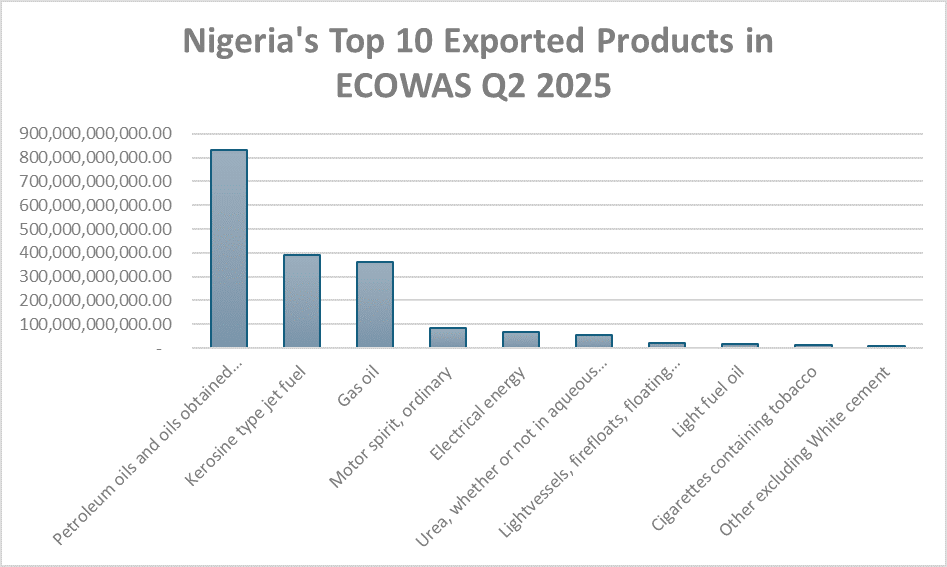
| Products | Value (₦) |
| Petroleum oils and oils obtained from bituminous minerals, crude. | 829,783,824,177.41 |
| Kerosine type jet fuel | 390,067,540,350.41 |
| Gas oil | 362,266,374,025.28 |
| Motor spirit, ordinary | 85,833,075,171.51 |
| Electrical energy | 68,456,821,855.04 |
| Urea, whether or not in aqueous solution | 55,673,876,777.10 |
| Lightvessels, firefloats, floating cranes, | 21,914,031,572.00 |
| Light fuel oil | 17,838,329,139.17 |
| Cigarettes containing tobacco | 14,412,420,766.94 |
| Other excluding White cement | 10,356,287,035.75 |
Conclusion
Nigeria’s trade across all levels continues to lean on petroleum, but regional and sub-regional markets show more diversity compared to global flows.

The recurring appearance of urea, cashew nuts, hides, and energy products suggests opportunities for Nigeria to expand beyond oil.
Unlocking these sectors through export diversification and improved value addition could reduce dependency on hydrocarbons and strengthen Nigeria’s competitiveness in Africa and beyond.