

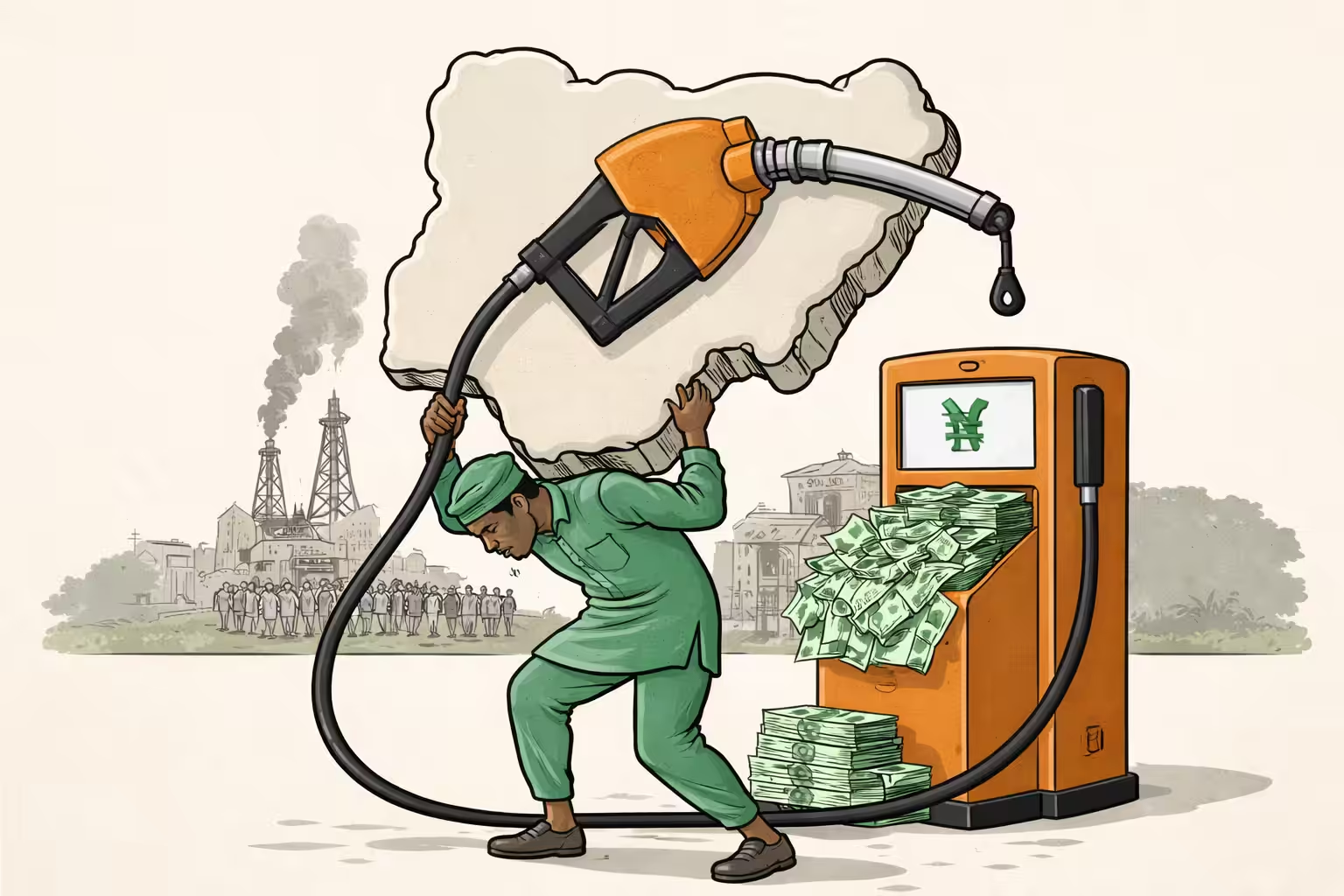
Abundant oil revenues enabled Nigerian governments to institute vast subsidies and statist economic controls. These government interventions progressively weakened the competitiveness of the Nigerian economy and the country’s capacity to diversify its exports. This, rather than corruption, explains Nigeria’s persistent economic failure and deep poverty.
Nigeria discovered oil in commercial quantities in 1956, commencing production in 1957 and exports the following year. By 1970, earnings from oil exports had reached $300 million. They rose astronomically to $6.3 billion by 1976 as a consequence of the 1973 Arab-Israeli Yom Kippur War. Arab states declared an oil supply embargo against the United States and other Western nations for supporting Israel. This triggered a sharp rise in oil prices and created a massive windfall for Nigeria.
Nigeria’s earnings from oil exports rose from $300 million in 1970 to $6.3 billion in 1976. The money was spent faster than the oil flowed through the pipelines. By 1978, the Federal Government had more than tripled its annual spending. By the end of 1978, Nigeria had accumulated over $3.3 billion in external debt. The Shagari administration inherited external reserves of about $5.1 billion in 1979. But by the time it was deposed in a coup in 1983, Nigeria’s external debt had climbed to $20 billion.
The rise in oil prices during the Arab-Israeli war also led to the decision to subsidise petrol prices for Nigerian consumers. At the time, this seemed like a wise decision. Why inflict hardship on Nigerians who had taken no side in the Arab-Israeli conflict? Yet this decision marked the beginning of one of the greatest policy tragedies in economic history.
Why is Nigeria Trapped in Subsidy?
Nigeria’s oil industry and, indeed, the entire economy have been trapped by this decision to shield Nigerians from rising global crude oil prices since 1973. Many governments have attempted to remove the fuel subsidy, but none has succeeded in eliminating it entirely.
In one of the earliest attempts, the Murtala-Obasanjo government increased fuel prices by 76.3 percent in 1976. However, even this dramatic adjustment did not achieve a complete removal of subsidies.
While some countries saved their Arab-Israeli War oil windfall, Nigeria rapidly increased government expenditure, doubling the capital budget in some years far beyond the country’s capacity to plan or manage projects effectively. The result was massive waste, rising unemployment, oil theft, and crippling debt.
As oil revenue surged, Nigeria doubled expenditure in 1974 and again in 1975. Between 1971 and 1973, the Nigerian government had spent 18 percent less than it earned. In 1974, the Federal Government saved 46 percent of its revenue, which itself had increased by 183 percent.
But between 1975 and 1978, the Federal Government spent 24 percent more than it earned. In those four years alone, government expenditure was more than three times what it had been in 1973, before the Yom Kippur oil boom.
Oil reserves were depleted, and foreign loans financed the expenditure binge. By 1978 Nigeria had accumulated more than $3.3 billion in external loans and was running a large budget deficit.
In 1979, the Shagari administration inherited external reserves of about $5.1 billion, but by the time it was overthrown in a coup in 1983, the country’s external debt had climbed to $20 billion.
While it is popular to blame the corruption of politicians for this outcome, the deeper explanation lies in the set of economic ideas that assigned a central role to the state in improving social welfare and achieving economic development, while also granting it extensive tools to pursue these goals. By their nature, these policies created fertile ground for waste and corruption.
Emblematic Fraud – The Cement Armada
The principal objective of public procurement appeared to be to spend as much money as possible, as quickly as possible, so that as much as possible could be stolen.
Perhaps nothing symbolises this objective better than the so-called “cement armada” scandal. In 1975 Nigeria ordered 20 million tons of cement, with 16 million tons requested by the Ministry of Defence — the military rulers then in power.
The quantity ordered was twice the total off-loading capacity of all Nigerian ports.
The result was an extraordinary queue of ships waiting to deliver their cargo. As many as 420 vessels were counted in September 1976, stretching into the Atlantic Ocean as far as the eye could see. Some ships waited for more than a year, each collecting $54,100 per day in demurrage.
A government inquiry later found that much of the cement purchased at inflated prices became unusable while waiting to be unloaded.
The government tribunal reported that it could not untangle the “web of kickbacks and bribes involving government officials, foreign shipowners, corrupt purchasing agents, unscrupulous middlemen, phony corporations, dubious letters of credit and Swiss bank accounts” that produced the cement armada, largely because the public did not cooperate in providing information.
Countries typically finance future development from the proceeds of past or ongoing economic activity. Governments invest in roads, urban planning, ports, schools, agricultural extension services, and well-recruited, well-remunerated civil services using tax revenues generated from productive economic activity.
States and societies gradually develop the planning capacity needed to stimulate growth across multiple sectors, often beginning with agriculture, and to invest productively in public services that expand economic activity and diversify the production structure.
Nigeria, however, rapidly stopped nurturing the growth of the economic activities — particularly agriculture — that countries typically rely on during the early stages of economic modernisation.
By the mid-1970s oil accounted for 77 percent of Federal Government revenue; a decade later the figure had risen to 80 percent. Nigeria also relied on oil dollars for roughly 80 percent of its export earnings.
Although Nigeria produced a wide range of industrial goods, the high exchange rate made possible by oil revenues — in 1976 one dollar bought only 0.62 kobo — made Nigerian products too expensive abroad.
Soon, as the country could no longer afford to maintain or replace infrastructure, the rising cost of producing and transporting goods within Nigeria made its products even less competitive.
Even advanced economies with long-established bureaucracies and political institutions would have struggled to plan and spend efficiently after doubling annual expenditure in such a short period.
The expenditure binge created three defining features of Nigeria’s political economy: a deeply entrenched culture of profligacy, a widespread belief that the country is inherently wealthy and should therefore provide many goods and services for free or at heavy subsidy, and a political culture centred on capturing state institutions and expenditure for personal gain. These tendencies gradually permeated both the state and society, reinforcing each other.
As Nigerians witnessed widespread waste and corruption, the belief that their country was rich and should provide free or subsidised goods and services grew even stronger. Subsidies in turn created further opportunities for corruption among politicians and bureaucrats.
Subsidies Nigeria: The Evil Twin
Since the mid-1970s, Nigeria’s economy and national trajectory have been trapped by two interconnected subsidies.
The first is the persistent attempt by the Central Bank of Nigeria to supply foreign exchange at an “affordable” rate even when falling oil prices reduce the country’s supply of foreign currency.
The naira exchange rate has little relationship with the Nigerian economy’s capacity to produce goods that can be sold abroad to pay for imports. Yet the CBN continues to maintain this economic distancing, even when falling oil prices provide an opportunity to adjust the exchange rate and reduce the economy’s dependence on the inherently volatile international oil market.
The second subsidy is the policy of selling petroleum below global market prices — and later below the actual cost of supplying the product.
More Nigerians live in extreme poverty than Indians, despite India having a population of 1.3 billion. Many Nigerians do not understand how the nation’s poverty is produced by the twin traps of fuel and foreign exchange subsidies.
Nigerians came to believe that the country’s abundant oil wealth could finance development on its own. Oil income has therefore been used to pay for roads, education, industrial and agricultural research, pilgrimages, and many other public expenditures.
Nigeria’s Omnipotent Oil Export Revenue
The disappointing reality is that Nigeria’s oil income is far from sufficient to finance the country’s needs, even if it were invested honestly. In 2018 Saudi Arabia produced 129 barrels of oil per citizen, Malaysia produced seven, Kuwait 260, and Norway 101. Nigeria, by contrast, produced only three barrels per citizen.
Successful oil exporters such as Malaysia treated oil as supplementary income that could finance development, rather than as a substitute for building a diversified economy.
The policies favoured by Nigerian governments suggest a belief that oil wealth eliminates the need to use economic resources prudently or invest in sectors that enable the country to compete internationally.
Nigeria’s insistence on fuel subsidies has diverted investment that could have created domestic jobs and generated foreign exchange. Instead, it has shifted national wealth away from productive investment toward unsustainable consumption.
In a 2019 study, the budget-tracking organisation BudgIT reported that the Federal Government spent about ₦10.78 trillion on fuel subsidies over 14 years.
The ₦1.5 trillion spent on subsidies in 2011 alone was 118 percent greater than spending on infrastructure and more than triple the combined spending on education, healthcare and roads.
According to Bloomberg, Nigeria in 2019 spent four times more on fuel subsidies than on “building schools, health centres and science laboratories” — a year after the country was declared the poverty capital of the world.
Nigeria has more than 10 million out-of-school children, the highest number globally. About 80 percent of primary school leavers cannot read, compared with only 20 percent in Tanzania.
These outcomes reflect funding choices. Nigeria has consciously neglected investment in human capital while pouring billions into a fraud-ridden petroleum subsidy regime.
Malaysia, by contrast, collects the full price of petroleum from most of its citizens and also charges users for its extensive network of toll roads built by private investors.
Malaysia possesses one of Asia’s best expressway networks after Japan and China, and most of its highways are tolled.
Yet in Nigeria, even wealthy residents of areas such as Lekki — including prominent lawyer Ebun-Olu Adegboruwa (SAN) — oppose toll roads on the grounds that Nigerians already pay taxes.
This argument ignores reality. Malaysia’s tax-to-GDP ratio in 2017 was 12.5 percent, while Nigeria’s was only 5.7 percent. The average across 26 African countries was 17.5 percent. Nigeria’s insistence on funding nearly everything with oil income is reflected in its weak productive capacity.
In 2018 Nigerian agricultural exports totalled ₦302.3 billion, less than one billion dollars, while Malaysia exported $27.5 billion worth of agricultural products in 2016.
Nigeria once exported more palm oil than Malaysia in the 1950s and early 1960s. Today it is a net importer.
With a population of nearly 196 million and land covering 923,768 square kilometres, Nigeria should be producing far more agricultural goods. Malaysia, by contrast, has a population of just 31.5 million and a landmass of 329,847 square kilometres.
Oil Prices and Nigeria: Permanent Boom and Bust
Nigeria’s decision to anchor its foreign exchange system to oil export revenues has created a permanent boom-and-bust cycle.
When oil prices are high, Nigeria can manufacture goods and create employment because it can afford imported inputs. When oil prices fall, production and employment decline sharply.
Just as Nigeria has countless “abandoned projects” — public works begun during oil booms but left unfinished when prices collapse — the country also has many “abandoned businesses” destroyed by foreign exchange shortages that suddenly make imported inputs unaffordable.
The resulting boom-and-bust cycle, compounded by hesitant and delayed devaluations of the naira, erodes savings, consumption and investment. Many manufacturers have therefore preferred to export goods to Nigeria rather than build factories within the country. The volatile pattern of Nigerian consumption — tied closely to global oil prices — explains why companies such as Leyland Motors, Dunlop, Michelin, Exide Batteries, and Procter & Gamble have exited Nigeria.
In the late 1980s, a Spanish building-materials manufacturer considered establishing a Nigerian factory but ultimately decided to continue exporting to the country instead.
The decisive factor was Nigeria’s foreign exchange policy. The company feared its products would not be protected from imports if the government resumed supplying cheap dollars once oil prices recovered.
Nigeria attempted to channel subsidised foreign exchange to sectors it considered strategic, particularly manufacturing. In practice, these cheap dollars financed a wide range of imported consumer goods and entrenched manufacturing dependence on imported inputs.
Even today, subsidised CBN dollars discourage manufacturers from developing local alternatives to imported raw materials.
A January 2020 report noted that the foreign exchange shortage following the 2015-2016 oil price collapse forced Nigerian manufacturers to source more local inputs. But once oil prices recovered and foreign exchange became easier to obtain, manufacturers reverted to imported inputs. Subsidised foreign exchange also created enormous profits for individuals engaged in “round-tripping” — the practice, known in the 1970s as “arrangee,” of buying cheap official dollars and reselling them on the black market. Instead of strengthening manufacturing, the policy had the opposite effect. It stunted industrial expansion and discouraged investment.
The management of Nigeria’s petrodollars has therefore created a volatile microeconomic environment that has made the country poorer. Without oil, investors might have been able to plan around more stable consumption trends.
Will Nigeria Be Free From Its Subsidy Trap?
Nigeria’s political economy has shown remarkable continuity. Politicians continue to promise free or subsidised goods and services, while citizens continue to demand them.
Politicians and bureaucrats profit from delivering these subsidies, while the heavy economic controls required to sustain them deter billions of dollars of private investment.
At the same time, poverty continues to spread.
Fuel subsidies deliver enormous profits to smugglers who transport Nigerian petrol to neighbouring countries where prices are higher. Others profit by claiming payment for phantom fuel imports.
The subsidy regime also discourages investment in domestic refining.
Political economist Peter Lewis once observed that during the 1970s and 1980s the key to sudden wealth in Nigeria was possession of an import licence — the document that allowed privileged individuals to purchase cheap official dollars for “approved imports.”
When banking was liberalised in the late 1980s, the equivalent instrument of sudden fortune became a banking licence.
New bank owners and a handful of privileged insiders accumulated enormous wealth. The underlying system remained unchanged.
The Federal Government and the Central Bank still claim to allocate subsidised foreign exchange to manufacturers. In practice, insiders fabricate documents that enable them to purchase cheap dollars and resell them on the parallel market.
Liberalisation in sectors such as banking and telecommunications has nevertheless encouraged genuine entrepreneurship. A new generation of Nigerian entrepreneurs has built substantial fortunes through vision, energy and innovation, creating hundreds of thousands of jobs.
Yet subsidies and economic controls continue to make access to government a major source of wealth while constricting the space for genuine investment and enterprise.
The Buhari government has announced plans to eliminate subsidies for electricity and fuel — not because it recognises the deep economic damage caused by these policies, but because the country can no longer afford them.
Yet the government has retained one of the most damaging policies in Nigeria’s economic history: the selective allocation of subsidised foreign exchange.
A gap of ₦7 now exists between the official CBN exchange rate and the parallel market rate. As always, this difference creates opportunities for illicit profits and deters investment.
More importantly, it suggests that Nigeria is still not ready to escape the trap it created in the 1970s.
Without the courage to wean the economy from volatile oil revenues, the country will remain trapped in the cycle of boom and bust.


















2 Responses
Will Buhari set Nigeria free?
How is that ever going to be possible? This is an endeavour that should ordinarily stretch brilliant minds to the limit. Pray, where would ordinary Buhari begin?
Any mumu can seek loans and spend the proceeds.
Haba!