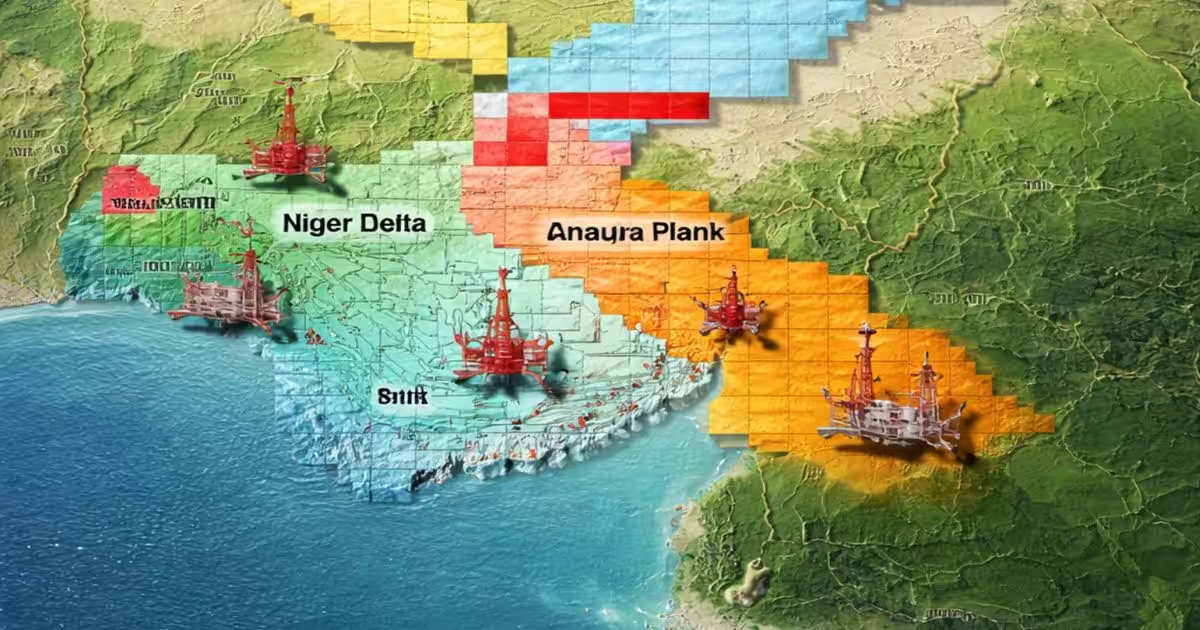
A Quiet but Strategic Shift in Nigeria’s Exploration Map: Nigeria’s 2025 oil licensing round is quietly testing investor appetite in new geological territory, with two blocks in the underexplored Calabar Flank signalling a shift beyond the Niger Delta.
Nigeria’s 2025 oil and gas licensing round marks a deliberate shift in upstream strategy, as the Nigerian Upstream Petroleum Regulatory Commission (NUPRC) expands exploration into underdeveloped geological provinces.
Of the 50 blocks on offer, official licensing documents show that PPL 2A61 and PPL 2A62 are classified within the Calabar Flank, a basin long identified as prospective but largely underexplored.
A third block often mentioned in connection with the area—PPL 2A45—is not classified as Calabar Flank. NUPRC materials place it instead in the eastern offshore Niger Delta, at the mouth of the Calabar River.
This distinction matters. It clarifies that Nigeria is testing investor appetite in the Calabar Flank—but cautiously, with a limited number of blocks rather than a full basin-scale opening.
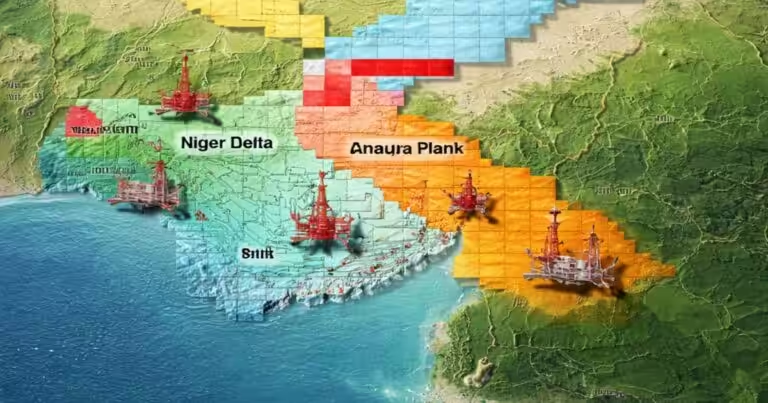
The Map: Expanding Beyond the Niger Delta


- Niger Delta (core producing basin)
- Benue Trough (gas-prone frontier)
- Chad Basin (northeast exploration)
- Sokoto and Bida Basins (northwest and central frontier zones)
- Calabar Flank (emerging southeastern frontier)
This distribution signals a portfolio diversification strategy, aimed at reducing overdependence on mature Niger Delta assets.
Why the Calabar Flank Is Back in Focus
The Calabar Flank has historically attracted limited drilling activity, despite:
- Geological continuity with productive basins in the Gulf of Guinea
- Indications of hydrocarbon systems from earlier seismic work
- Proximity to coastal export infrastructure
At the Energy Cross River Conference and Exhibition 2026, NUPRC officials highlighted the need to unlock such underexplored provinces as part of Nigeria’s long-term upstream strategy.
While public documentation does not fully quantify reserves in the Calabar Flank, its inclusion in the licensing round reflects a policy decision to move from resource concentration to resource expansion.
Policy Direction: Frontier Basins as the Next Growth Engine
Under the leadership of Oritsemeyiwa Eyesan, NUPRC has positioned the 2025 Licensing Round as more than a routine acreage offering.
The strategic objectives are clear:
- Rebuild reserves amid declining output from mature fields
- Attract new categories of investors, particularly independents and frontier explorers
- Extend Nigeria’s production horizon beyond current assets
In effect, Nigeria is attempting to replicate earlier exploration cycles that transformed the Niger Delta—this time in less developed basins.
Investor Perspective: Early-Stage Opportunity, Higher Geological Risk
For investors, Calabar Flank blocks represent a frontier play with asymmetric outcomes.
Opportunities:
- Entry into a low-competition acreage position
- Potential for material discoveries in an underexplored basin
- Strategic location near existing coastal infrastructure
Constraints:
- Sparse well data and limited subsurface validation
- Higher exploration risk relative to mature basins
- Longer development timelines
This places the Calabar Flank in the category of “high-risk, high-upside” assets, likely to appeal to technically capable independents rather than risk-averse majors.
Broader Context: Nigeria’s Exploration Imperative
Nigeria’s upstream sector faces a structural challenge:
- Production has struggled to consistently exceed ~1.6–1.8 million barrels per day
- International oil companies are divesting onshore and shallow-water assets
- Reserve replacement has lagged production depletion
Against this backdrop, the 2025 Licensing Round—and particularly the inclusion of frontier basins—signals an attempt to reset the exploration pipeline.
Prospects for Investors and Conclusion: A Measured Opening of a New Basin
Beyond policy signalling, the investment case for the Calabar Flank rests on a growing body of geological studies that point to a technically credible—though still unproven—petroleum system.
Evidence from Cretaceous formations, particularly the Nkporo shale, indicates Total Organic Carbon (TOC) levels ranging from around 1% to as high as 5%, suggesting the presence of sufficient organic material to generate hydrocarbons under favourable thermal conditions. The kerogen mix—typically Type II/III—implies potential for both oil and gas generation, depending on depth and maturity.
Structurally, the basin reflects the Early Cretaceous rifting associated with the opening of the South Atlantic, creating faulted horst and graben systems that are widely associated with hydrocarbon accumulation across the West African margin. Reservoir candidates, including carbonate formations such as the Mfamosing Limestone and sandstone intervals, are complemented by regional shale seals—indicating that the core elements of a working petroleum system are present.
The constraint is not geology, but data and maturity. The basin remains lightly drilled, with limited seismic coverage and insufficient deep well control to fully confirm hydrocarbon generation at commercial scale. In that sense, the Calabar Flank sits firmly within the category of early-cycle frontier basins.

This is precisely what makes its inclusion in the 2025 Licensing Round significant. The offering of PPL 2A61 and PPL 2A62 does not represent a basin-wide opening, but it is a measured strategic signal. Nigeria is testing investor appetite in new geological zones, gradually expanding its exploration frontier, and positioning underexplored basins as the next phase of upstream growth.
For investors, the implication is clear: this is not an immediate production play, but a positioning opportunity ahead of potential discovery. If early exploration activity yields results, the Calabar Flank could move rapidly from geological promise to commercial relevance—much as the Niger Delta once did.