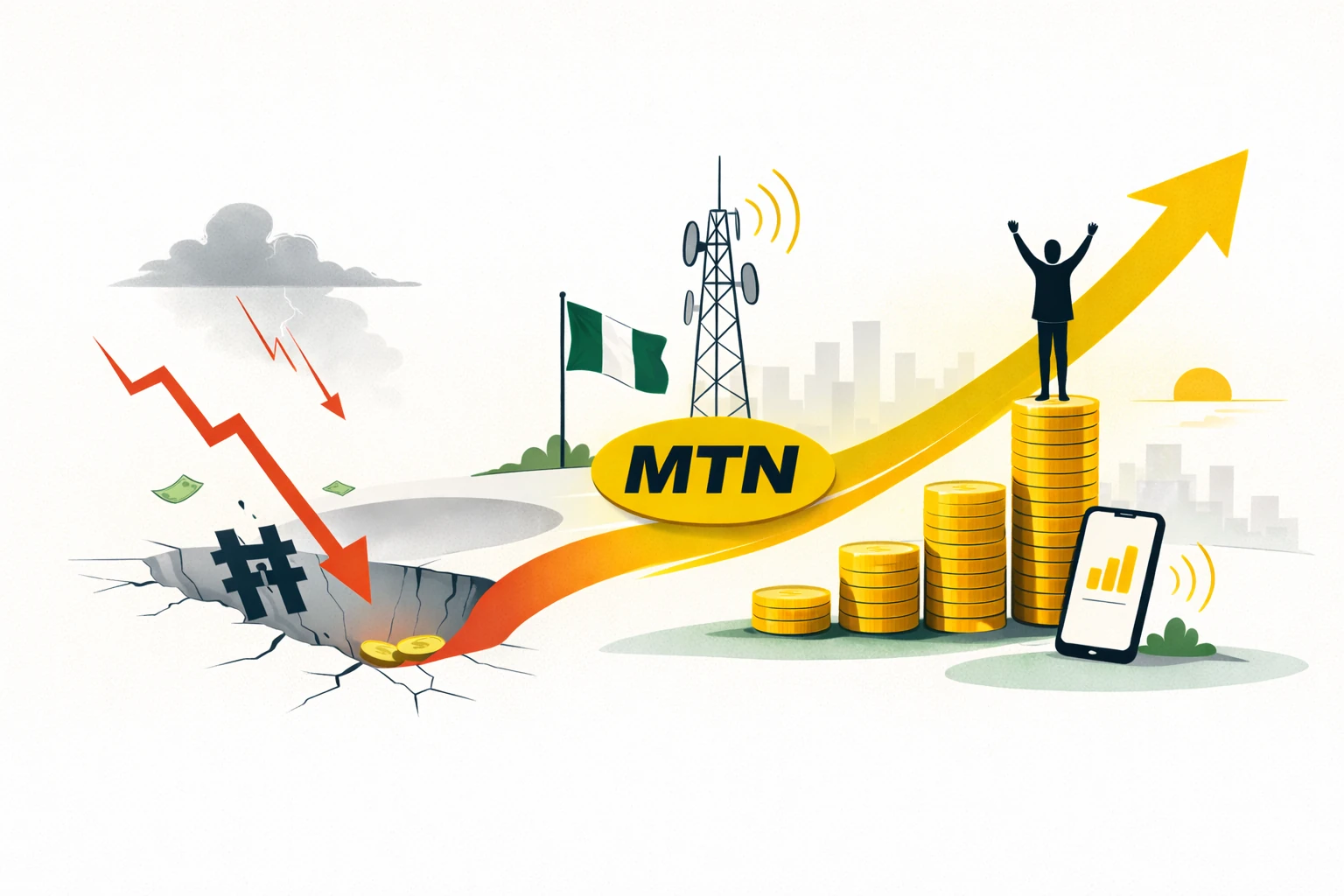
After posting a ₦400 billion loss in 2024, MTN Nigeria Communications Plc returned in 2025 with a staggering ₦1.11 trillion profit. In simple terms, the company moved from heavy loss to massive profit in just one year. This is not just a comeback year for MTN. It is one of the biggest financial turnarounds ever recorded by a Nigerian company. That swing — over ₦2.2 trillion at pre-tax level — shows how quickly fortunes can change when the economy stabilises.
The Numbers That Tell the Story
From the company’s 2025 financial highlights :
• Revenue: ₦5.20 trillion (2024: ₦3.36 trillion)
• Profit before tax: ₦1.70 trillion (2024: ₦550 billion loss)
• Profit after tax: ₦1.11 trillion (2024: ₦400 billion loss)
• Net foreign exchange gains: ₦90.3 billion (2024: ₦925 billion loss)
• Share price: ₦511 (2024: ₦200)
• Market value: ₦10.7 trillion (2024: ₦4.2 trillion)
Investors added over ₦6.5 trillion to MTN’s market value in one year.
How Naira Stability Changed Everything
That loss alone was enough to wipe out profits and push the company into the red.
In 2025, the situation changed. The naira became more stable, and instead of losses, MTN recorded ₦90.3 billion in foreign exchange gains.
That is a difference of over ₦1 trillion in one year — just from currency movements.
In simple terms:
When the naira was unstable, MTN bled.
When the naira steadied, MTN breathed again.
This shows how closely large Nigerian companies are tied to the strength of the currency. When the naira shakes, their profits shake too. Tariff Increase Gave Breathing Space.
Another major factor was pricing.
On 20 January 2025, the Nigerian Communications Commission approved a 50 per cent tariff increase for telecom operators.
Telecom companies spend heavily in dollars — for equipment, software and network expansion — but earn mostly in naira. For years, prices had not fully reflected rising costs.
The tariff adjustment helped MTN:
• Cover rising operating costs
• Protect its network investments
• Improve its earnings
Revenue jumped to ₦5.20 trillion — an increase of nearly ₦1.84 trillion in one year.
In short, better pricing plus a steadier naira created the perfect recovery mix.
From Negative to Positive: A Full Financial Reset
In 2024, MTN’s financial position had been badly weakened by foreign exchange losses.
By 2025, the story changed:
• Shareholders’ equity: ₦548.7 billion (2024: negative ₦458 billion)
• Net assets per share: ₦26.17 (2024: negative ₦21.84)
Simply put, the company moved from being financially stretched to standing on solid ground again.
That is not a small improvement. It is a complete turnaround.
Dividends Are Back
Profit means little to investors without returns.
MTN declared:
• ₦5 interim dividend
• ₦15 proposed final dividend
• Total: ₦20 per share
After paying no dividend during its loss year, MTN is back to rewarding shareholders.
For many investors, that is the clearest sign that the crisis phase is over.
The Market Reacted Swiftly
The stock market wasted no time.
MTN’s share price more than doubled from ₦200 to ₦511.
Market capitalisation surged from ₦4.2 trillion to ₦10.7 trillion
That is a ₦6.5 trillion jump in company value.
Investors were not just reacting to profit. They were responding to:
• Greater currency stability
• Improved pricing environment
• Restored dividend confidence
• Reduced fear of another financial shock
Bigger Than One Company
MTN Nigeria’s recovery is, at first glance, a corporate story — a tale of red ink turning black, of dividends restored and investor confidence renewed.
But look more closely and it reads as something broader: a reflection of an economy trying to steady itself after one of its most turbulent stretches in recent memory.
The company’s return to profit suggests that exchange rate reforms, painful in their first shock, can begin to settle into something more predictable.
When the naira plunged, it exposed how vulnerable large Nigerian companies were to currency swings.
When the currency steadied, those same companies found room to breathe. Stability, even imperfect stability, proved powerful.
It also underscores a less dramatic but equally important point: pricing matters. For years, businesses in key sectors operated under tariffs that did not fully reflect rising costs.
When regulators approved more realistic pricing, it helped protect the infrastructure millions rely on every day. Telecom towers stayed powered, networks expanded, and investment did not stall.
Cost-reflective pricing, often unpopular in the moment, may be the difference between decay and durability.
And there is another lesson in the speed of MTN’s rebound. Strong companies, battered but intact, can recover quickly when economic pressure eases.
The machinery of the business — its network, its subscribers, its brand — had not disappeared during the crisis. What changed was the environment around it.
Yet the real test lies ahead. Some would argue that Nigerian macroeconomic stability is still fragile; sustaining and consolidating it is the real challenge.
Will the naira hold steady? Will regulators maintain pricing discipline? Will earnings remain robust once the one-off boost from foreign exchange gains fades?
If calm replaces volatility for good, MTN Nigeria could cement its place among the most valuable companies on the Nigerian Exchange. If turbulence returns, the story may shift again.

For now, though, one conclusion stands. MTN Nigeria’s ₦2.25 trillion profit swing is not merely a corporate comeback.
It is evidence that when the economic winds begin to calm, even giants brought low by the storm can find their footing — and rise.