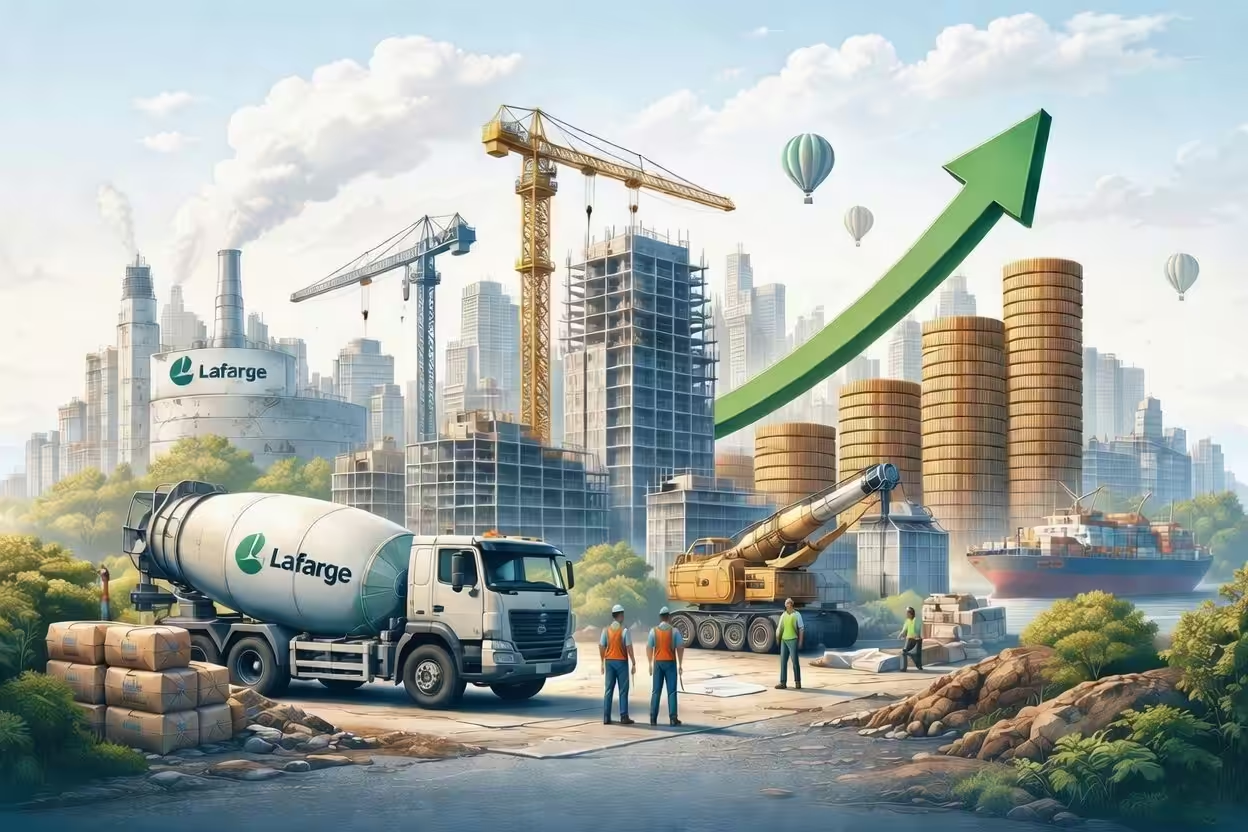
Lafarge Africa has delivered one of the most striking earnings expansions in Nigeria’s industrial sector this cycle, reporting ₦1.066tn in revenue and ₦273.12bn in profit after tax for the year ended 31 December 2025.
The performance represents a sharp acceleration from 2024, when revenue stood at ₦696.76bn and profit at ₦100.15bn. Net income rose by approximately 173 per cent year-on-year, a scale of expansion that reflects both pricing power and improved financial structure.
The cement producer — one of Nigeria’s leading listed players, though smaller than Dangote Cement by market capitalisation — has now crossed the symbolic ₦1tn revenue threshold. Revenue rose 53 per cent year-on-year, underscoring the extent to which domestic demand and price adjustments offset earlier cost pressures.
Margin expansion and financial repair
Operating profit nearly doubled to ₦392.1bn, from ₦193.0bn in 2024, as the company benefited from operating leverage and tighter cost discipline.
The improvement was amplified by a marked shift in the finance line. Net finance costs swung from –₦40.49bn in 2024 to +₦19.22bn in 2025, materially strengthening bottom-line performance and signalling reduced balance-sheet strain.
Basic earnings per share rose to 1,696 kobo, from 622 kobo a year earlier — a figure that will not go unnoticed in a Nigerian equity market where investors have increasingly rewarded hard earnings rather than narrative growth.
Dividend signal
The board has proposed a 600 kobo dividend per share, up from 120 kobo previously. The payout, amounting to roughly ₦96.65bn, represents a fivefold increase in dividend per share.
By comparison, the 120 kobo dividend declared for 2024 amounted to about ₦19.33bn. The scale of the proposed increase sends a clear capital-allocation signal: management is confident that cash flows are durable rather than cyclical.
Balance sheet strength
Equity rose to ₦693.99bn, from ₦504.64bn the previous year. Cash and cash equivalents climbed to ₦384.97bn, while operating cash flow reached ₦292.63bn — sufficient to fund capex and dividends without recourse to additional leverage.
The result is a balance sheet that appears materially more resilient than it was two years ago, when higher finance costs and macro volatility weighed on industrial players.
Ownership consolidation
Following Holcim’s divestment, Huaxin Building Materials Group now controls 83.81 per cent of Lafarge Africa through its subsidiaries. The consolidation tightens strategic control and may shape future capital allocation, expansion decisions and regional positioning within West Africa’s cement market.
A more stable macro backdrop
The 2025 performance was achieved in a macroeconomic environment that, while still fragile, showed signs of stabilisation.
Nigeria’s headline inflation declined through the year following CPI rebasing, ending December at 15.15 per cent in the updated series. The Central Bank of Nigeria responded by cutting the policy rate by 50 basis points in September — its first reduction in several years — before holding steady thereafter.
Foreign exchange conditions also became more predictable relative to the sharp dislocations of 2023–24, narrowing spreads between official and parallel markets and improving planning visibility for manufacturers with imported inputs.
Cement demand remains closely linked to infrastructure execution, housing development and credit availability. A more stable inflation and FX regime reduces cost volatility and improves project viability across the construction chain.
For Lafarge Africa, the question now is not whether it can grow — 2025 answers that decisively — but whether it can sustain margins as monetary easing gradually feeds into domestic demand. If stability persists, the company appears structurally positioned to benefit from any renewed construction cycle.