

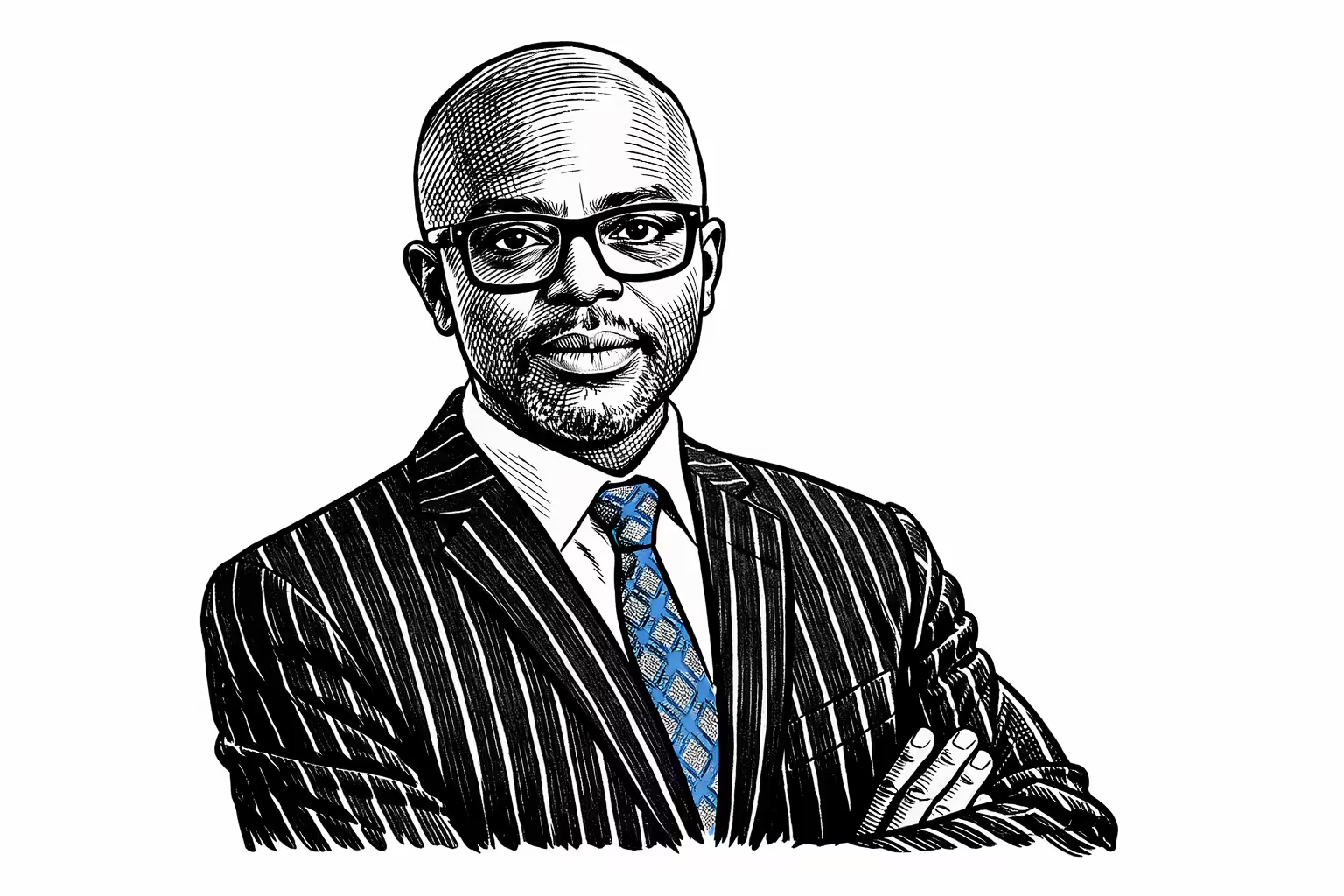
In March, Tola Adeyemi will take the helm of KPMG’s African operations at a moment when the global accounting giant is building coherence as a strategy to leverage growth in African economies.
The firm announced on Wednesday that Adeyemi will become Chief Executive Officer for KPMG in Africa, alongside the appointment of Professor Olayinka David-West and George Njenga as independent members of its Africa Governance Council. Together, the moves are intended to deepen oversight and bring greater integration to a network that spans dozens of jurisdictions, languages and regulatory systems.
“Africa is one of the most dynamic and promising regions in the global economy,” Adeyemi said in a statement. “KPMG is committed to playing a meaningful role in its growth story.”
Behind the careful phrasing lies a larger institutional challenge. For years, global professional services firms have wrestled with how to balance local autonomy with global standards — especially in regions where regulatory complexity and political risk can vary sharply from one market to another. KPMG’s “One Africa” strategy is its answer: a more unified operating model designed to strengthen cross-border collaboration and ensure consistent quality across the continent.
A Career Built Inside the Network
Adeyemi is not an outsider brought in to reset the firm’s direction. He is a product of it.
Over more than two decades within KPMG, he has held senior leadership roles, most recently serving as Managing Partner and Chief Executive of KPMG Nigeria, one of the network’s largest and most strategically important African practices. In that role, he oversaw audit, tax and advisory operations across sectors ranging from financial services to energy and public sector reform.
Colleagues describe him as technically rigorous but institutionally minded — a leader attentive not only to client growth but also to risk controls and governance standards that have come under intense global scrutiny in the accounting industry.
He has also served on KPMG’s Global Council, a body that shapes strategic priorities across the firm’s worldwide network. That exposure, according to Professor Ben Marx, chairman of the Africa Governance Council, makes him “exceptionally well-positioned” to lead.
“In addition to his global perspective,” Marx said, “he brings significant influence and credibility as a respected business leader across the continent.”
Governance, and the Weight of Reputation
The appointments of Professor David-West and Mr. Njenga to the Africa Governance Council reflect another priority: independent oversight.
Large accounting firms have faced growing pressure worldwide to demonstrate strong governance structures, particularly after high-profile corporate failures that have tested the credibility of auditors. Strengthening board-level independence is part of that recalibration.
David-West, an academic known for her work in digital transformation and financial inclusion, brings policy and research depth. Njenga contributes experience in executive education and leadership development in East Africa. Their roles will center on providing governance supervision rather than operational management.
“These appointments reinforce KPMG’s commitment to strong governance, accountability and leadership depth,” Marx said.
The Stakes in Africa
Africa’s economic landscape is expanding in both opportunity and complexity. Rapid urbanization, fintech growth, infrastructure financing and energy transition investments have created demand for sophisticated advisory services. At the same time, regulatory regimes remain uneven, and political shifts can reshape market conditions quickly.
For multinational clients operating across borders, consistency matters as much as local expertise. The “One Africa” framework seeks to ensure that an audit in Nairobi, Lagos or Johannesburg meets the same technical standards and risk discipline.
Adeyemi, who trained as an accountant and holds fellowship status within Nigeria’s chartered accounting institute, represents a generation of African business leaders shaped both by domestic market realities and global governance expectations.

“It is a privilege to step into this role at such a pivotal moment,” he said. Whether the new structure succeeds will depend less on rhetoric and more on execution — on whether integration can move beyond strategy documents into everyday practice.
For KPMG, the appointment signals confidence not only in its African leadership bench but in the continent’s long-term trajectory. For Adeyemi, it marks a shift from leading a national practice to stewarding a diverse regional enterprise where reputation, risk and opportunity are tightly intertwined.


















One Response
Please check your email.