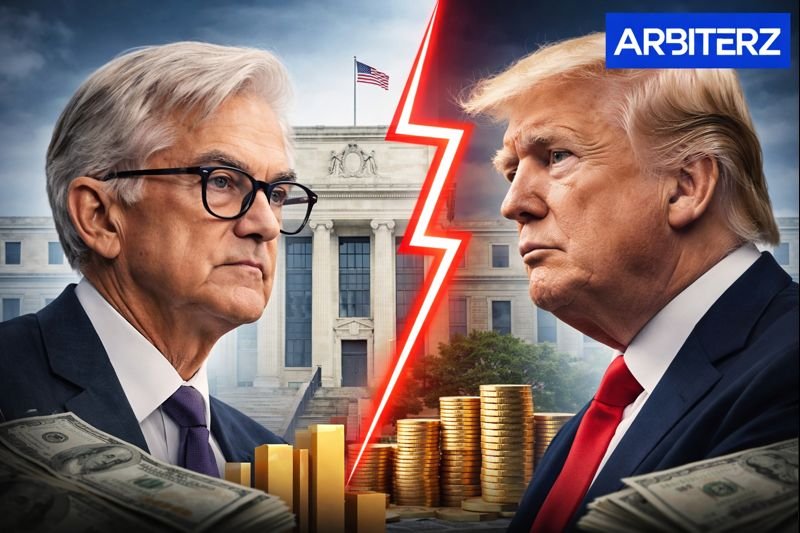
The U.S. Federal Reserve has held its benchmark interest rate steady, resisting renewed pressure from President Donald Trump for aggressive rate cuts, while revealing a rare internal split that underscores growing debate inside the central bank over the path of monetary policy.
At the conclusion of its first meeting of the year, the Federal Open Market Committee (FOMC) voted to keep rates unchanged at 3.5%–3.75%, even as two policymakers dissented in favour of a cut. The decision reflects the Fed’s judgment that the U.S. economy remains resilient enough to withstand higher borrowing costs, despite lingering inflation and political pressure from the White House.
Rates Hold Despite Political Pressure
President Trump has repeatedly argued that interest rates should be slashed to 1% or lower, insisting that cheaper borrowing would turbocharge growth and investment. In the days leading up to the meeting, he renewed his public calls for rate cuts, portraying the economy as strong enough to justify easier monetary policy.
Yet the Fed’s statement struck a deliberately measured tone, signalling independence from political influence. Officials said economic activity is expanding at a “solid pace,” an upgrade from the “moderate” growth language used late last year, while the unemployment rate has shown “some signs of stabilisation.”
A Divided Committee
Two governors — Stephen Miran and Christopher Waller — voted against the majority, calling for a quarter-point rate cut. Mr. Miran’s dissent was widely anticipated; he has consistently pushed for looser policy. Mr. Waller’s vote, however, surprised many analysts and adds weight to speculation about emerging fault lines within the Fed.
Still, the split was narrower than in previous meetings, when dissenting votes pulled in opposite directions. That suggests disagreement over timing rather than a fundamental break over the Fed’s overall strategy.
Inflation Still Elevated, Uncertainty High
While acknowledging economic strength, the Fed cautioned that inflation remains “somewhat elevated.” The statement also noted that economic uncertainty is still high, citing unresolved questions around administration policies — including tariffs and immigration — and their potential impact on growth and prices.
In a subtle but important shift, the Fed dropped language from its December statement warning that “downside risks to employment” had risen, reinforcing the impression that policymakers are increasingly confident about labour-market conditions.
Bond Purchases, Not a Return to QE
The Fed also indicated it is prepared to resume bond purchases as necessary to maintain orderly market conditions. Officials were careful to stress that this would not amount to a return to crisis-era quantitative easing, but rather a technical tool aimed at preserving financial stability.
All Eyes on Powell
Attention now turns to Fed Chair Jerome H. Powell, who is due to face reporters at a press conference. Analysts expect Mr. Powell to avoid giving a clear signal on when — or under what conditions — rate cuts might resume, especially amid escalating criticism from President Trump.

Mr. Powell is also likely to face questions about political pressure on the central bank, including the president’s broader attacks on the Fed and ongoing legal battles involving Fed officials.
For global markets, the message is one of cautious continuity. The Fed is signalling confidence in the U.S. economy while keeping its options open, resisting both political pressure and premature easing. For investors, businesses and emerging markets — including Nigeria — the decision reinforces the likelihood that U.S. rates will remain higher for longer, shaping capital flows, exchange rates and global financing conditions.