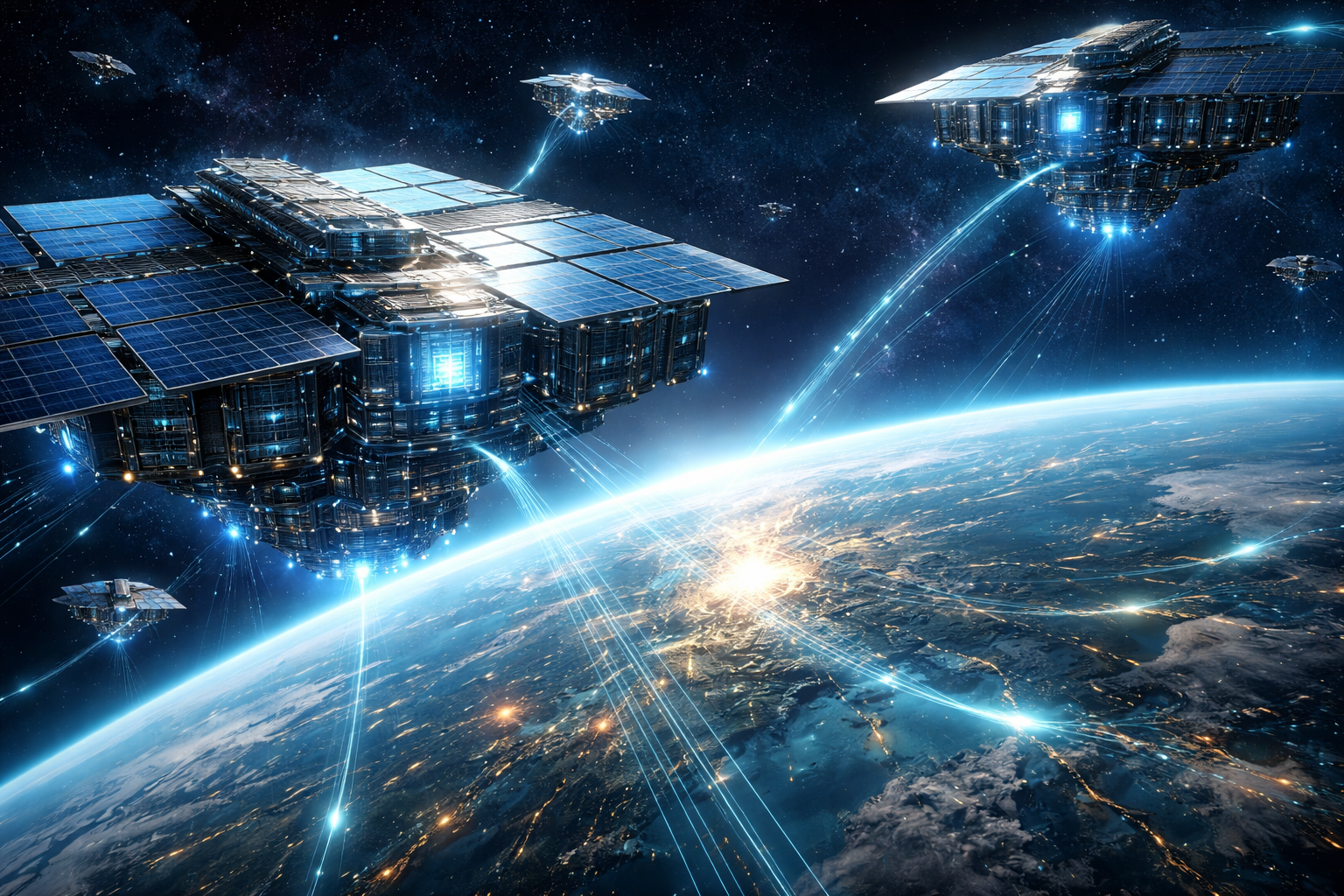
Elon Musk is no longer treating space as just a launchpad for rockets or satellites — he is increasingly framing it as the next home for the world’s most powerful computers.
In recent weeks, the billionaire entrepreneur has sharpened his vision for orbital data centers, arguing that artificial intelligence workloads will eventually be cheaper, easier, and more scalable in space than on Earth.
The idea gained new momentum following SpaceX’s filing with U.S. regulators for a massive satellite-based data network and the formal merger of SpaceX with Musk’s AI company, xAI.
Taken together, these moves suggest a broader strategy: rebuilding the foundations of AI infrastructure beyond Earth’s physical and energy limits.
AI’s Energy Problem Is Driving the Space Argument
Modern AI systems require enormous computing power, and that demand is exploding.
Data centers already consume vast amounts of electricity, and global capacity is projected to climb toward 200 gigawatts by the end of the decade, representing close to $1 trillion in infrastructure investment.
Musk’s argument is that Earth is becoming an inefficient place to support that growth.
In orbit, solar panels generate significantly more energy than they do on the ground, thanks to constant exposure to sunlight and the absence of atmospheric interference.
According to Musk, this advantage could fundamentally change the economics of AI computing, especially as models grow larger and more power-intensive.
From his perspective, the challenge isn’t whether space-based AI is possible — it’s whether Earth-based systems can keep up long-term.
Orbital Data Centers as a Scaling Strategy
Unlike traditional terrestrial data centers, orbital systems wouldn’t compete for land, water, or local power grids.
In theory, they could scale continuously by adding more computing clusters in orbit, powered directly by solar energy.
Musk has publicly suggested that this shift could happen faster than many expect.
He has pointed to the late 2020s as a tipping point, when operating AI infrastructure in space could become economically more compelling than expanding on Earth.
If that prediction holds, space could transition from a niche environment for satellites into a core layer of global digital infrastructure.
Skepticism Remains, but the Direction Is Clear
Industry experts remain cautious.
While solar energy is more abundant in space, AI data centers face challenges that go far beyond electricity — including hardware maintenance, cooling, latency, and the difficulty of repairing failed components in orbit.
Still, Musk appears undeterred.

With SpaceX controlling launch capabilities and xAI focused on large-scale model training, he is uniquely positioned to test the concept in real-world conditions.
As tech giants continue pouring hundreds of billions of dollars into AI infrastructure on Earth, Musk’s bet raises a provocative question: what if the next generation of AI doesn’t live in data centers we can visit — but in ones orbiting above us?