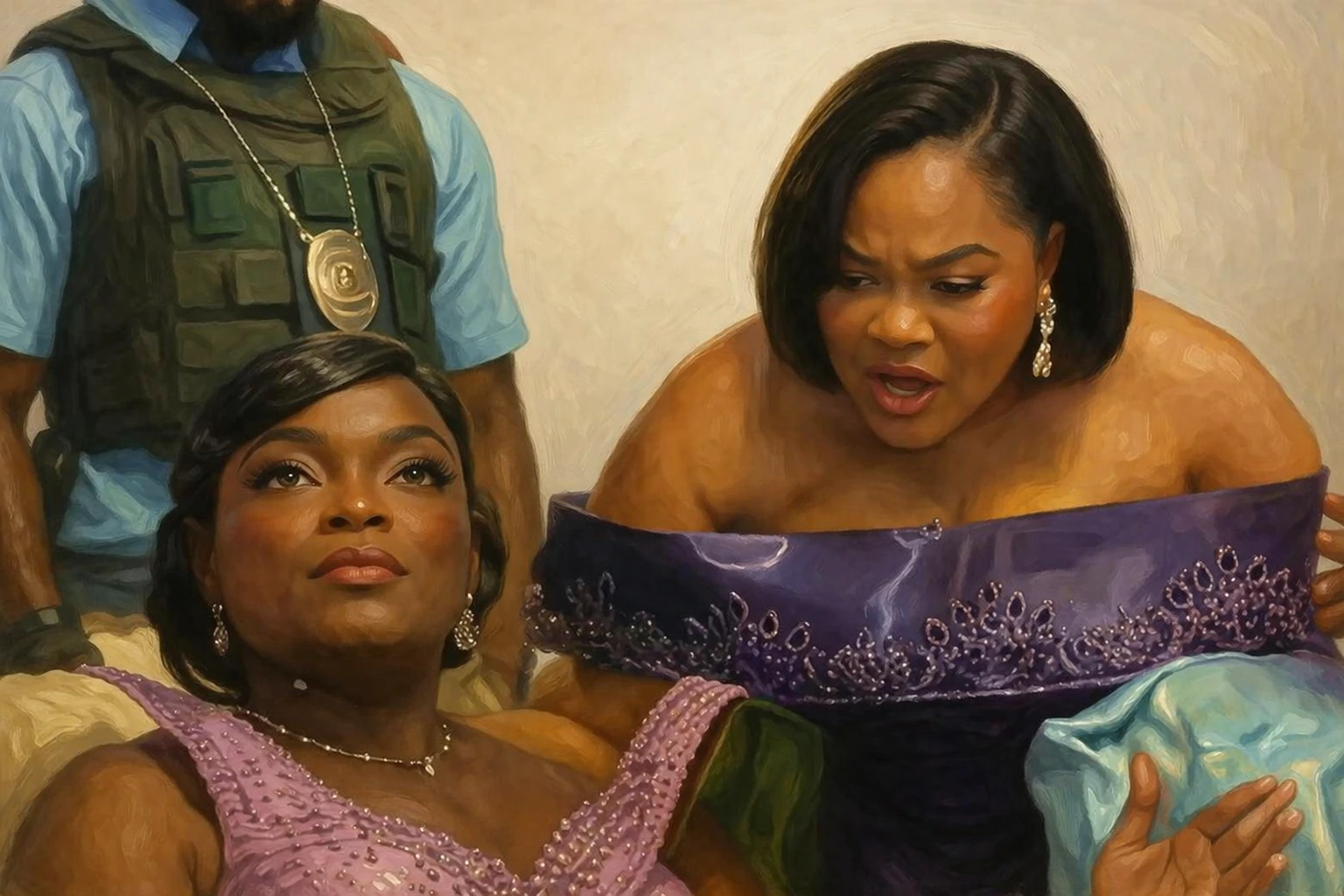
On a Wednesday evening in December 2025, across fourteen cinema locations in Lagos, thousands of Nigerians, in different states, queued for a film called Behind The Scenes.
Within nineteen days of its release, it had crossed the ₦1 billion mark at the box office — the fastest any West African film had ever done it.
The headlines celebrated, the industry toasted, and Funke Akindele, the filmmaker behind the record, posted a quiet “Forever grateful to God” on social media.
Around the same time, on a Sunday afternoon, a film titled Achalugo was being watched on a phone screen by a woman in Kaduna.
She was not buying a ticket. She was not commuting to a cinema. She was watching for free, on YouTube, as she had watched dozens of Nollywood films before.
By the time she pressed play, the film had already been watched 25 million times on Omoni Oboli’s channel — generating millions in advertising revenue for a production that never saw the inside of a cinema at all.

These two scenes, happening simultaneously in the same country, in the same industry, with the same audience, are not in conflict.
They are the business story of Nigerian film in 2026. And understanding both — not choosing between them — is the most important thing anyone with money, creative ambition, or a strategic interest in Nollywood can do right now.
| ₦15.64 billion
Nigeria’s total box office gross in 2025 — a 28% jump from 2024 — even as total cinema admissions remain below 2021 levels. |
THE REVENUE ILLUSION
The Box Office Is Growing. The Audience Is Shrinking. Both Are True.
The headline figures from Nigeria’s cinema industry are genuinely impressive.
Box office gross rose from ₦6.94 billion in 2022 to ₦7.2 billion in 2023, then to ₦11.58 billion in 2024, and climbed further to ₦15.64 billion in 2025.
Revenue more than tripled in four years. If you stopped there, you would conclude that Nigerian cinema is in a golden era.
But stop at the revenue and you miss the more important number: admissions. In 2021, 3.42 million Nigerians went to the cinema.
By 2024, that figure had fallen to roughly 2.6 million. Revenue tripled. The audience shrank. The gap between those two facts is the most honest description of where Nigerian cinema actually stands.
The explanation is not complicated. Average cinema ticket prices in Nigeria have increased by more than 300% since 2018.
A single ticket that cost ₦1,287 that year now costs over ₦5,900 in some markets.
By December 2024, the average ticket had risen 45% in a single year alone — the sharpest annual increase on record. A family of four that paid ₦16,076 for a cinema outing in 2024 faced a bill of ₦21,796 by late 2025.
For context, that additional cost represents approximately a week’s minimum wage for millions of Nigerians.
The industry is not losing money. It is losing people. And there is a meaningful difference.
| “Total box office revenue has more than tripled since 2021. In that same period, cinema admissions have fallen from 3.42 million to 2.80 million. The market is earning far more from far fewer people.”
— FilmOne Entertainment, 2025 Nigeria Box Office Yearbook |
When an industry prices out its mass-market audience and survives on a premium segment, two things happen. First, the industry looks healthier than it is, because revenue metrics flatter the reality.
Second, the industry becomes dangerously dependent on a small pool of high-spending consumers in a small number of locations.
Nigeria’s cinema infrastructure tells exactly that story. Lagos generated ₤5.8 billion at the box office in 2024 — more than every other region in the country combined.
The North-East of Nigeria, a zone of tens of millions of people, contributed ₤2.4 million.
Not billion. Million. Less than 0.05% of the national total. As of 2024, the country of 220 million people had 102 cinema locations and 333 screens.
For comparison, the United States sold 849 million cinema tickets in 2023 — from a population only 50% larger than Nigeria’s. India sold over 981 million.
Nigeria, in a strong year, sells around 2.6 million. Only 1.16% of Nigerians saw a film in the cinema in 2023.
The infrastructure problem and the affordability problem are not separate issues. They are the same issue wearing two faces.
THE ECONOMY FACTOR
When the Naira Collapses, the Cinema Queue Thins.
No analysis of Nollywood’s distribution landscape survives contact with economic reality if it ignores what happened to Nigeria between June 2023 and January 2024.
The naira fell from ₤450 to the dollar to ₤1,600 — a 230% devaluation within seven months.
Fuel subsidies were simultaneously removed, causing petrol prices to triple overnight. Food inflation approached 40%. Inflation generally peaked above 35%.
Families across the country, particularly in the low- and middle-income brackets that represent the mass cinema audience, began making triage decisions about spending. Food first.
Transport second. Everything else: renegotiated. Cinema, for most Nigerians outside Lagos Island, became a luxury consideration that lost the negotiation.
This is not speculation. The admissions data says it plainly. In Q1 2024, even as box office revenue jumped 46% year-on-year due to higher ticket prices, cinema admissions fell 4%.
Cinemas were charging more and drawing fewer people. The people who remained were, by definition, those who could afford the new prices.
The mass audience — the same audience that bought one million VCD copies of The Maidens in a single week in 2010 — did not disappear. They found somewhere else to watch.
| 1.16%
The share of Nigeria’s population that saw a cinema film in 2023 — compared to a 249% patronage rate in the United States the same year. |
That somewhere else has a name. It is called YouTube.
And understanding the flight to YouTube as an economic response, not merely a creative or technological one, is the key to understanding why it has happened so fast and so comprehensively in the Nigerian market specifically.
THE YOUTUBE ECONOMY
Free at the Point of Consumption. Profitable at the Point of Upload.
The shift of Nollywood talent to YouTube is, in business terms, entirely rational.
The argument is not complicated: the traditional distribution system was built on physical media that pirates destroyed, replaced by a cinema infrastructure that serves under 2% of the population and a streaming landscape where Netflix has roughly 169,000 subscribers in a country of 220 million people — a penetration rate so low it barely registers.
Amazon and Netflix, once aggressive buyers of Nollywood content, have both scaled back acquisition budgets. DStv and GOtv have increased subscription prices multiple times.
The formal distribution ecosystem is contracting precisely when production has become cheaper and more accessible.
YouTube sits at the other end of that equation. It requires no distribution deal, no theatrical booking, no minimum production standard, no subscription from the viewer, and no gatekeeping intermediary.
It pays directly, based on views, and the creator retains full ownership of the content.
For an actress-turned-producer shooting a three-day film in a Lekki service apartment with a mid-range camera, YouTube is not a compromise. It is the most financially coherent option available.
The economics of the top end of YouTube Nollywood are striking. Omoni Oboli’s channel, launched in December 2023, accumulated 182 million views in roughly eighteen months.
YouTube monetisation calculators put conservative revenue estimates on her channel at between $1,82,000 and $9,10,000 over that period.
A single film, Achalugo, generated an estimated ₤54 million to ₤137 million from views alone. The channel retained full IP ownership. There were no distributors to negotiate with, no marketers to battle, no pirates to fight on the physical market.
| “Nollywood has officially entered its YouTube streaming era. Between 2024 and 2025, some of the most culturally significant Nigerian films did not debut in cinemas or on global streamers — they premiered on YouTube.”
— New Telegraph, 2025 |
Across the landscape, the pattern repeats. Uche Montana’s channel, launched in February 2024, hit 743,000 subscribers and 95 million views from 86 videos in under two years.
Bimbo Ademoye, Toyin Abraham, Maurice Sam, Sandra Okunzuwa — actors who spent their early careers inside a system that paid them poorly and controlled their output — have each built independent digital distribution channels that generate passive income directly proportional to audience interest.
Even Funke Akindele’s FAAN TV, the channel of the filmmaker who simultaneously dominates Nigerian cinema, has accumulated over 335 million views. She is playing both games, and playing both well.
The economic case for YouTube is, at present, difficult to argue with. The business case for the industry’s long-term health is considerably more complicated.
THE CREATIVE COST
When the Algorithm Becomes the Commissioning Editor.
YouTube’s monetisation model rewards consistency of output, algorithmic favourability, and audience retention.
These incentives, in isolation, produce exactly the kind of content that currently dominates Nollywood YouTube: rapid-turnaround love dramas, recycled plotlines, minimal production ambition, and a reliance on recognisable faces in familiar situations.
A film shot in three days and edited in twelve hours can be online by the weekend. If it performs, upload another next week. The machine must be fed.
The platform’s content policies compound the creative ceiling.
YouTube’s community guidelines prohibit graphic violence, explicit content, and material deemed unsuitable for general audiences — restrictions that eliminate entire categories of serious storytelling from the platform entirely.
Crime dramas with realistic consequence, war narratives, psychologically complex adult content, the kind of material that defines prestige cinema in every serious film market in the world — none of it is viable on YouTube without significant sanitisation.
Veteran actor Kanayo O. Kanayo identified the problem precisely in a recent podcast interview: YouTube, he argued, “restricts you from showing what you can do in the technical area.”
The constraints are not merely aesthetic. They are structural. A filmmaker who builds their entire creative and commercial identity around YouTube distribution is, by definition, excluding themselves from the language of international cinema.
No YouTube Nollywood production has ever received a major festival nomination. None has competed at the level of international recognition that films like Lionheart, Mami Wata, or Brotherhood have pursued.
The volume of accessible content is not translating into elevated reputation.
| 2,500+
Films Nollywood produces annually — making it the second-largest film industry in the world by volume. The quality-to-volume ratio remains the industry’s central unresolved tension. |
There is also the matter of market saturation and the economics of attention. When every actor has a YouTube channel and releases films weekly, the laws of scarcity invert.
Star power, which is built on controlled exposure and memorable performances, erodes when audiences see the same faces in the same stories every seven days.
The marketers of the old Nollywood era were exploitative and often corrupt, but they understood one thing clearly: scarcity creates value.
YouTube Nollywood, in its current form, is industriously destroying the scarcity of its own talent.
THE FUNKE AKINDELE PROBLEM
One Filmmaker Is Holding Up a Mirror the Industry Does Not Want to Look Into.
The business story of Nollywood cinema in 2023, 2024, and 2025 is, to an uncomfortable degree, the story of a single person.
Funke Akindele directed and produced four consecutive films that became the highest-grossing Nollywood movies of all time at the time of each release: Omo Ghetto: The Saga in 2020, Battle on Buka Street in 2022, A Tribe Called Judah in 2023 — the first Nigerian film to cross ₦1 billion — Everybody Loves Jenifa in 2024, which ultimately grossed ₤1.88 billion, and Behind The Scenes in 2025, which reached 1 billion in just seventeen days.
Her combined box office total exceeds ₦4.7 billion. No other filmmaker in Nigerian history comes close.
The industry correctly celebrates this.
But a question sits beneath the celebration that serious industry observers are beginning to ask more openly: what happens to Nigerian cinema’s headline numbers in the years when Akindele does not release a December film?
The admissions data outside her release windows already provides a partial answer.
The industry is not growing a broad base of reliable, returning cinema-goers. It is growing a narrow base of Funke Akindele fans who come out for her films and return home.
That is a franchise business, not an industry ecosystem.
| “She has produced and directed the four highest-grossing Nollywood films of all time, with a combined gross exceeding ₤4.7 billion. No other filmmaker in Nigerian history is close.”
— YNaija Nollywood Film 100, 2026 |
The parallel with the international streaming landscape is instructive.
Netflix built its early subscriber growth on a few marquee original series that drove sign-ups.
When those shows ended, churn increased sharply.
The platform learned the hard way that dependency on a small number of tent-pole properties is not a sustainable content strategy. Nollywood’s cinema sector is relearning the same lesson in real time.
The path to a healthy theatrical market runs through a pipeline of multiple compelling releases per year, not through one filmmaker’s annual masterwork.
To her credit, Akindele appears to understand this more clearly than most.
Through her Funke Akindele Network and associated film academies, she is actively investing in developing new talent — young writers, directors, and performers who feature in her YouTube productions as part of a structured training and debut pipeline.
It is both a business strategy and an industry responsibility. The question is whether enough other established filmmakers are doing the same.
THE WAY FORWARD
What the Industry Needs to Build Before the Next Platform Displaces YouTube.
The strategic error that Nollywood cannot afford to repeat is the one it made with VCDs, DVDs, and the physical distribution era: building a business model so dependent on a single distribution channel that when the channel shifts, the business collapses.
The marketers of the 1990s and 2000s owned the distribution chain so completely that when piracy and the internet dismantled it, they had nothing.
A generation of Nollywood’s financial infrastructure was wiped out in under a decade.
YouTube is not permanent. Algorithms change, policies tighten, platform dynamics shift, and new entrants with different business models — short-form, AI-generated, interactive — will eventually compete for the same attention.
Channels can be demonetised.
Content can be removed. The filmmaker who builds their entire business inside YouTube’s ecosystem is a tenant, not an owner. The asset they are building belongs, ultimately, to a platform headquartered in California.
What the Nollywood business community needs to build, urgently and deliberately, are the things YouTube cannot provide: a sustainable theatrical infrastructure outside Lagos; an audience development programme that makes cinema-going a regular cultural habit rather than a December event; a pricing strategy that does not progressively exclude the majority of the country’s population; and a content quality framework that uses the revenue generated by YouTube’s accessibility to finance the kind of storytelling that builds international reputation.
| ₦20 billion
The box office total Nigerian cinema is projected to cross by the end of 2026, according to the West Africa Box Office Year Book — contingent on sustained audience growth and disciplined release strategies. |
The two-tier model that has already emerged — cinematic Nollywood for the theatrical audience and YouTube Nollywood for the mass digital audience — is not inherently a problem.
Every mature film market in the world operates on multiple distribution tiers simultaneously.
Hollywood makes IMAX blockbusters and streaming originals. Bollywood fills 6,000-seat multiplexes and uploads to YouTube within weeks of theatrical release.
The issue is not which tier a filmmaker occupies. The issue is whether the industry is managing the relationship between the tiers strategically, or simply allowing economic pressure to make the decision by default.
Right now, the decision is largely being made by default. The naira devaluation drove producers to YouTube. Ticket price inflation drove audiences away from cinema.
Netflix’s retreat from acquisition left filmmakers without a premium streaming option. These were not industry choices. They were industry responses to forces the industry did not control.
The window to regain control — to use the current YouTube revenue boom to invest in infrastructure, talent development, and content quality before the next disruption arrives — is open right now. It will not remain open indefinitely.
THE BOTTOM LINE
Nigerian cinema is not dead. It is becoming a premium product in an economy where premiums are increasingly unaffordable for the majority.
YouTube Nollywood is not killing the industry. It is filling a distribution vacuum that the industry’s own structural failures created.
The real question — the business question — is whether Nollywood uses this moment of dual growth to build a durable architecture, or whether it celebrates the numbers until the next disruption makes the celebration look premature.
The woman in Kaduna watching Achalugo on her phone and the family queuing at Silverbird for Behind The Scenes are both Nollywood’s audience. An industry that can only monetise one of them is not yet the industry it needs to become.