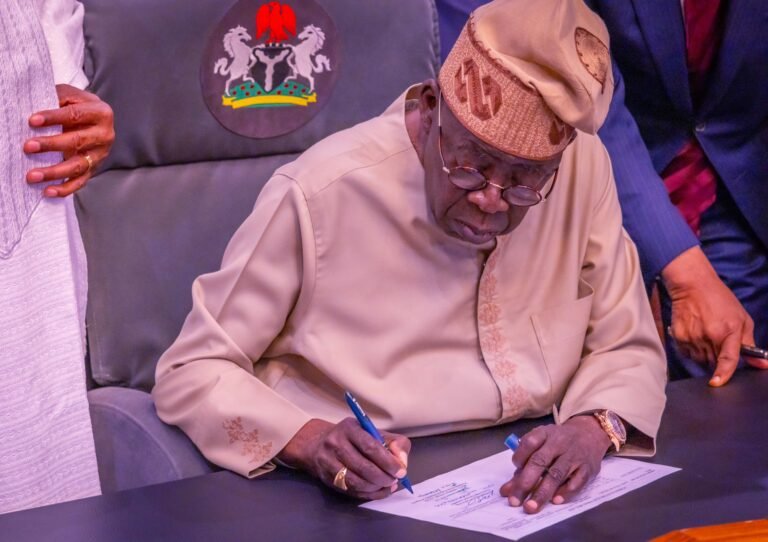
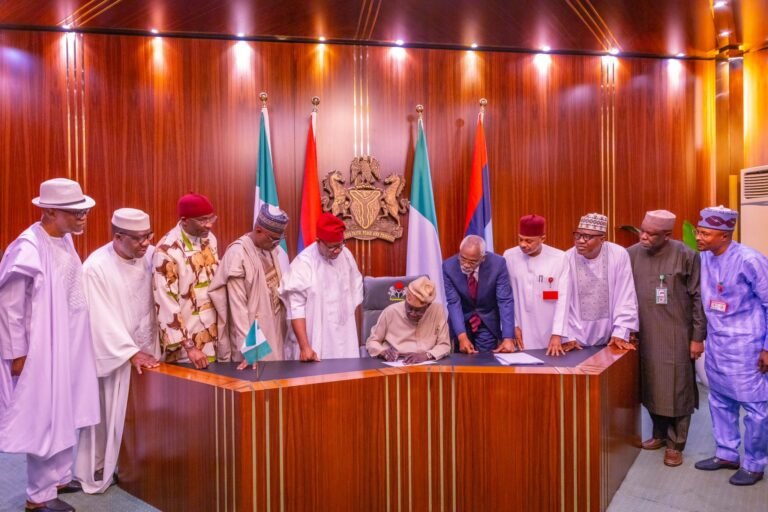
President Bola Ahmed Tinubu has signed an Executive Order directing the immediate remittance of key oil and gas revenues to the Federation Account, a sweeping intervention designed to curb statutory leakages, eliminate duplicative deductions, and reinforce fiscal transparency in Nigeria’s petroleum sector.
The directive, issued pursuant to Section 5 of the 1999 Constitution (as amended) and anchored on Section 44(3), reasserts federal ownership and control over mineral resources and seeks to restore what the administration describes as constitutionally due revenues to the Federal, State, and Local Governments.
At the centre of the order is a fundamental restructuring of the remittance architecture created under the Petroleum Industry Act (PIA), which the Presidency argues has allowed substantial portions of oil income to be retained or diverted through layered deductions.
Suspension of 30% Management Fee
Under the current framework, NNPC Limited retains 30 per cent of Profit Oil and Profit Gas derived from Production Sharing Contracts (PSCs), Profit Sharing Contracts, and Risk Service Contracts as a management fee. In addition, the company retains 20 per cent of its profits for working capital and future investments.
The Executive Order suspends the 30 per cent management fee on Profit Oil and Profit Gas, arguing that the existing 20 per cent profit retention already provides sufficient financial support for NNPC Limited’s commercial operations.
Going forward, NNPC Limited is required to transfer all Profit Oil and Profit Gas it receives in its capacity as concessionaire or government representative directly to the Federation Account.
Frontier Exploration Fund Halted
The President also suspended NNPC Limited from collecting and managing the 30 per cent Frontier Exploration Fund established under Sections 9(4) and (5) of the PIA.
Previously, 30 per cent of profit oil and gas from PSCs and related contracts was earmarked for frontier basin exploration. The administration contends that allocating such a significant share of revenues to speculative exploration risks creating idle balances and inefficient capital deployment at a time of fiscal strain.
Under the new order, the 30 per cent previously channelled into the Frontier Exploration Fund will instead accrue directly to the Federation Account.
Direct Payment by Operators
Effective February 13, 2026, all operators and contractors under Production Sharing Contracts are required to remit Royalty Oil, Tax Oil, Profit Oil, Profit Gas, and any other government entitlements directly to the Federation Account.
This provision removes intermediary collection structures and seeks to reduce opacity in revenue flows, a longstanding concern in Nigeria’s petroleum governance architecture.
Gas Flare Penalty Redirection
The Executive Order further suspends payments of Gas Flare Penalties into the Midstream and Downstream Gas Infrastructure Fund (MDGIF) created under Section 52(7)(d) of the PIA.
Instead, proceeds from gas flare penalties imposed by the Nigerian Upstream Petroleum Regulatory Commission (NUPRC) will now be paid directly into the Federation Account.
The Presidency argues that the MDGIF duplicates the Environmental Remediation Fund already established under Section 103 of the PIA, which is specifically designed to address environmental rehabilitation in impacted communities.
All MDGIF expenditures will henceforth comply strictly with public procurement laws.
Structural Concerns Over NNPC’s Dual Role
Beyond fiscal leakages, the order identifies structural distortions arising from NNPC Limited’s dual position as both concessionaire under PSCs and commercial operator. The existing framework allows the company to influence operating costs while simultaneously functioning as a market participant.
The administration maintains that this duality undermines NNPC Limited’s transition into a fully commercial enterprise, as envisioned under the PIA.
The Executive Order introduces measures to clarify roles, enhance transparency, and reposition NNPC strictly as a commercial entity rather than a quasi-fiscal collector.
Implementation and Review
President Tinubu has constituted an Implementation Committee comprising the Minister of Finance and Coordinating Minister of the Economy, the Attorney-General of the Federation, the Minister of Budget and National Planning, the Minister of State for Petroleum Resources (Oil), the Chairman of the Nigeria Revenue Service, the Special Adviser on Energy, and the Director-General of the Budget Office, who will serve as Secretary.
A joint project team will also be established to coordinate integrated upstream and midstream petroleum operations, with the regulator serving as interface with licensees and lessees.
The Presidency confirmed that a comprehensive review of the Petroleum Industry Act will follow, aimed at addressing fiscal and structural anomalies identified since the law’s enactment in 2021.
Fiscal and Market Implications
The Executive Order signals an assertive attempt to increase immediate Federation inflows amid ongoing pressures on debt sustainability and national budgeting. By redirecting management fees, frontier allocations, and gas flare penalties to the Federation Account, the government expects a significant uplift in distributable oil revenues to subnational governments.

However, the move is likely to trigger debate within the petroleum industry over contractual sanctity, regulatory certainty, and the long-term investment climate — particularly as Nigeria competes for upstream capital in a tightening global energy market.
For an administration focused on fiscal consolidation and economic stabilisation, the measure marks one of the most consequential interventions in Nigeria’s petroleum revenue architecture since the passage of the PIA.