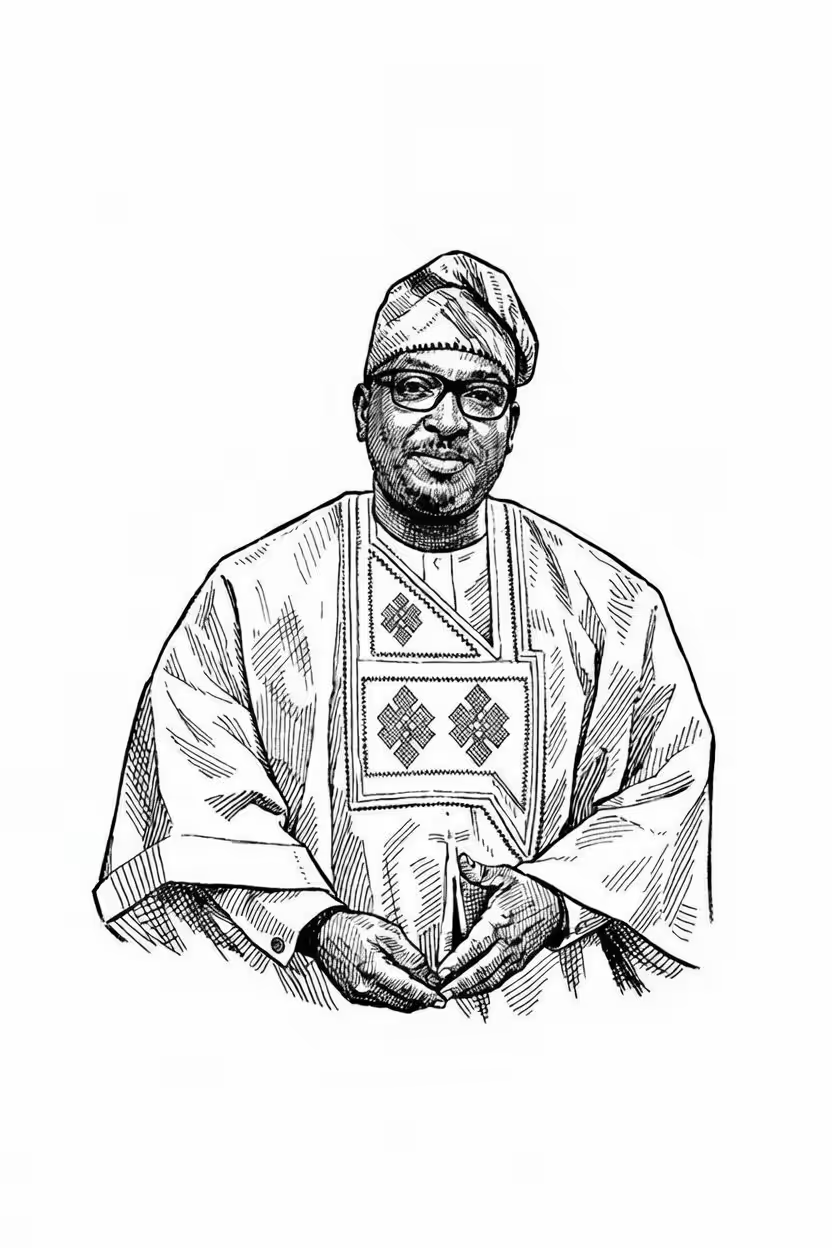
The Academic Staff Union of Universities (ASUU) has issued a detailed update on its ongoing renegotiation of the 2009 ASUU–FG agreement, outlining major progress in university funding, autonomy, staff welfare and research development.
The update, signed by ASUU President Professor Christopher Piwuna, confirms that both sides have reached several critical resolutions aimed at restoring stability and improving standards across Nigerian universities.
University Autonomy Strengthened
ASUU and the Federal Government agreed that Nigerian universities must operate with full autonomy, guided strictly by existing university laws governing the Senate, Governing Councils and internal processes.
Any government circular that contradicts these laws will no longer be used.
Additional governance reforms include:
- Appointment of vice-chancellors strictly on merit.
- Governing Council members must be individuals of proven integrity and administrative experience.
- Departments will elect their heads, while deans, sub-deans and provosts will also be selected internally.
- Recruitment of staff and students must promote national and international diversity.
Statutory bodies such as the Senate and Congregation will continue to operate according to law.
Improved Funding, Budgeting and Research Support
A new university budgeting template was approved to ensure adequate funding for both operational and capital needs.
The Federal Government also committed to:
- Making universities benefit from the National Research Council,
- Encouraging private sector sponsorship of research and development,
- Protecting university lands, and
- Introducing new education-focused taxes to ensure sustainable funding.
Universities will now be allowed to import books, laboratory equipment, journals, teaching materials and renewable energy devices without paying import duties.
Promotion, Salaries and Academic Staff Welfare
ASUU confirmed the removal of the controversial pyramidal promotion structure, which tied promotions to available vacancies. Promotions will now be based purely on research productivity and academic performance.
The union also secured:
- Automatic salary adjustments whenever public-sector salaries increase,
- Annual payment of Earned Academic Allowances (EAA) set at 12% of each university’s academic wage bill,
- Inclusion of EAA in national budgets.
Although ASUU initially rejected the government’s salary proposal, it later accepted a revised structure similar to the Nimi Briggs Committee recommendation to avoid further delays.
Implementation and Monitoring Structures
To guarantee full compliance with the renegotiated agreement:

- A monitoring unit will be established at the National Universities Commission (NUC),
- An implementation committee will oversee enforcement,
- Relevant laws will be amended where necessary,
- The entire agreement will be reviewed every three years.
Universities were also directed to refocus their pre-degree programmes on science and low-enrolment courses, while fully respecting students’ rights to peaceful assembly.
ASUU further secured a clause ensuring that no union member or government representative involved in the negotiation will be victimized.