The African Export-Import Bank (Afreximbank) has reaffirmed its role as a cornerstone financier of African industrialisation, announcing support for Dangote Group’s ambitious plan to scale annual revenues to $100 billion by 2030.
At the centre of this push is a capital-intensive expansion strategy—“Vision 2030: Supercharging Dangote Group for Long Term Success”—which was presented to Afreximbank’s Board and executive team in Cairo. The plan outlines a two-phase growth trajectory spanning 2025–2028 and 2028–2030, targeting a significant scale-up across refining, fertiliser, cement, and new infrastructure-linked sectors.
$40bn Investment Drive Anchors Industrial Scale-Up
Dangote Group estimates it will require at least $40 billion in new investments over the next five years to execute its continental expansion agenda. The scale reflects not just capacity growth, but a structural shift towards vertically integrated, export-oriented industrial platforms.
A key pillar is the expansion of the Dangote Petroleum Refinery in Lagos from 650,000 barrels per day (bpd) to 1.4 million bpd—effectively positioning it among the largest refining hubs globally. In parallel, the Group plans to quadruple fertiliser output from 3 million tonnes annually to 12 million tonnes, potentially making it the world’s largest urea producer.
Beyond core assets, the strategy extends into high-impact sectors: ports and pipelines to strengthen logistics, gas and power to underpin industrial energy needs, mining for value-added exports, and data centres to support Africa’s digital infrastructure.
Afreximbank Deepens Strategic Financing Role
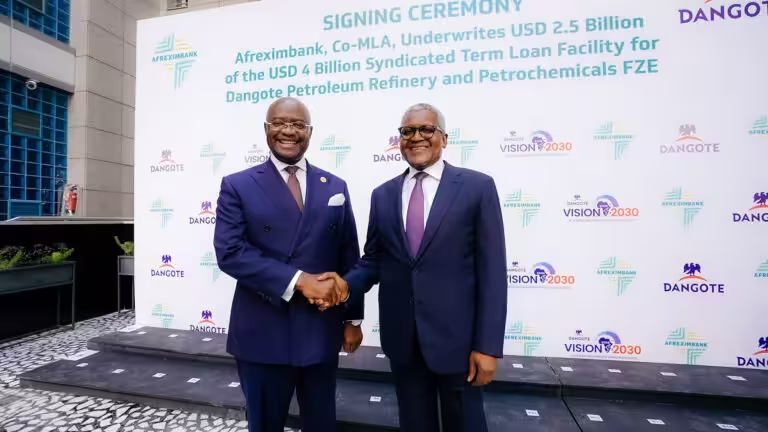
Reinforcing its commitment, Afreximbank is underwriting a $2.5 billion facility as part of a broader $4 billion syndicated senior term loan for Dangote Petroleum Refinery and Petrochemicals FZE. The financing underscores the bank’s continued positioning as a development-oriented lender willing to back large-scale African industrial projects.
Speaking on the partnership, Aliko Dangote described Afreximbank as a long-standing strategic ally, noting that the bank supported the refinery project at a time when global investors were sceptical. He framed the relationship as one anchored in a shared objective: reducing Africa’s dependence on imports while building domestic industrial capacity.
For Afreximbank, the transaction aligns with its institutional mandate. Its President, George Elombi, emphasised the urgency of scaling local production capacity in a global environment increasingly defined by protectionism and supply chain fragmentation.
Afreximbank’s Track Record in Financing Dangote and Nigeria’s Energy Transition
The latest facility builds on a long-standing financing relationship between African Export-Import Bank and Dangote Group, particularly in Nigeria’s energy and industrial sectors. Afreximbank has been one of the most consistent African-led financiers of the Dangote Petroleum Refinery, contributing several billion dollars across different tranches of debt financing alongside a syndicate of regional and international lenders.
Its involvement has been critical not just in providing capital, but in crowding in additional financing—de-risking the project sufficiently to attract commercial banks, export credit agencies, and institutional investors. In effect, Afreximbank has functioned as both lender and anchor institution, signalling confidence in what has been one of Africa’s most ambitious private-sector infrastructure projects.
Beyond Dangote, Afreximbank has played a broader role in Nigeria’s energy ecosystem. The bank has financed petroleum product import substitution programmes, supported trade finance for refined products, and backed initiatives aimed at strengthening intra-African energy trade under the African Continental Free Trade Area (AfCFTA) framework. Its interventions have also extended to supporting gas monetisation efforts and infrastructure linked to industrial energy use—areas seen as critical to Nigeria’s long-term competitiveness.
Notably, Afreximbank has increasingly positioned itself as a counter-cyclical lender in Africa’s energy markets—stepping in at moments when global capital has been more cautious, particularly around large hydrocarbon projects. This approach has been evident in its sustained support for refinery development, a segment that many international financiers had historically avoided due to scale, execution, and policy risks.

Industrialisation as Strategic Imperative
Elombi referenced lessons from the COVID-19 pandemic, when African economies struggled to access basic protective equipment despite available financing—highlighting structural vulnerabilities tied to limited manufacturing capacity.
The Dangote expansion plan, in this context, is positioned not merely as a corporate growth strategy but as part of a broader continental push toward industrial sovereignty. Afreximbank’s backing signals a deliberate effort to catalyse large-scale, African-owned industrial platforms capable of competing globally.