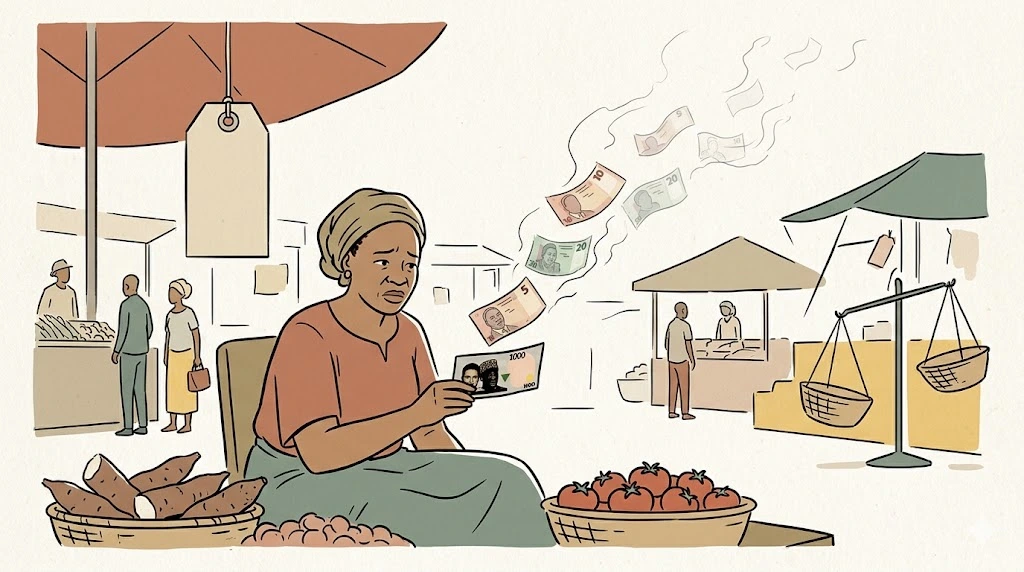
There was a time when you could hold the entire breadth of Nigeria’s economy in your palm — coins of 50 kobo and one naira, notes for five, ten, twenty. Change was change. Money was money. Today, you’d be hard-pressed to find a market stall that accepts a ₦5 note. Many traders don’t even stock ₦10 or ₦20. Ask for change with a ₦50 note and you might get a shrug. Nigeria’s lower denominations are, for all practical purposes, extinct. This isn’t dramatic. It’s quiet. And that’s what makes it alarming. The informal death of a denomination. No government announcement was made. No ceremony was held.
The ₦5 note — featuring Sir Abubakar Tafawa Balewa, Nigeria’s first prime minister — did not cease to be legal tender. It simply became useless. You cannot buy sachet water with it. You cannot pay a bus fare. In most of Lagos, Abuja, Port Harcourt, you cannot buy the smallest pack of biscuit with N5. It is a denomination that still “exists on paper” but since it cannot purchase anything, it has effectively ceased to exist.
“Nigeria is undergoing an informal redenomination — driven not by policy, but by the daily mathematics of survival.“
Economists call this “stealth redenomination.” In most countries, redenomination is formal: governments remove zeros, reprint notes, adjust wages. Nigeria has done none of that. Instead, the market has done it for them — silently, ruthlessly, and without compensation to the impoverished who hold the most small-denomination cash.
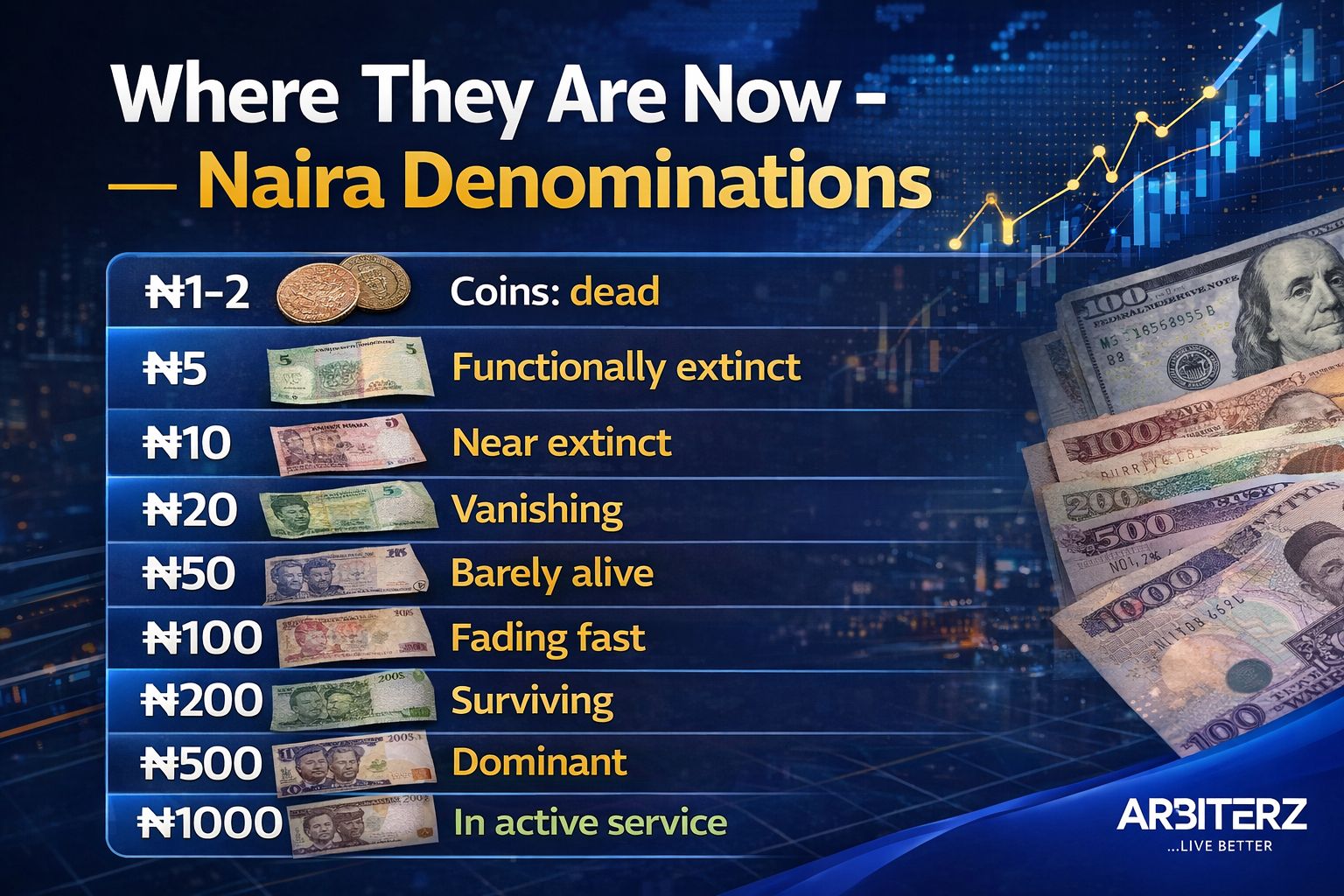
Where They Are Now- Naira Dominations
The numbers behind the collapse
To understand how we got here, follow the naira’s exchange rate. When the naira was introduced in 1973, one naira was worth more than one US dollar. By 2023, the Central Bank abandoned its currency peg and the naira fell to ₦600 per dollar — a single-day loss of 23%. By early 2024, it had collapsed further to ₦1,400. As of early 2026, it trades around ₦1,356 to the dollar.
The purchasing power of a ₦5 note is now so small it is mathematically closer to zero than to anything useful.
The ₦100 is the new ₦5
There is a pattern here that Nigerians recognise instinctively even if they have never named it. The denomination that once served everyday transactions gets hollowed out by inflation until it is worthless.
Then the next one up takes its place — briefly. Then that one falls too. The ₦5 replaced the kobo. The ₦50 replaced the ₦5. The ₦200 replaced the ₦100. And now, the ₦100 — the note that once bought you a full meal in a roadside buka — barely covers a small sachet of water in some states.
The question Nigerians are now whispering is not whether the ₦100 will go. It’s how long before the ₦200 follows. If the pattern continues unchecked, Nigeria will be left with a currency system anchored entirely by ₦500 and ₦1,000 notes — and possibly a new higher denomination. This is not hypothetical. Zimbabwe printed a hundred-trillion-dollar note.
Venezuela has redenominated multiple times in a decade.
The difference is those countries acknowledged what was happening. Nigeria, so far, has not. The consequences fall hardest on the impoverished. Informal traders, market women, okada riders, and day labourers deal primarily in small cash. When the smallest usable denomination is ₦500, every transaction becomes blunt — merchants round up, buyers overpay, and the friction cost is borne entirely by those with the least margin to absorb it.
“Every time a denomination dies, the poor pay the funeral costs.”
What the government should — and hasn’t — done
Proposals for formal naira redenomination are not new. A 2008 proposal would have removed two zeros from the currency, converting ₦100 into ₦1. It was shelved. Since then, Nigeria has focused on exchange rate policy, banking reforms, and currency redesigns — but has not addressed the structural collapse of its lower denominations. The Central Bank of Nigeria’s 2022–23 currency redesign exercise was chaotic, legally challenged, and ultimately failed to solve the underlying problem: the naira is losing value faster than new notes can replace old ones.
What is needed is honest acknowledgment that Nigeria is undergoing de facto redenomination already — just in the worst possible way, without coordination or compensation.

A formal redenomination, combined with credible monetary policy and inflation control, would at minimum give Nigerians clarity about what their money is worth.
Is Nigeria getting better?
The disappearance of small naira denominations is not a sign of progress. It is the fingerprint of sustained inflation on the body of a currency. When a nation’s smallest note cannot buy its cheapest product, it is not a sign that everyone has grown wealthy. It is a sign that money has been allowed to quietly rot. Nigeria deserves a currency that works at every level of its economy — from the ₦50 biscuit to the ₦500,000 land transfer. Right now, it does not have one. And until policymakers treat the death of small denominations with the urgency it deserves, Nigerians will keep watching their money vanish — one note at a time.