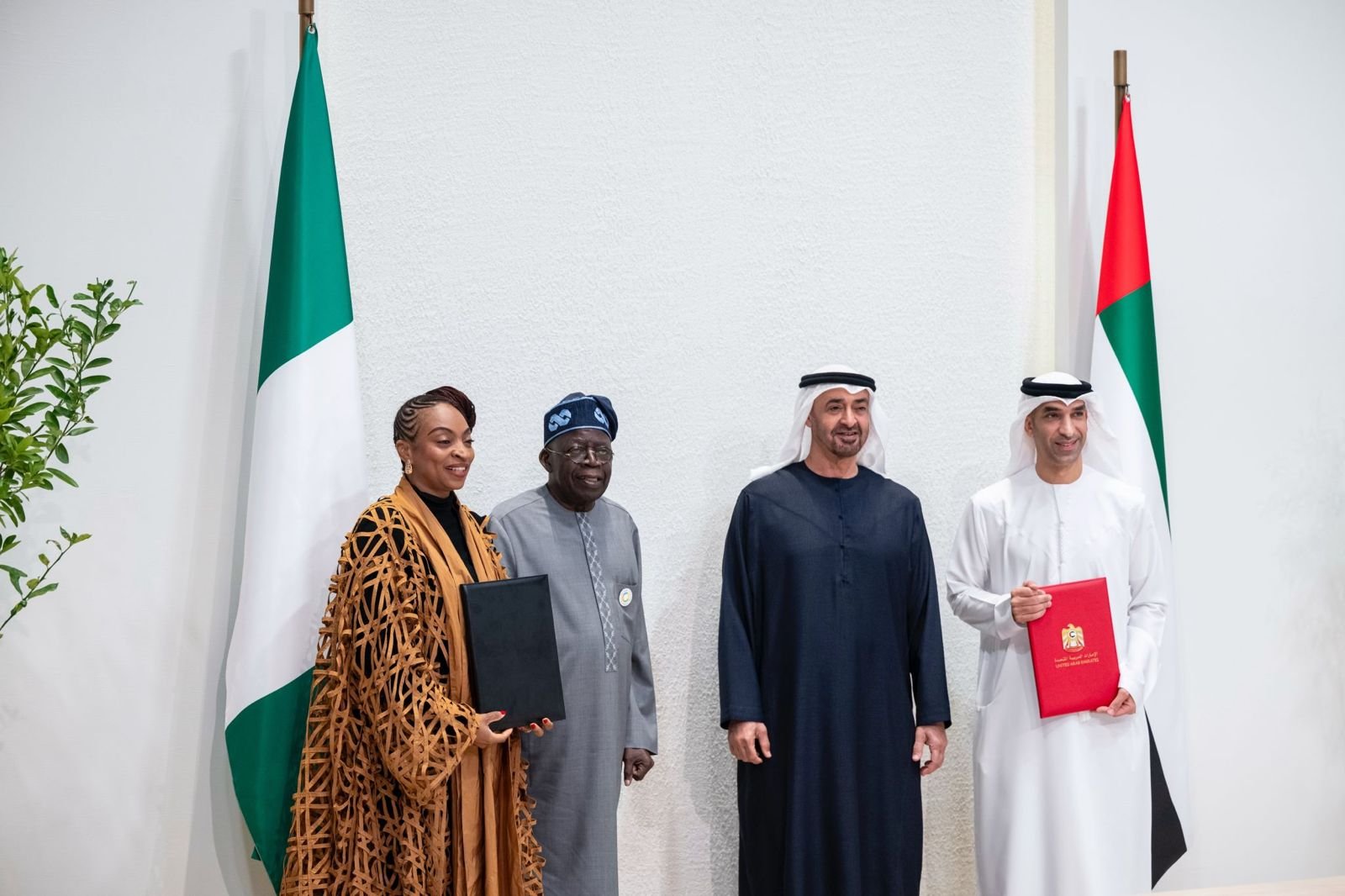
Nigeria and the United Arab Emirates (UAE) on Tuesday signed a Comprehensive Economic Partnership Agreement (CEPA) that significantly expands market access for Nigerian goods, services, and professionals, while reinforcing Nigeria’s ambition to position itself as a gateway for global investment into West Africa and the African Continental Free Trade Area.
The agreement was signed on 13 January 2026 by Jumoke Oduwole, Nigeria’s Minister of Industry, Trade and Investment, and Thani bin Ahmed Al Zeyoudi, UAE Minister of Foreign Trade, in the presence of President Bola Ahmed Tinubu of Nigeria and President Mohamed bin Zayed Al Nahyan of the UAE.
According to an official Information Note issued by the Federal Ministry of Industry, Trade and Investment, the CEPA is designed to accelerate non-oil exports, attract high-quality foreign direct investment, and generate employment—particularly for Nigeria’s youthful population—while remaining fully aligned with Nigeria’s obligations under the World Trade Organization (WTO), the African Continental Free Trade Area (AfCFTA), and ECOWAS.
Tariffs Scrapped Across Thousands of Products
Under the trade-in-goods pillar, the UAE will eliminate tariffs on 7,315 Nigerian products, while Nigeria will liberalise 6,243 products for UAE imports. A substantial proportion of these tariff eliminations take effect immediately, with the remainder phased in over three to five years.
For Nigerian exporters, the agreement opens the UAE market to a broad range of agricultural commodities and manufactured goods, including seafood, cereals, oilseeds, fruits, pharmaceuticals, chemicals, paper products, apparel, footwear, furniture, ceramics, and glass. The inclusion of value-added industrial products underscores Nigeria’s strategy to diversify exports beyond crude oil.
Nigeria, in turn, grants enhanced access to UAE industrial inputs and capital goods such as machinery, vehicles, electrical equipment, plastics, iron, and steel—supporting domestic manufacturing, infrastructure development, and supply-chain efficiency. Sensitive items on Nigeria’s import prohibition list remain excluded, preserving policy space for local industries.
Deep Opening in Services and Professional Mobility
Beyond goods, the CEPA delivers one of Nigeria’s most expansive services-trade openings to date. Nigeria has scheduled commitments covering 99 specific services across 10 sectors, while the UAE’s commitments span 108 services across 11 sectors.
Nigerian firms will be permitted to establish commercial presence in the UAE through subsidiaries, branches, and representative offices. Business visitors from Nigeria may enter the UAE for up to 90 days within a 12-month period, while intra-corporate transferees—managers, executives, and specialists—may reside for renewable three-year periods.
Priority service sectors include tourism and hospitality, creative industries and media, professional services such as accounting, engineering, architecture, and consulting, financial services operating within designated financial centres, and technology-enabled services including software development.
Strategic Signal to Global Investors
The Federal Ministry of Industry, Trade and Investment said the agreement removes long-standing impediments to trade and investment flows between both countries and strengthens Nigeria’s role as a preferred entry point for investors targeting ECOWAS and AfCFTA markets.
Implementation of the CEPA will involve coordinated action by multiple government agencies, including the Nigeria Customs Service, the Nigerian Export Promotion Council, and the Nigerian Investment Promotion Commission, to ensure businesses can fully leverage the opportunities created.

In a direct message to the private sector, Nigerian negotiators emphasised that the agreement was structured to give businesses confidence to scale into the UAE market, supported by clear rules of origin, predictable market access, and legal protections.
With tariffs dismantled across thousands of products and unprecedented access secured in services, the Nigeria–UAE CEPA ranks among the most consequential trade agreements Nigeria has signed in recent years—signalling a more assertive integration of Africa’s largest economy into global trade and investment flows.