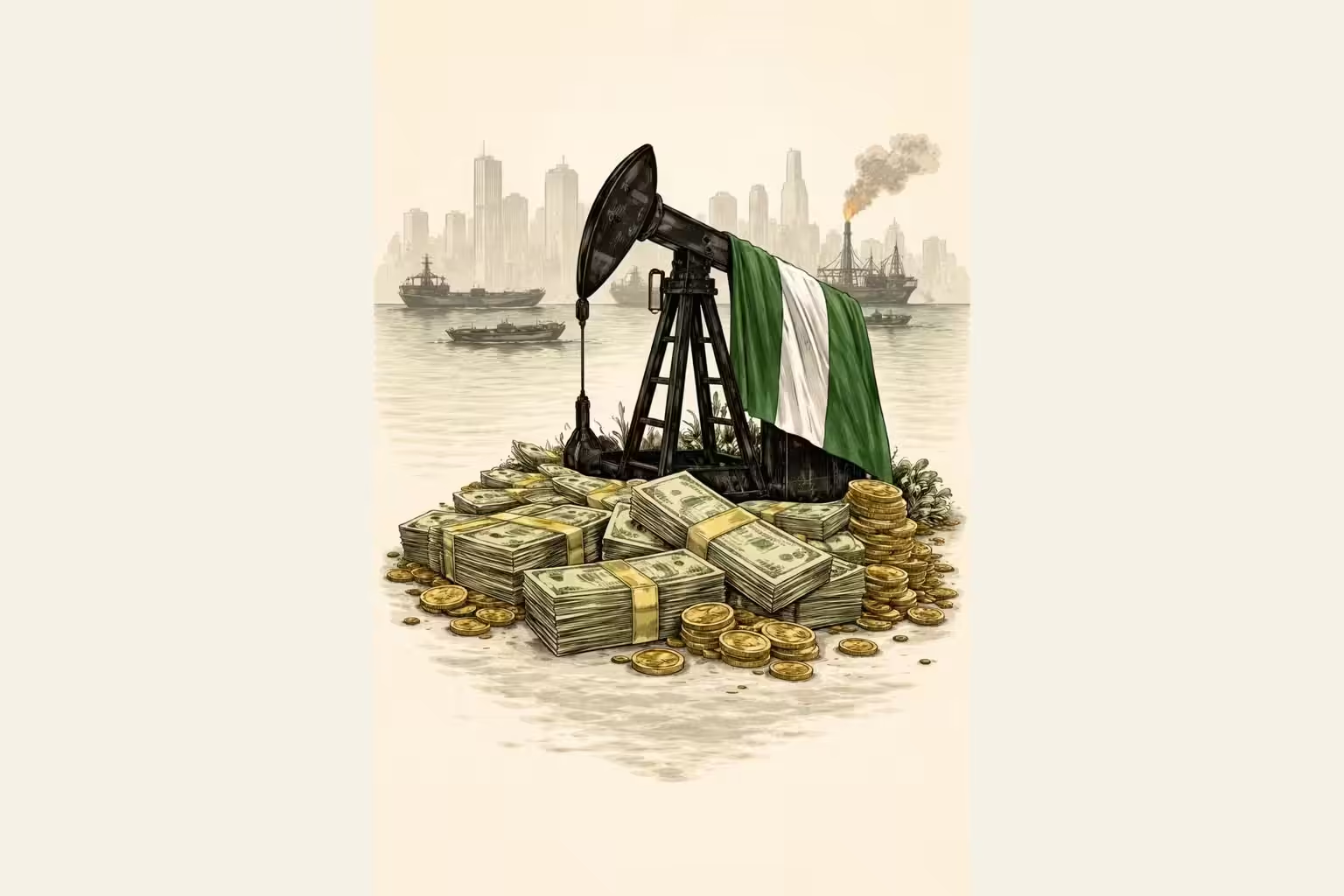
Nigeria’s 2026 budget assumes oil at $64.85 per barrel. If crude rises toward $100 amid escalating tensions involving Iran, the country could see tens of billions in additional export earnings—though production constraints mean the fiscal windfall may fall short of its theoretical potential.
In Abuja’s fiscal calculations, oil is not merely another commodity price. It is the hinge on which the country’s public finances turn. Nigeria’s 2026 federal budget of roughly ₦58 trillion rests on three key assumptions: an oil benchmark of $64.85 per barrel, production of 1.84 million barrels per day, and an exchange rate of ₦1,400 to the dollar. These parameters shape everything from federal borrowing plans to the monthly allocations shared by Nigeria’s federal, state and local governments.
The assumptions reflect deliberate caution. Oil markets have been volatile for years, swinging between pandemic-era collapse and geopolitical spikes. Yet geopolitical shocks can swiftly rewrite fiscal arithmetic. Should crude prices climb toward $100 per barrel and remain there for several months, as traders increasingly fear amid the deepening confrontation between the United States and Iran, Nigeria’s revenue outlook could shift dramatically.
The arithmetic of a $100 oil scenario
The mathematics of such a shift is straightforward. The difference between the budget benchmark of $64.85 and a market price of $100 amounts to $35.15 per barrel. If Nigeria were producing at its budget target of 1.84 million barrels per day, that gap would translate into approximately $64.7 million in additional export value each day.
Over a full year, the uplift would amount to roughly $23.6 billion beyond the revenue implied by the budget benchmark.
At the government’s production assumption of 1.84 million barrels per day, Nigeria would produce roughly 671 million barrels annually. At the budget benchmark price of $64.85, those barrels would generate approximately $43.5 billion in gross export value.
At $100 per barrel, however, annual export earnings would rise to about $67 billion. The difference—roughly $23–24 billion—represents the immediate windfall from higher prices alone.
However, geopolitical crises rarely stop neatly at $100. During severe supply shocks oil prices have often moved significantly higher. If crude were to surge further toward $110–$115 per barrel, Nigeria’s annual export earnings at the same production level could reach roughly $74–$77 billion.
Under that scenario, the gap between the conservative assumptions used in Nigeria’s budget and actual market prices could widen to $30–$33 billion, and potentially approach $40 billion if prices moved well beyond $115 during periods of acute geopolitical disruption.
Another way to see the sensitivity is that every $10 increase in global oil prices adds roughly $6–7 billion to Nigeria’s annual export earnings at the government’s benchmark production level.
For a country where oil still generates roughly two-thirds of export earnings and a significant share of government revenue, such shifts in global prices reverberate quickly through fiscal and monetary policy. A surge in oil receipts would ease pressure on Nigeria’s 2026 budget deficit, projected at about ₦23.85 trillion, while boosting the monthly allocations distributed through the Federation Account Allocation Committee (FAAC).
Lessons from the last $100 oil cycle
Nigeria does not need to look far back to see how such dynamics play out. The last time crude prices hovered near or above $100 per barrel was in 2022, when Russia’s invasion of Ukraine triggered a global energy shock and briefly pushed Brent crude above $120 per barrel.
The surge produced an immediate rise in Nigeria’s oil export earnings and strengthened dollar inflows into the economy. External reserves improved during the period, while revenues from petroleum taxes and royalties rose. Monthly FAAC allocations to Nigeria’s states also increased sharply during the months when oil prices remained elevated.
Yet the 2022 episode also exposed the structural fragility of Nigeria’s oil sector. At the time, crude production had collapsed to roughly 1.2 million barrels per day, largely due to oil theft, pipeline vandalism and years of under-investment in upstream infrastructure. As a result, Nigeria captured far less of the global price rally than it might have under normal production conditions.
Several smaller oil exporters with far lower reserves recorded higher export revenues during that period simply because they were producing closer to their capacity.
That structural constraint remains visible today. Nigeria is still producing below the levels assumed in its fiscal projections. Recent industry data indicate total output of roughly 1.6 million barrels per day including condensates, about 200,000 barrels below the government’s budget benchmark.
This gap means that even if oil prices surge, the fiscal windfall will be moderated by limited production capacity.
But It’s Going to Be A windfall with limits
Even so, a sustained rally toward $100 oil would materially improve Nigeria’s finances. Higher export receipts would boost the Federation Account, increase monthly FAAC allocations to states, and strengthen foreign-exchange inflows.
Dollar earnings from crude exports ripple through Nigeria’s financial system, influencing liquidity in the foreign-exchange market and shaping monetary policy decisions by the Central Bank. Stronger oil receipts would likely ease pressure on the naira and help replenish the country’s external reserves.
The geopolitical forces driving such a price spike could, however, complicate the economic picture. A confrontation involving Iran carries particular significance for oil markets because it raises the possibility of disruption in the Strait of Hormuz, the narrow shipping corridor through which roughly one-fifth of the world’s traded oil flows.
Even the perception of risk in that route can add a significant premium to global crude prices.
For Nigeria, the result would be a familiar paradox. Higher crude prices would boost export revenues and government income, but the same geopolitical shock would also raise the cost of imported fuels, shipping and food—adding inflationary pressure to the domestic economy.
Nigeria’s energy landscape is also beginning to change. For decades, despite being Africa’s largest crude producer, the country relied heavily on imports of refined petroleum products because its state-owned refineries operated far below capacity. That structural dependence meant global oil shocks often translated quickly into higher domestic fuel costs even when export revenues were rising.
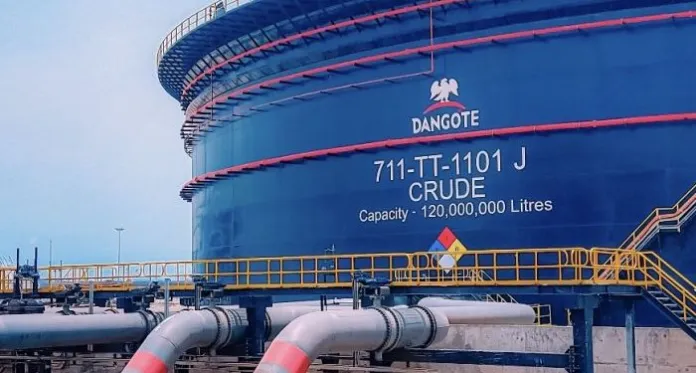
The emergence of the 650,000-barrel-per-day Dangote Refinery, now gradually ramping up operations, has the potential to alter that equation. As the refinery reaches full capacity and begins to supply a larger share of Nigeria’s domestic petrol, diesel and aviation fuel demand, the country could become less exposed to the inflationary impact of global fuel price spikes. In principle, that would allow Nigeria to capture more of the benefits of higher crude prices through export revenues while reducing the domestic cost pressures associated with imported fuels.
Even so, the broader lesson from the past five years remains clear. High oil prices can temporarily transform Nigeria’s fiscal outlook, but the durability of that benefit depends less on price than on production.
When crude surged above $100 per barrel in 2022, Nigeria’s gains were constrained by falling output. Oil theft, pipeline disruptions and under-investment pushed production down to nearly 1.2 million barrels per day, preventing the country from fully capitalising on the global price rally.
If prices rise again in 2026 amid geopolitical tensions, the same structural challenge will determine how much of the windfall ultimately reaches government coffers. Until Nigeria consistently produces near—or above—its budget benchmark of 1.84 million barrels per day, even the most dramatic oil rally will remain an incomplete windfall.