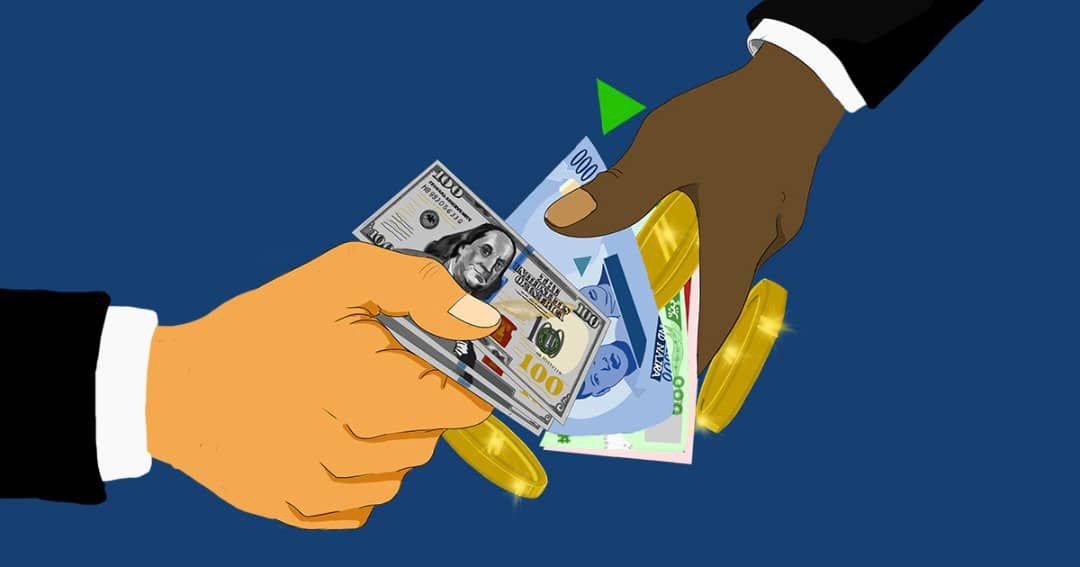
As Nigeria opened the first full trading week of February 2026, the official dollar-to-naira rate remained anchored around ₦1,396–₦1,398 per dollar, but the gap with the parallel market continues to be materially wide, defying narratives that the spread has uniformly narrowed.
Mid-January: Spread Expanded Before February
On January 15, 2026, official market data showed the naira trading around ₦1,422/$ in the Nigerian Foreign Exchange Market (NFEM).
At the same time, Bureau De Change (BDC) operators in the black market were quoting the dollar nearer to ₦1,475–₦1,490/$ — implying a spread of ₦50–₦70 or more, reflecting persistent informal market pressures and elevated retail demand.
Early February: Official Holds, Parallel Still at a Premium
By February 2, 2026, the official window saw the dollar trading around ₦1,396.88/$ midday, consistent with recent official liquidity improvements.
However, the parallel market continues to quote the dollar between ₦1,465 and ₦1,480/$ — maintaining a premium gap of roughly ₦70–₦85 even after the start of the new month.
This spread reveals that while the official rate has stabilised near the low ₦1,390s, the street rate remains meaningfully divergent, a pattern also seen through late January, e.g., ₦1,475–₦1,485/$ quoted in major hubs like Lagos and Abuja around January 27.

Why the Gap Matters
The re-emergence—and persistence—of a gap between Nigeria’s official and parallel exchange rates is more than a statistical curiosity; it points to an unresolved tension at the core of the foreign-exchange regime. After a period of apparent convergence late last year, the premium has widened again, signalling that stability at the official window has not yet translated into uniform pricing across the economy. For businesses and households, this divergence acts as a quiet but pervasive tax. Importers unable to secure dollars officially continue to price goods off the parallel rate, pushing up costs along supply chains. Families paying school fees or travel expenses abroad face a similar reality, as transactions are often settled at rates far weaker than those quoted by the authorities. The result is an inflationary pass-through that remains stubbornly high, even when the official exchange rate appears calm.
For the Central Bank of Nigeria, the renewed gap crystallises a familiar policy dilemma. One route to closing it is to allow further depreciation at the official window, aligning the rate more closely with market-clearing levels and compressing the parallel premium. That would restore coherence, but at the cost of a weaker headline naira and the attendant inflationary and political fallout. The other option is to lean harder on supply—injecting more foreign currency into the official market and broadening access—so that demand is pulled away from informal channels. This approach preserves the nominal rate, but it consumes reserves and raises questions about durability so long as structural demand for dollars remains elevated.

As long as access to official foreign exchange is uneven, the parallel market will continue to exert disproportionate influence over real economic pricing, regardless of calm at the centre. The gap’s reappearance is therefore not an anomaly but a signal: Nigeria’s foreign-exchange market has stabilised, but it has not yet fully normalised.
Outlook
With Nigeria’s gross external reserves stable and oil receipts gradually improving, the central bank’s reforms (including improved price discovery mechanisms) remain supportive of official rate stability. But unless parallel market supply catches up with demand and restrictions on official access are eased further, the wedge between official and black market rates may persist into February — continuing to influence pricing decisions across the economy.