
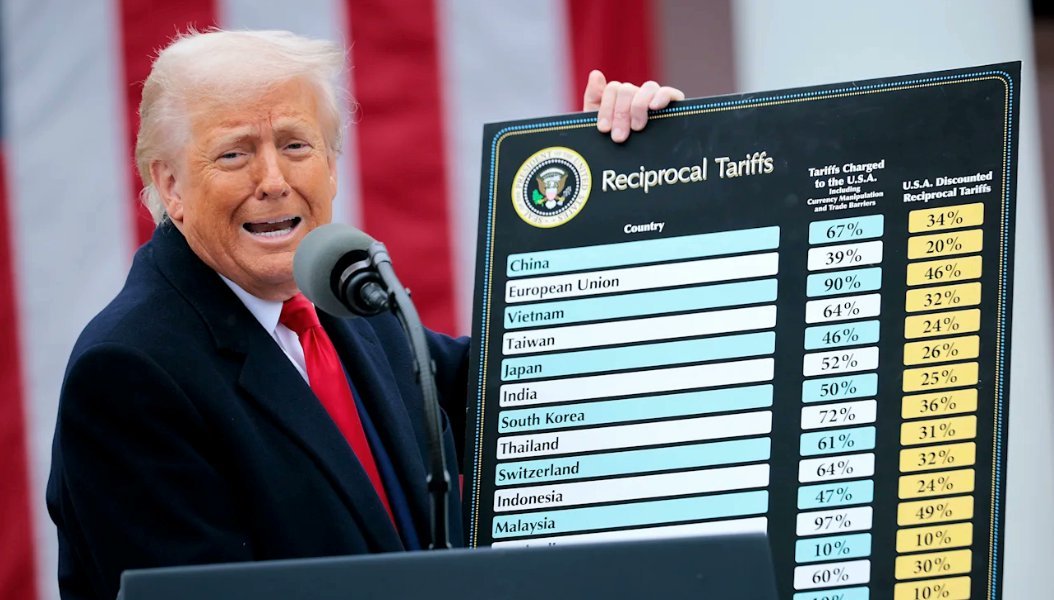
The US Supreme Court has ruled against US President Donald Trump’s global tariffs, which went into effect last year in a 6-3 majority ruling. In its ruling, the US Supreme Court says Trump exceeded his authority in imposing sweeping tariffs through a law reserved for a national emergency.
The high court rules the International Emergency Economic Powers Act “does not authorize the President to impose tariffs”.
The ruling centres on Trump’s use of a 1977 law, the International Emergency Economic Powers Act (IEEPA), that gives the president the power to “regulate” trade in response to an emergency.
Trump first invoked it in February 2025 to tax goods from China, Mexico and Canada, saying drug trafficking from those countries constituted an emergency.
He deployed it again in April, ordering levies from 10% to 50% on goods from almost every country in the world. He said the US trade deficit – where the US imports more than it exports – posed an “extraordinary and unusual threat”.
The industry-specific steel, aluminium, lumber and automotive tariffs, which were implemented under Section 232 of the Trade Expansion Act of 1962, citing national-security concerns were however unaffected.
How The Supreme Court Voted
The three liberal justices, Ketanji Brown Jackson, Elena Kagan and Sonia Sotomayor, joined by three conservative justices, Amy Coney Barrett, Neil Gorsuch and John Roberts, voted to strike down the tariffs.
Justices Brett Kavanaugh, Samuel Alito and Clarence Thomas dissented.
The court’s decision represents a rare check on this president’s broad use of executive authority. A majority of the justices over the past year have shown a willingness to allow Trump to press ahead with his agenda, particularly on immigration and reshaping the federal government, even as legal challenges work their way through the court system.
These import taxes were introduced under the International Emergency Economic Powers Act. But the court ruled that the Act did not authorise measures which were “unbounded in scope, amount and duration”.
Trump Calls Decision a Disgrace
Donald Trump has reacted to the Supreme Court’s decision to strike down his tariffs, calling it a “disgrace”. He reportedly made the remark while speaking at a meeting with state governors earlier this morning according to BBC sources.
However, this is not the only legal avenue the administration has used to impose extra tariffs since Trump took office. There are other laws which he could use to re-impose them if he wishes.
Given the president’s clear enthusiasm for tariffs as a negotiating tool, we are unlikely to see a big change in policy from the White House.
That said, those other methods may require congressional approval or investigations by the US Department of Commerce – so would probably take longer. It’s not yet clear what will happen in terms of refunds for tariffs that have already been paid by US importers.