
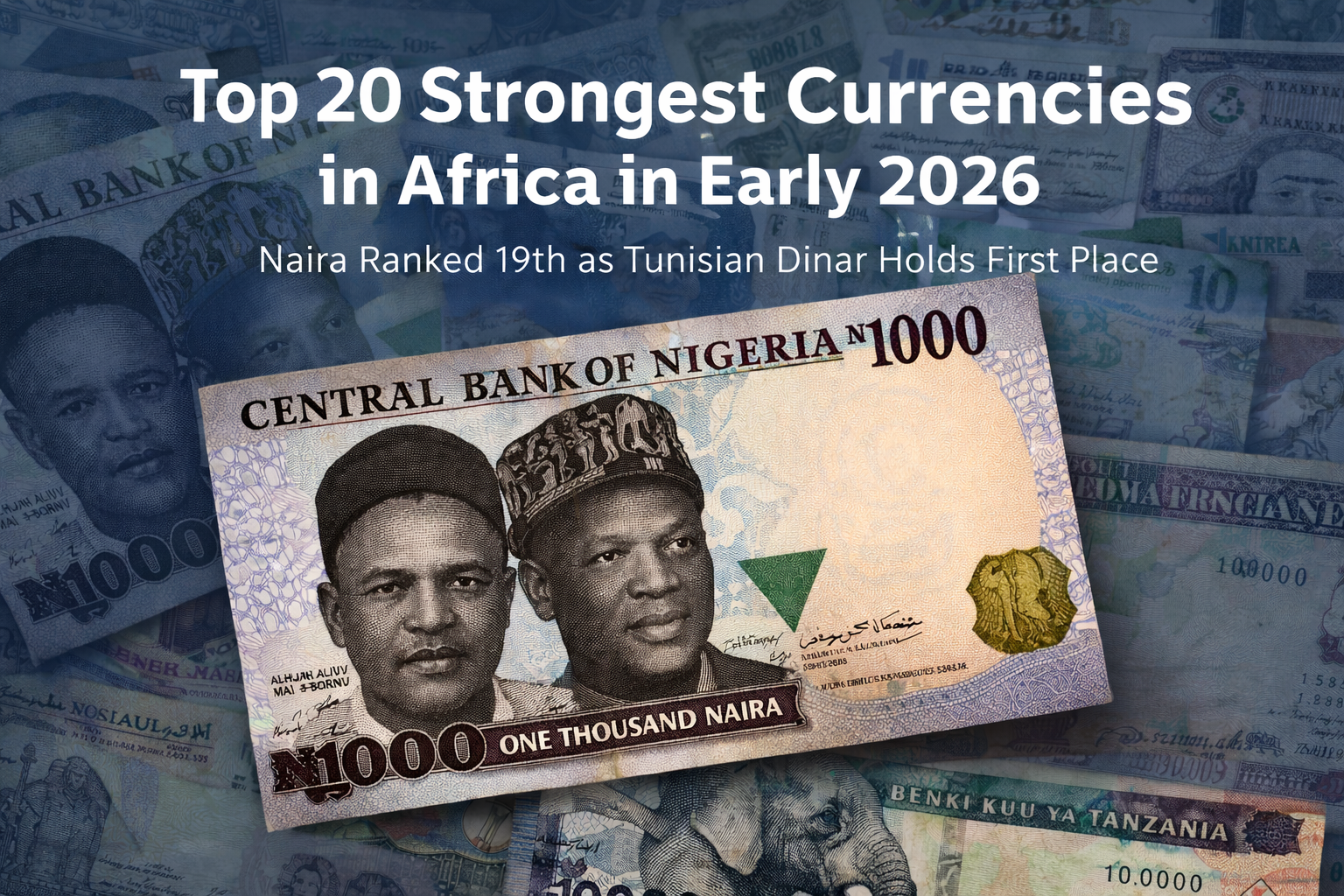
Below is a ranking of the top 20 strongest currencies in Africa in the opening weeks of 2026, based on approximate mid-range market rates compiled from financial platforms, analyst reports, and market trackers as of late January to early February 2026.
Top 20 Strongest African Currencies (Early 2026)
1. Tunisian Dinar (TND)
2.82–2.93 TND per USD
Tunisia’s dinar retains its position as Africa’s strongest currency, supported by strict exchange controls, disciplined inflation management, and a diversified economy spanning manufacturing, tourism, and services.
2. Libyan Dinar (LYD)
5.40–6.31 LYD per USD
Despite political uncertainty, Libya’s currency remains firm due to strong oil export revenues, which provide steady foreign exchange inflows.
3. Moroccan Dirham (MAD)
9.01–9.22 MAD per USD
Morocco continues to benefit from prudent monetary policy, economic diversification, resilient tourism earnings, renewable energy investment, and rising foreign direct investment.
4. Ghanaian Cedi (GHS)
10.50–10.94 GHS per USD
The cedi stands out in early 2026 after a strong rebound in 2025, driven by robust cocoa and gold exports, tighter fiscal discipline, and improved market sentiment.
5. Botswana Pula (BWP)
12.30–13.98 BWP per USD
Diamond exports, low public debt, investment-grade credit ratings, and consistent macroeconomic management keep the pula among Africa’s most stable currencies.
6. Seychellois Rupee (SCR)
13.60–14.50 SCR per USD
Tourism-led foreign exchange inflows and careful central bank oversight continue to underpin the rupee’s relative strength.
7. Eritrean Nakfa (ERN)
15 ERN per USD (official rate)
The nakfa’s stability reflects Eritrea’s fixed exchange regime and tight economic controls, though the currency is not freely convertible.
8–11. Common Monetary Area Currencies
15.80–16.40 per USD
-
South African Rand (ZAR)
-
Namibian Dollar (NAD)
-
Lesotho Loti (LSL)
-
Swazi Lilangeni (SZL)
These currencies move almost in lockstep under the Common Monetary Area (CMA). The rand, Africa’s most liquid currency, is supported by deep financial markets and commodity exports such as platinum and gold.
12. Egyptian Pound (EGP)
30.80–31.50 EGP per USD
Despite past devaluations, the pound’s relative positioning reflects tight monetary policy, IMF-backed reforms, and stabilising foreign inflows.
13. Mauritian Rupee (MUR)
44.00–46.00 MUR per USD
Mauritius benefits from a diversified economy anchored by financial services, tourism, and manufacturing exports.
14. Kenyan Shilling (KES)
145–155 KES per USD
Improved foreign inflows, fiscal adjustments, and reduced external pressures have helped stabilise the shilling compared with previous years.
15. Zambian Kwacha (ZMW)
22.00–23.50 ZMW per USD
Copper export revenues and debt restructuring progress have supported the kwacha’s recovery.
16. Tanzanian Shilling (TZS)
2,500–2,650 TZS per USD
The shilling’s relative stability reflects controlled inflation and steady export earnings from gold and agriculture.
17. Ugandan Shilling (UGX)
3,750–3,900 UGX per USD
Sound central bank policy and oil project-related capital inflows continue to support the currency.
18. Rwandan Franc (RWF)
1,300–1,350 RWF per USD
Strong governance, disciplined fiscal policy, and steady growth underpin Rwanda’s currency stability.
19. Nigerian Naira (NGN)
1,400–1,450 NGN per USD (official market)
While still under pressure, the naira’s ranking reflects recent reforms, improving liquidity in official FX windows, and increased foreign participation.

20. Ethiopian Birr (ETB)
57–60 ETB per USD
Gradual reforms, export growth, and remittance inflows help keep the birr within the top 20 despite ongoing structural challenges.
Currency strength does not always translate directly into purchasing power or economic performance, but it remains a useful signal of macroeconomic discipline, export strength, and investor confidence.