
By any conventional measure, the Trump era should mark the end of American democracy promotion. “Make America Great Again” has come to mean that Washington will pursue commercial advantage abroad rather than risk economic relationships by raising uncomfortable questions about democracy and human rights in the world’s many quasi-democracies. It has also meant rolling back long-standing legal and ethical constraints that once signalled a commitment to cleaner global business practices, even in poorly governed but resource-rich states.
Development assistance — historically a central instrument of American foreign policy used to build institutional relationships, encourage reform and apply quiet pressure for improved governance — has been sharply reduced. Aid was never purely altruistic; it functioned as leverage. Its contraction signals not just fiscal retrenchment but strategic withdrawal.
America foreign policy has come a long way in 30 years. When Nigeria’s military ruler Sani Abacha presided over repression following the annulled June 12 1993 election — by Moshood Abiola — and when Abiola’s wife, Kudirat, was assassinated in 1996, Washington publicly demanded a restoration of democratic rule, funded pro-democracy actors and supported sanctions. It is far from clear that similar outrage today would elicit the same level of American engagement were comparable abuses to occur in West Africa.
Contemporary US foreign policy appears increasingly transactional. Security cooperation may intensify where counter-terrorism interests are involved; targeted strikes may be debated; intelligence partnerships may continue. But the sustained, values-based promotion of accountable government and institutional reform has receded as a declared objective.
America’s foreign policy institutions — at least in their former role as democracy promoters — have been battered. Budgets have been slashed. Rhetoric has been inverted. Alliances with western partners that once aligned around a shared democratic mission are strained. At home, the world’s most influential democracy is deeply polarised, raising questions about its own constitutional durability. Abroad, authoritarian powers are ascendant, confident and unapologetic. In such a climate, it is reasonable to ask whether American democracy promotion has simply run its course.
Yet the democracy scholar Larry Diamond insists the obituary is premature. In a sweeping historical reflection, Diamond argues that the retreat from democracy promotion under Donald Trump — severe though it has been — is neither unprecedented nor irreversible. Indeed, he suggests, moments of American democratic fragility have previously produced not retreat but reinvention. To understand his claim, one must return to 1973.
That year, amid the Watergate scandal and the disintegration of public trust in the Nixon White House, the United States hardly seemed in a position to lecture others about constitutional propriety. Abroad, dictatorships proliferated: Ferdinand Marcos had declared martial law in the Philippines; Augusto Pinochet was preparing to overthrow Chile’s democracy; authoritarian regimes dominated much of Africa, Latin America and eastern Europe.
Henry Kissinger’s foreign policy doctrine, grounded in cold realism, prioritised strategic stability over human rights. At home, the “Saturday Night Massacre” suggested American democracy itself was wobbling. Yet it was in this atmosphere that the congressman Donald Fraser convened hearings linking foreign assistance to human rights. The result was the institutionalisation of human rights reporting within the State Department and amendments conditioning security assistance on democratic standards. A few years later, Jimmy Carter elevated human rights to the centre of US diplomacy. Soon after, even Ronald Reagan, campaigning as a critic of Carter’s “idealism”, would deliver in Westminster a ringing defence of freedom as a universal right and help create the National Endowment for Democracy, embedding democracy support within bipartisan statecraft.
Diamond’s central point is that today’s despair mirrors that earlier moment of disillusion. The belief that democracy promotion “had a good run” and is now finished, he argues, is historically myopic. Certainly, the present rupture is serious. The closure of the U.S. Agency for International Development, deep cuts to democracy and human rights programming, and attempts to weaken Voice of America represent a structural contraction of American soft power. Admiration voiced for illiberal leaders such as Hungary’s Viktor Orbán, coupled with abrasive treatment of democratic allies, has compounded doubts about Washington’s reliability.
More troubling still is the erosion of democratic norms within the United States itself. Diamond does not evade this contradiction. A country grappling with assaults on electoral legitimacy and institutional checks cannot easily present itself as a democratic exemplar. Yet he advances a pragmatic, rather than sentimental, defence of democracy promotion. The argument is not that America has a moral duty to evangelise. It is that its strategic interests are better served in a world of accountable governments than of corrupt autocracies.
Authoritarian regimes, he observes, are disproportionately associated with aggression, repression, organised crime, forced migration and economic volatility. Democracies, by contrast, tend to be more reliable trading partners and security collaborators. Retreat from the “war of ideas” with Beijing and Moscow would not simply diminish American prestige; it would concede influence over the norms governing technology, trade routes and global governance.
There is also, Diamond contends, more domestic support for democracy promotion than is commonly assumed. Polling suggests majorities favour foreign assistance aimed at strengthening democratic institutions, even if voters remain sceptical of military interventions. On Capitol Hill, attempts to defund the National Endowment for Democracy have been defeated with bipartisan backing. What would a post-Trump renewal look like? Diamond is clear about what it should not involve. Large-scale military campaigns designed to impose democracy have generally failed. Broad sanctions that impoverish populations without destabilising elites often entrench authoritarian rule.
Instead, he sketches a subtler strategy: targeted sanctions and intelligence operations to fracture regime coalitions; investment in independent media and digital tools capable of circumventing censorship; stronger aid conditionality tied to governance reforms; and a reimagined public diplomacy infrastructure — perhaps even, he suggests, a “DARPA for freedom” to innovate technologies that counter authoritarian surveillance and disinformation. Budgetary constraints will be formidable. But the international affairs budget is modest compared with defence spending, and preventive engagement, as the former US defence secretary James Mattis once remarked, is cheaper than ammunition.
Perhaps Diamond’s most compelling insight is that the next phase of democracy promotion, if it comes, must be grounded in humility. The era of lecturing from a pedestal is over. Any renewed American engagement would need to acknowledge its own democratic fragilities and approach partners not as dependants but as collaborators. For British and European observers, accustomed to doubts about America’s reliability in recent years, the question is not whether trust can be fully restored. It is whether strategic alignment against authoritarian expansion makes renewed cooperation inevitable.
Diamond believes it does. Democracies, even wary ones, have little appetite for living in a world shaped by Beijing’s model of techno-authoritarian governance or Moscow’s coercive revisionism. Nor have citizens within authoritarian states abandoned their aspirations for accountable government. Half a century ago, amid Watergate and global dictatorship, American democracy promotion was reborn rather than buried. Whether history repeats itself is uncertain. But Diamond’s provocation is clear: nations do not merely drift into decline; they choose it. The choice, he suggests, remains open.
Nigeria, Ethnicity and the Stakes of a “Multipolar” World
For readers in Africa — and particularly in Nigeria — Larry Diamond’s defence of democracy promotion is not an abstract geopolitical debate. It intersects directly with questions he has wrestled with for decades: why democracy in multi-ethnic societies so often falters, and why development without accountability ultimately corrodes the state.
Diamond’s work on Nigeria, dating back to the Second Republic and continuing through the Fourth Republic, centres on a distinctive thesis: that ethnicity in itself is not the core problem. Rather, it is the interaction between ethnic fragmentation and weak institutions that turns political competition into zero-sum conflict.
In his landmark book Class, Ethnicity and Democracy in Nigeria, Diamond argued that Nigeria’s democratic breakdown in the 1980s was not inevitable. The country’s ethnic pluralism — Hausa-Fulani, Yoruba, Igbo and numerous minority groups — could have been managed through institutional design, cross-ethnic coalitions and credible electoral administration. Instead, political elites mobilised ethnicity as an instrument of patronage and access to state resources.
Diamond’s broader proposition is that in deeply divided societies, democracy requires strong, impartial institutions: credible electoral commissions, professional civil services, independent courts, rule-bound parties. Where institutions are weak, elections become ethnic censuses; where they are rigged, they delegitimise the state; and where state resources are treated as spoils, politics becomes a scramble for distribution rather than a contest over policy.
Crucially, Diamond has long insisted that democracy is not a luxury to be postponed until after development. It is the mechanism through which development becomes sustainable. In resource-rich but institutionally fragile states such as Nigeria, the absence of accountability enables corruption to metastasise. Oil rents, rather than building national capacity, become fuel for patronage networks. The result is a paradox he frequently highlights: vast natural wealth coexisting with underdevelopment. This is where the debate over a so-called “multipolar world” becomes consequential.
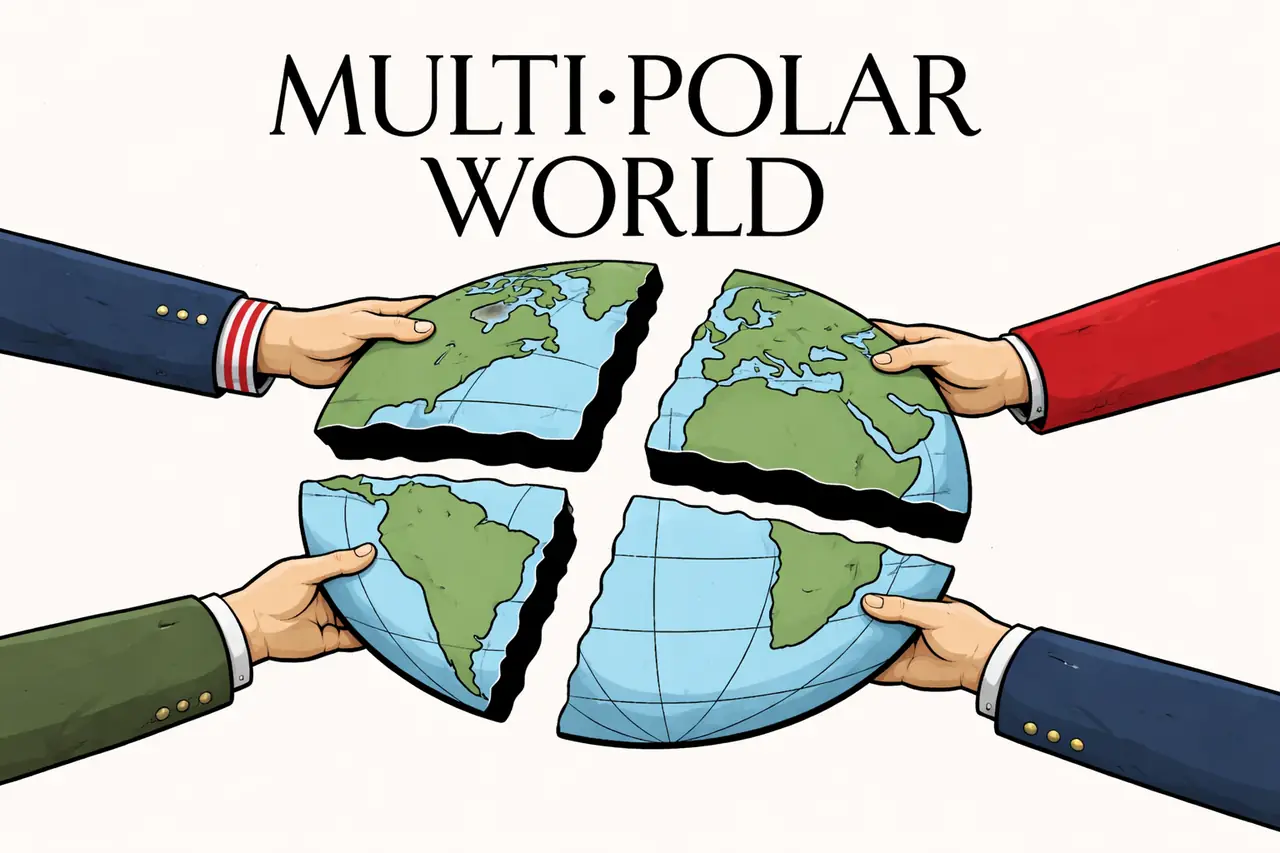
Proponents of multipolarity often frame it as emancipation from western hegemony: a world in which sovereign choices are respected and countries are free to align with Beijing, Moscow or Washington as they wish. But Diamond’s framework invites a harder question: sovereign for whom? In a world where “non-interference” becomes an absolute principle, regimes that rig elections, jail opponents and suppress media can claim international legitimacy so long as they are formally sovereign. External scrutiny is dismissed as neocolonial interference. Human rights abuses become internal matters.
For countries like Nigeria, this environment is not empowering. It is permissive — but permissive for elites, not citizens. When governance standards are treated as optional and elections as domestic rituals immune from international evaluation, corrupt regimes thrive unhindered. External actors — whether western corporations, Chinese state-backed firms or Russian security contractors — find it easier to transact with opaque governments than with transparent ones. Deals are negotiated with executives rather than parliaments. Contracts are shielded from public oversight. Resource concessions can be structured to benefit ruling coalitions rather than the broader population.
In such a system, richer powers — regardless of ideology — gain leverage. Weak institutions in the host country lower the cost of entry. Corruption becomes a lubricant of foreign policy. Sovereignty rhetoric shields exploitation. Diamond’s argument implicitly challenges the romanticism sometimes attached to multipolarity. A world without shared norms of electoral integrity, rule of law and human rights does not level the playing field. It entrenches asymmetries.
Nigeria’s experience offers a sobering illustration. Periods of democratic opening — notably after 1999 — expanded civil society space, investigative journalism and judicial activism. Even imperfect elections created pressure for reform. Conversely, moments of democratic erosion have coincided with greater impunity in public finance, weakened oversight of security agencies and diminished public trust. In Diamond’s schema, democracy is not merely about alternating governments. It is about constraining power. And constraints are precisely what corrupt elites resist.
If the international system shifts decisively toward a model in which election-rigging and repression are treated as culturally specific “choices,” reformers within countries such as Nigeria lose leverage. Domestic civil society organisations lose international partners. Electoral malpractice becomes normalised. Anti-corruption campaigns lose external backing. The informational space narrows as regimes justify censorship in the name of sovereignty. The irony, Diamond would argue, is that such a system ultimately benefits the strongest states. When governance standards dissolve, power politics fills the vacuum. Smaller and middle-income countries become arenas for influence rather than agents of rule-making.

For Nigeria — Africa’s largest democracy and third largest economy — the stakes are especially high. Its size gives it weight, but its institutional fragility makes it vulnerable. A global order that deprioritises democratic accountability risks reinforcing the very dynamics Diamond has long warned about: ethnicised patronage politics, elite predation and developmental stagnation. In this sense, the survival of democracy promotion is not about exporting American values. It is about preserving an international environment in which citizens — whether in Lagos, London or Los Angeles — can plausibly demand accountable government.
If that environment erodes, it will not be Washington alone that feels the loss. Countries like Nigeria, where the struggle to align democracy, diversity and development remains unfinished, would find the ground shifting beneath them — and not in their favour.