
Femi Otedola, chairman of First HoldCo Plc, has publicly defended the group’s decision to take a ₦748 billion one-time impairment charge, describing it as a decisive balance-sheet reset rather than a sign of continuing weakness.
In a statement posted on X, Otedola acknowledged that the provisioning caused a 92% collapse in reported profit, but argued that the move aligned with supervisory expectations and positioned the bank more credibly for Nigeria’s recapitalisation cycle.
“We took a huge one-time hit of ₦748bn to admit old bad loans instead of pretending they do not exist,” he wrote. “Painful headline, but it is a serious long-term move.”
For investors, however, the debate triggered by the write-off is already moving beyond the headline loss. The central question is not whether the loans will recover — they have been written off — but what the scale and timing of the recognition reveal about past governance, and how that should now influence buy-and-sell decisions.
Even before the market assesses whether the clean-up proves genuinely one-off, the impairment has begun to alter how First HoldCo is classified within institutional portfolios. In equity markets, losses matter — but late recognition of losses matters more. That distinction helps explain why the write-off, despite being framed as a reset, has immediately reshaped investor behaviour.
What the Statement Gets Right
On its own terms, Otedola’s communication is disciplined and largely well judged.
First, it accepts finality. By framing the charge explicitly as a write-off rather than a provisioning buffer, the statement removes ambiguity. Investors are not being asked to model recoveries or reversals; the loss is acknowledged as permanent.
Second, the write-off is positioned as regulatory-driven, in line with pressure from the Central Bank of Nigeria for banks to stop deferring problem assets. Markets are generally more forgiving of losses recognised under supervisory direction than of losses forced by sudden market shocks.
Third, Otedola anchors the defence in core earnings capacity, pointing to ₦2.96 trillion in interest income and ₦1.91 trillion in net interest income, arguing that the franchise retained sufficient earnings power to absorb the shock without threatening solvency.
Crucially, Otedola avoids overreach. He does not argue that value can still be salvaged from the impaired loans. That restraint matters. Once exposures are written off, investor focus shifts from recovery to process failure and future prevention, not asset salvage.
The Single-Obligor Question—and What the Disclosures Show
The size of the ₦748bn charge has inevitably prompted speculation about whether it stems from a single large borrower. However, there is no indication in First HoldCo’s FY 2025 financial statements that the impairment relates to one obligor.
Analysts note that an exposure of this magnitude, if attributable to a single counterparty, would almost certainly have triggered explicit disclosure under concentration-risk and material-exposure rules. Instead, the pattern is more consistent with multiple legacy credits accumulated over several years, recognised at once.
That distinction is critical. A single-obligor collapse would imply acute limit breaches and board-level failures. A multi-obligor clean-up instead points to systemic weaknesses in credit governance and delayed recognition—a different, though still serious, problem.
Why Investor Skepticism May Persist
Even if the explanation is internally coherent, markets tend to trade consequences, not intent. Investor scepticism may therefore remain focused on three unresolved issues.
The first is timing. Losses of this scale do not materialise overnight, and investors are likely to seek clarity on why recognition was delayed and what changed internally to allow full acknowledgement now.
The second is controls. A write-off closes the accounting chapter, but not the governance one. Investors will look for evidence that credit approval, monitoring, and escalation frameworks have been materially tightened.
The third is repeat risk. The credibility of the “one-time clean-up” claim will depend entirely on what impairment numbers look like in subsequent reporting periods. As one market participant put it privately, “Big write-offs are forgivable. Repeated ‘one-offs’ are not.”
Why Timing May Matter More Than the Loss Itself
Markets may focus less on the loss itself than on when it was recognised. Impairments of this magnitude rarely arise suddenly; they typically reflect risks that accumulated over several years, periods of deferred recognition, and restructuring assumptions that proved overly optimistic.
When losses of this scale are recognised late and all at once, equity markets are likely to infer weaknesses in credit governance, delayed escalation to the board, and insufficient internal challenge. That judgement is less about accounting compliance than institutional behaviour, and on its own may be enough to trigger a reclassification of the stock—from a quality compounder to a turnaround situation—shaping future buy-and-sell decisions.
How the Write-Off Could Reposition First Bank Within the FUGAZ Peer Group
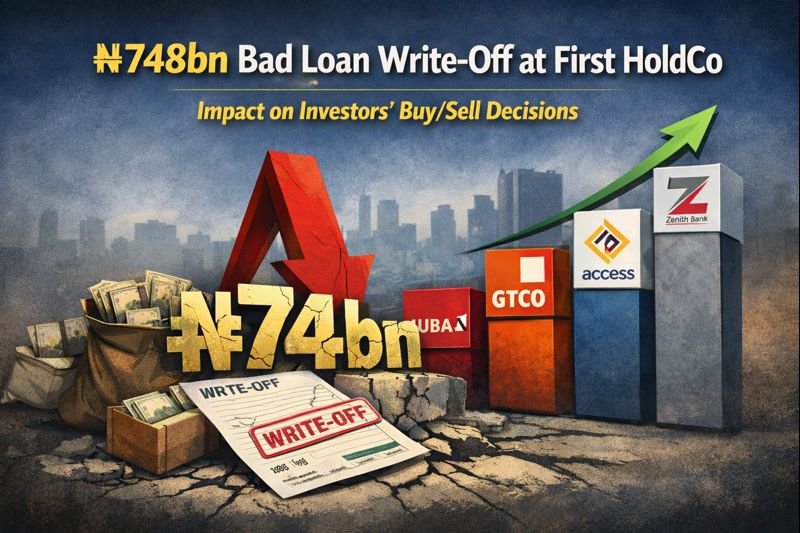
Beyond the defence itself, the ₦748bn write-off could materially alter how investors position First HoldCo relative to the rest of Nigeria’s FUGAZ banks—United Bank for Africa, GTCO, Access Holdings Plc, and Zenith Bank Plc.
In the near term, the charge is likely to weaken First Bank’s standing relative to its peers, even if it does not render the stock uninvestable. More importantly, it forces a reclassification. Within the FUGAZ universe, First HoldCo may no longer be viewed as a quality compounder but as a high-risk turnaround play, and that shift is likely to dominate future buy-and-sell decisions.
Earnings quality sits at the centre of this divergence. First HoldCo’s profit collapsed by 93% in FY 2025, overwhelmingly due to the impairment. By contrast, UBA, GTCO, Access, and Zenith continue to be seen as lower-impairment institutions with more predictable earnings profiles and clearer dividend visibility. Their credit losses are typically measured in tens of billions of naira, not hundreds, and their cost of risk remains in low single digits.
The practical effect is likely to be a gradual rotation, rather than an abrupt one. Income-focused funds, conservative domestic institutions, foreign portfolio investors, and governance-sensitive mandates may underweight or reduce exposure to First HoldCo, reallocating toward other FUGAZ names that still screen as clean on asset quality. GTCO is often favoured for its capital-light, fee-driven model; Zenith for its deeply conservative culture; Access for scale and execution capacity; and UBA for geographic diversification and resilient earnings.
First HoldCo, by contrast, is more likely to attract a different class of investor: deep-value players, turnaround and special-situations funds, and long-horizon domestic investors prepared to wait. For them, the logic is straightforward. The bad news is finally out; what matters now is whether anything truly changes.
Governance Premium, Valuation—and the Market’s Likely Verdict
Markets continue to assign a governance premium, and for now the rest of the FUGAZ group is likely to retain it. Those banks trade as institutions investors do not feel compelled to monitor closely, while First Bank is increasingly treated as one that requires sustained scrutiny.
Until First HoldCo demonstrates several quarters of materially lower impairments, tighter cost control, a stable and improving return on equity, and the absence of further legacy surprises, it is unlikely to command valuation multiples comparable to its peers. Relative cheapness alone is therefore unlikely to drive a rerating. First HoldCo will need to earn any recovery in valuation through execution, not explanation.
What First HoldCo’s Investor-Relations Strategy Must Look Like Over the Next 12 Months
If First HoldCo is to stabilise sentiment and gradually re-enter mainstream institutional portfolios, its investor-relations strategy will need to move decisively from explanation to proof.
The first priority will be predictable disclosure. Markets will expect unusually granular commentary on asset quality in the next several reporting cycles, including clear movements in Stage 2 and Stage 3 loans, sectoral concentrations, and early-warning indicators. Silence or aggregation that appears evasive is likely to be interpreted negatively.
Second, management will need to pre-empt impairment anxiety. Even modest credit charges will be scrutinised, making it essential to guide expectations carefully around what constitutes a “normalised” cost of risk after the clean-up—and to adhere to that guidance.
Third, governance reform must become visible rather than rhetorical. That means clearly identifying changes in credit committees, escalation thresholds, internal audit authority, and risk leadership—and allowing those changes to show up in behaviour, not just policy language.
Fourth, capital-allocation discipline will matter as much as capital strength. Dividend policy, expansion plans, and discretionary spending will be read as signals of whether management fully understands the cost of lost trust.
Finally, communication itself must evolve. Investors are likely to respond better to measured, institutional messaging than to episodic, personality-driven interventions. Otedola’s statement has drawn the line; what follows must be carried by consistent execution and unemotional disclosure.

If First HoldCo can deliver that sequence over the next year, the ₦748bn write-off may ultimately be seen as the painful beginning of a credible reset. If not, investors are likely to interpret it as the first visible admission of a deeper structural problem.
For now, the likely market positioning is clear. Within the FUGAZ universe, UBA, GTCO, Access, and Zenith remain the default holdings. First HoldCo is a selective, high-risk position, offering optional upside—but only for investors willing to wait for evidence, not reassurance.