
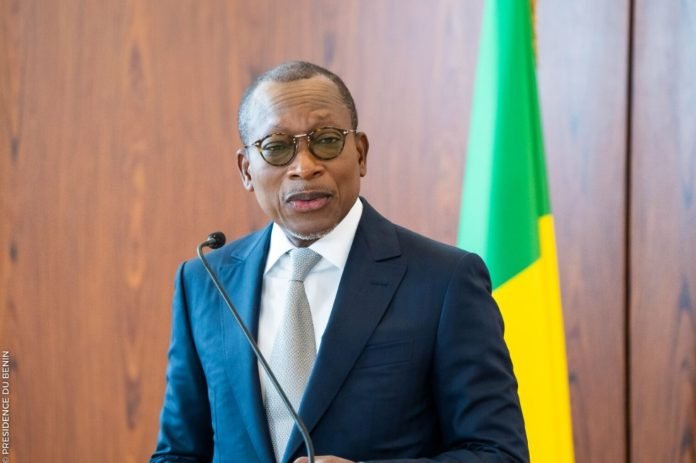
Just before dawn on Sunday, Beninese viewers watching the national broadcaster were jolted into disbelief. A small group of soldiers in helmets appeared on state television, declared that the government had been dissolved, the constitution suspended and the borders closed — and announced that a previously obscure officer, Lt. Col. Pascal Tigri, would head a new military authority.
For several anxious hours, rumors ricocheted through the coastal capital. Gunfire was reported near Camp Guézo, the military base close to President Patrice Talon’s official residence. Foreign missions issued security alerts. Traffic thinned on the streets as residents stayed indoors, uncertain whether their country had become the latest casualty in West Africa’s wave of military takeovers.
By midmorning, the government reasserted control.
In a video posted on social media, Interior Minister Alassane Seidou said a “small group of soldiers” had launched a mutiny but had been swiftly overpowered by loyal forces. The presidency confirmed that President Talon was safe and that the rebels had managed, at most, to seize the television station briefly. ECOWAS, the regional bloc, issued a swift condemnation and warned that it was prepared to defend Benin’s constitutional order.
For Benin — long celebrated as one of West Africa’s most stable democracies — the episode was nothing short of a shock. It was the first serious coup attempt in more than five decades, shattering a reputation built painstakingly after the Cold War as a rare example of peaceful political succession in a turbulent region.
A Fragile Politics Beneath the Calm
The attempted takeover did not arrive without warning.
Though Benin has avoided the dramatic military interventions that have convulsed neighboring Niger, Burkina Faso and Mali, the country’s political landscape has been tightening in ways that critics say have steadily narrowed democratic space.
President Talon, a cotton billionaire turned reformist politician, has ruled since 2016. In recent years, changes to electoral rules and institutional thresholds have severely weakened the opposition, leaving his allies with near-total control of parliament. A recent court ruling disqualified opposition figure Renaud Agbodjo from the 2026 presidential race, intensifying accusations that the political process is being engineered to protect the ruling elite.
At the same time, constitutional revisions have expanded presidential influence, feeding public unease over the balance of power.
Security pressures have also mounted. Once shielded by geography, northern Benin has increasingly come under attack from jihadist groups spilling south from the Sahel. The army has suffered mounting casualties, and the violence has strained relations between the government and segments of the security forces.
The foiled coup also comes at a delicate political moment. President Talon is constitutionally due to step down in April 2026, with Romuald Wadagni, his powerful former finance minister, widely seen as the favored successor. For some analysts, the sudden mutiny appeared timed to exploit both uncertainty over the succession and frustration within sections of the barracks.
A Country That Once Lived by the Gun
That Benin now views even a failed mutiny as an existential shock is itself a measure of how dramatically the country has changed.
At independence in 1960, when it was still known as Dahomey, Benin quickly earned one of the most unstable records on the continent. Between 1963 and 1972, power changed hands repeatedly through coups and counter-coups. Civilian leaders were pushed aside by soldiers; soldiers were toppled by rival soldiers. Governments collapsed almost as soon as they formed.
The chaos reached its climax on October 26, 1972, when Maj. Mathieu Kérékou, a little-known officer from the north, seized power. Two years later, he stunned both allies and adversaries by declaring Benin a Marxist-Leninist state. The country was renamed the People’s Republic of Benin. Banks were nationalized, industries seized, and political pluralism extinguished.
For nearly two decades, Kérékou governed through a rigid one-party state as the economy withered. By the late 1980s, unpaid salaries, labor strikes and mass discontent forced his hand. In 1990, he convened a National Conference that peacefully dismantled military rule and restored multi-party democracy — a transition that would later be hailed across Africa as a template for nonviolent reform.
A year later, in a twist that still astonishes historians, Kérékou lost a free election and stepped down peacefully, only to return later to power through the ballot box.
From that moment until today, Benin’s army stayed firmly in its barracks.
An Exception in a Region of Coups
As soldiers marched on presidential palaces in Bamako, Ouagadougou and Niamey over the past five years, Beninese officials often pointed with pride to their country’s exceptional record. Power changed hands through elections between Nicéphore Soglo, Boni Yayi, Kérékou and Talon, without tanks on the streets.
That pride is now shaken.
Even though today’s mutiny collapsed quickly, its symbolism has reverberated far beyond Cotonou. Regional officials worry that the “contagion effect” of military takeovers in the Sahel — amplified by economic hardship, anti-elite anger and the erosion of civilian checks — may finally have reached the Gulf of Guinea.
ECOWAS’s unusually sharp warning on Sunday underscored those fears. So did the anxious tone of foreign embassies, many of which urged their nationals to avoid large gatherings as the situation unfolded.
What the Mutiny Means Now
Unlike in Mali or Niger, the mutineers in Benin appeared to lack broad support within the ranks. Officials said only a “small group” had participated, and loyal units moved rapidly to isolate them.
Yet even a failed coup leaves scars.
It exposes fractures within the military. It emboldens extremist groups watching for weakness along porous northern borders. And it deepens political mistrust at a moment when Benin badly needs consensus to navigate a sensitive transition of power.
For President Talon — who built his reputation on technocratic reforms and fiscal discipline — the episode will likely harden criticism that political exclusion and heavy-handed state control have pushed dissent out of institutions and into the shadows.
For ordinary Beninese, the fear is simpler: that a country which worked so painstakingly to escape the curse of coups may now be drifting closer to it once again.
From Stability to Uncertainty
By late afternoon on Sunday, traffic was returning to Cotonou’s crowded boulevards. Shops reopened. The television broadcast returned to soap operas and football highlights. The government said the crisis had passed.
But the aftershocks are only just beginning.

In a region where the boundary between barracks and palace has grown perilously thin, Benin’s failed coup is a warning shot — not only about the fragility of its own institutions, but about how quickly even the most stable democracies in West Africa can be pulled into the gravitational field of military power.
Whether this moment becomes a historical footnote — or the beginning of another dangerous turn in Benin’s long political story — now depends on what comes next.