
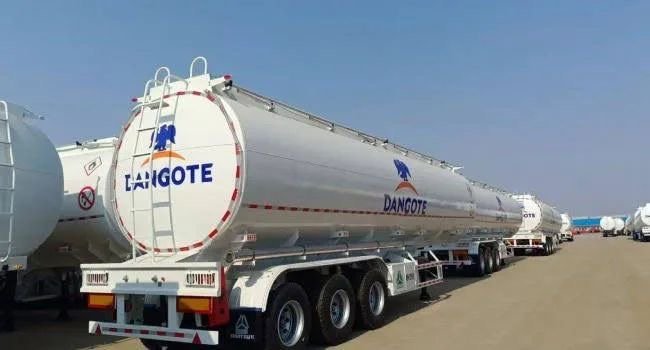
This The unveiling of 4,000 CNG-powered trucks by Dangote Refinery has generated both excitement and skepticism. On one side, oil marketers argue that the trucks will not be sufficient to meet Nigeria’s vast distribution needs. On the other, business leaders like Femi Otedola challenge depot owners to adapt, restructure, or risk irrelevance in a rapidly transforming energy landscape.
But this conversation is bigger than Dangote, DAPPMAN, or even the trucks themselves. It is about how Nigeria’s downstream sector must evolve in an era of local refining, clean energy, and shifting market realities.
Dangote Refinery and Nigeria’s Fuel Distribution: Can 4,000 Trucks Meet Demand?
Nigeria is a country of over 200 million people, with fuel demand stretching across urban cities, rural communities, and remote regions. While 4,000 CNG-powered trucks mark a bold step forward, they cannot single-handedly cover the supply chain to “the last mile.”
The truth is, no refinery or fleet — no matter how large — can succeed in isolation. Effective distribution requires a network that blends:
-
Refinery fleets like Dangote’s
-
Independent truck owners
-
Retail outlets (filling stations)
-
Depot infrastructure
-
Government and regulatory support
This is less about the number of trucks and more about the strength of the ecosystem.
Depot Transformation and the Future of Petroleum Distribution in Nigeria
Much of the debate has centered around depots. Otedola has argued that depots, originally built for an import-driven economy, are losing relevance in a refining-dominated system.
But here’s a different perspective: Depots don’t need to disappear — they need to transform.
Possible pathways include:
-
Conversion into multi-fuel logistics hubs (supporting petrol, diesel, and CNG).
-
Storage facilities for emergencies, ensuring product availability during supply disruptions.
-
Renewable energy integration — depots could evolve into hubs for solar-powered mini-grids or LNG distribution.
-
CNG & EV support centers as Nigeria transitions gradually toward cleaner energy solutions.
Scrapping decades of investment would be wasteful; repurposing ensures resilience.
Lessons from Global Markets
Global energy markets show us that adaptation is key:
-
In Europe and the U.S., fuel depots are being repurposed into bonded warehouses, LNG hubs, or even logistics parks.
-
In Nigeria’s cement sector, once local production surged, import-based infrastructure was retired, and new value chains emerged.
-
Energy majors worldwide are diversifying into renewables, charging infrastructure, and hybrid solutions to remain competitive.
The Nigerian downstream industry must learn from these transitions rather than resist them.
Collaboration Over Competition
This is not a zero-sum game between Dangote Refinery and existing marketers. The future lies in collaboration, not competition.
-
Refineries: Provide products at scale.
-
Marketers/Depots: Ensure storage, last-mile access, and local distribution.
-
Retailers: Serve consumers directly.
-
Government/Regulators: Create policies that encourage innovation, not monopoly.
A collaborative model would ensure that energy access is reliable, affordable, and sustainable, no matter where in Nigeria consumers live.
The Road Ahead
The Dangote Refinery is a catalyst for change, but it cannot transform the sector alone. The big question is not whether 4,000 trucks are enough — but whether the entire industry is willing to adapt.
-
Depot owners must reimagine their assets.
-
Retailers must modernize their networks.
-
Marketers must invest in alternative fuels.
-
Policymakers must ensure inclusivity and fair competition.
Those who embrace change will thrive. Those who cling to outdated models risk irrelevance.

Final Thought
The Nigerian energy sector stands at a crossroads. The conversation should not be framed as Dangote vs. DAPPMAN, but rather as Nigeria vs. the future.
The companies that innovate, collaborate, and adapt will drive the sector forward — ensuring that energy flows seamlessly from refineries to retail outlets, and ultimately, to the millions of Nigerians who depend on it daily.