
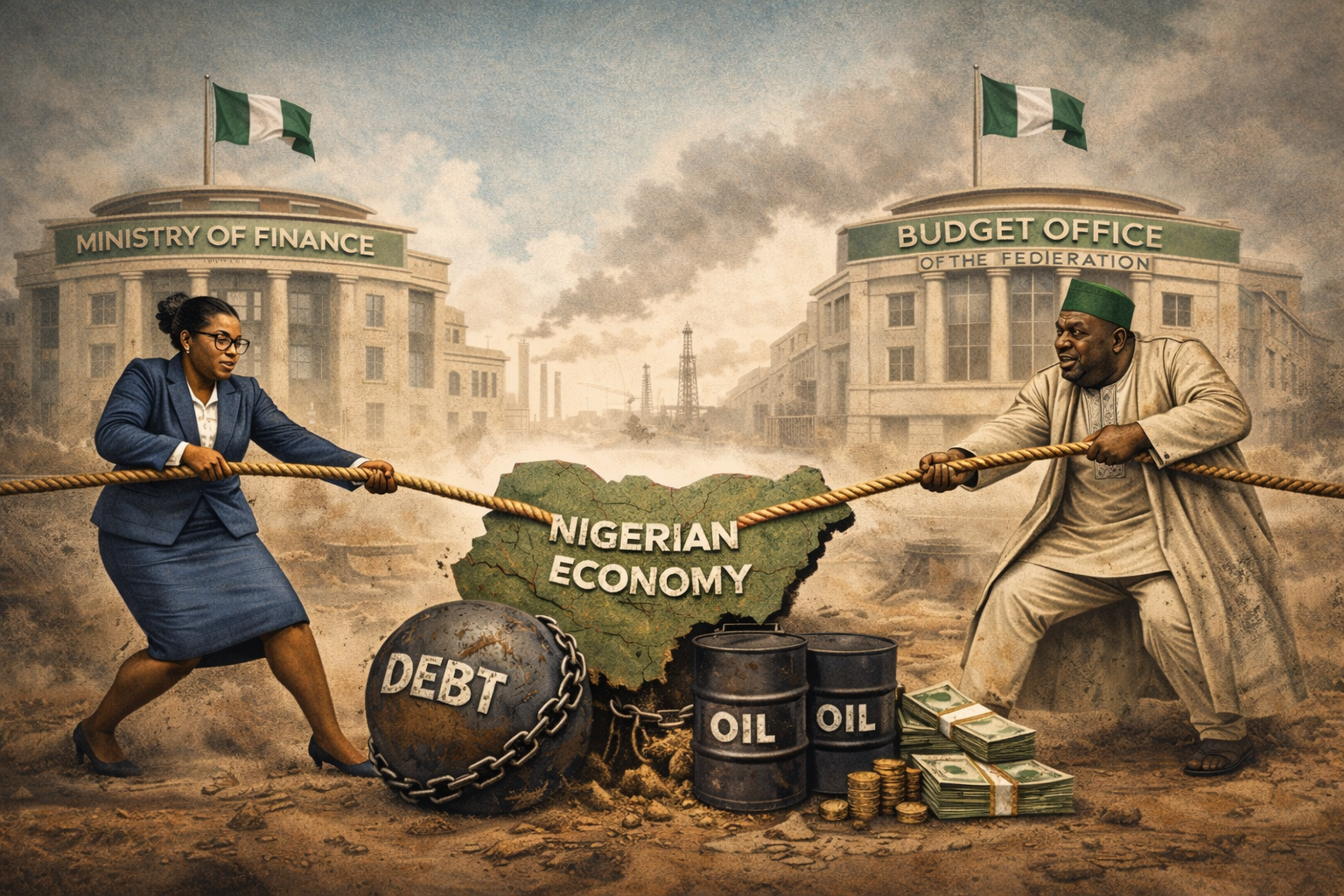
A structural flaw at the heart of Nigeria’s fiscal framework
Nigeria’s recurring budget shortfalls are often framed as a revenue collection problem or, more recently, as a debt sustainability challenge. Neither diagnosis fully captures the issue. What Nigeria faces is a budget credibility problem, rooted in the institutional separation between those who design the budget and those responsible for financing and executing it.
At the centre of this dysfunction is the uneasy division of roles between the Federal Ministry of Finance and the Budget Office of the Federation. In practice, expenditure ambitions are formulated through the budget process with limited binding constraint from realistic revenue projections, while the Ministry of Finance is left to fund, finance, and execute budgets after those ambitions have already been politically locked in.
This separation weakens accountability. It allows a system in which budgets can be expansive without being executable, and where fiscal adjustment occurs only after the fact, through cash rationing, capital expenditure cuts, and ad hoc borrowing.
How the split distorts revenue realism
The consequences of this institutional design are evident in Nigeria’s revenue outcomes. Data from the Office of the Accountant-General of the Federation show that between 2022 and 2025, actual federal government revenue consistently fell well below budget targets, with 2025 performance at just 26 percent of projections.
A key driver of this gap is the disconnect between oil and gas tax projections prepared by the Federal Inland Revenue Service (FIRS) and the significantly higher figures ultimately embedded in the Medium-Term Expenditure Framework (MTEF) and annual budgets. For 2025, Petroleum Profit Tax and hydrocarbon taxes were budgeted at ₦24.4 trillion, while FIRS itself projected only ₦5.2 trillion. Actual collections for January–September came in at ₦4.1 trillion—just 22 percent of the prorated budget benchmark.
A similar pattern is evident in Companies Income Tax from oil and gas companies, which achieved only 32 percent performance over the same period. The paradox is persistent: even when FIRS meets or exceeds its internal targets, federal revenue still underperforms against the official budget because the benchmarks themselves are anchored to implausibly optimistic assumptions.
This is not a narrow forecasting error. It reflects a budgeting process in which expenditure decisions are effectively taken first, and revenue assumptions—particularly oil-related revenues—are stretched to accommodate them.
Why institutional separation matters
Nigeria’s Fiscal Responsibility Act (2007) anticipated precisely this risk. Section 30(1) assigns responsibility for monitoring and evaluating budget implementation, assessing fiscal target attainment, and reporting to the National Assembly to the Minister of Finance, acting through the Budget Office. The logic is unambiguous: budget formulation, financing, and execution are intended to be integrated functions.
That logic was weakened when the Budget Office was split from the Ministry of Finance in 2015–16. Although the functions were formally re-merged in 2019 after the separation proved problematic, the operational legacy remains. Budget design continues to operate with insufficient binding constraint from cash-flow reality, while the Ministry of Finance manages the consequences rather than shaping the assumptions.
The result is a recurring mismatch: one institution designs the budget, another must fund it, and neither is fully accountable for delivery.
Credibility, illusion, and the size of the state
This institutional arrangement sustains an illusion of fiscal capacity. By embedding optimistic revenue assumptions, budgets create the impression that the state can sustain a level of spending—and a size of government—that is inconsistent with Nigeria’s actual revenue base.
Nigeria maintains a large federal bureaucracy with overlapping ministries, departments and agencies, alongside an expensive political architecture. Personnel costs, allowances, pensions, overheads, and political office entitlements absorb a dominant share of federally retained revenue, leaving limited fiscal space even in years of relatively strong oil prices. Senior political office holders and legislators continue to enjoy high remuneration and benefits, often shielded from public scrutiny, while public-sector productivity remains weak.
As long as budgets are built on inflated revenue assumptions, the political reckoning required to resize government is deferred. Adjustment is postponed rather than avoided, and reform is repeatedly pushed into the future.
Growth implications
The economic cost of this credibility problem is dynamic, not immediate. Nigeria is not necessarily poorer in a given year because a budget line is unfunded. The deeper damage lies in the stop-start nature of public investment, the repeated resetting of fiscal plans, and the absence of compounding gains from consistent strategy.
Infrastructure gaps persist, private investment remains cautious, and diversification stalls—not because of a single bad budget, but because the state never fully aligns its ambitions with its means.
What obtains elsewhere
In most major economies, budget formulation is institutionally anchored close to the centre of fiscal control, precisely to avoid this credibility gap.
In the United States, budget preparation sits within the Executive Office of the President through the Office of Management and Budget, working closely with the Treasury. While Congress retains appropriation authority, persistent unrealistic revenue assumptions are constrained by continuous scoring, oversight, and debt management discipline.
In Britain, HM Treasury is the undisputed centre of budget design, spending control, and in-year monitoring. Multi-year Spending Reviews and independent scrutiny by the Office for Budget Responsibility significantly raise the political cost of implausible forecasts.
In France, budget authority is embedded within the Ministry of the Economy and Finance, with strong central control over ministerial spending and financing coherence.
In Japan, the Ministry of Finance plays a dominant gatekeeping role in budget compilation and execution, ensuring that spending approvals are tightly coupled with financing realities.
Even in China, where the system is structurally different, fiscal authority sits with the Ministry of Finance, while economic planning is coordinated with the planning apparatus. Budgeting, financing, and execution remain tightly linked.
Across these systems, political negotiation is unavoidable. What differs is that the centre of finance remains the centre of budget credibility.

Fixing the root cause
Nigeria’s solution is therefore institutional, not rhetorical. Budget development, revenue forecasting, financing, and execution must be fully re-anchored under the Ministry of Finance, with binding expenditure ceilings and conservative, historically grounded revenue assumptions.
Until the tension between the Ministry of Finance and the Budget Office is resolved in practice—not just in statute—Nigeria will continue to produce impressive-looking budgets that unravel on contact with reality, while the harder task of resizing the state and resetting growth strategy remains perpetually deferred.