
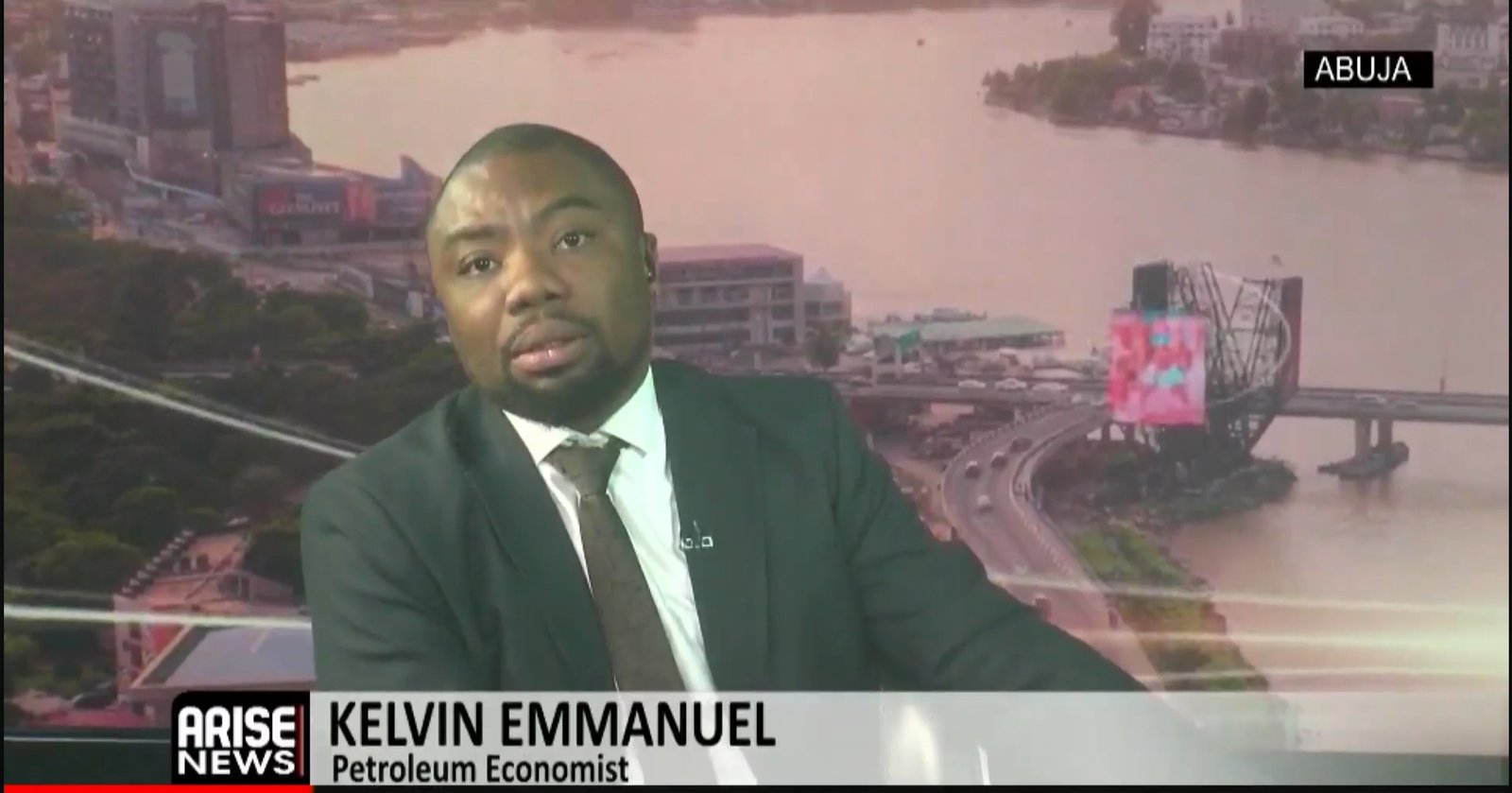
The controversy surrounding allegations by the Dangote Group against the Chief Executive of the Nigerian Midstream and Downstream Petroleum Regulatory Authority (NMDPRA), Farouk Ahmed, has triggered intense public debate.
But for petroleum economist Kelvin Emmanuel, who appeared on Arise TV to defend Dangote’s position, the issue is not primarily about personal allegations or the foreign education of a regulator’s children.
Rather, he argues, it is a window into Nigeria’s deeper regulatory failures, policy contradictions, and the long-standing reluctance of anti-corruption institutions to confront powerful interests.
Speaking forcefully during the live programme, Emmanuel framed the discussion around first principles: public accountability, regulatory integrity, and Nigeria’s energy security.
According to him, public funds do not belong to officials but to Nigerians, and any serious allegation touching on abuse of office deserves transparent investigation, regardless of who is involved.
“Nobody in government owns the money they are custodians of. The money belongs to Nigerians,” Emmanuel said. “If allegations arise, the law already provides mechanisms to investigate them.”
He pointed to provisions of the ICPC Act and asset declaration rules, arguing that Nigeria’s institutions already have the legal authority to act—what is lacking is the will.
Tax, Income, and the Question of Verifiable Wealth
Central to Emmanuel’s argument was the principle that in a functional society, claims of wealth must be supported by verifiable records, particularly tax returns.
Responding to suggestions that family members or inheritance could have funded expensive foreign education, he insisted that such explanations must withstand scrutiny.
“If anybody says, ‘I have this financial capacity,’ the first indication to verify that capacity is tax returns,” he said. “Where are your tax returns? What business did you do? What industry did you operate in to earn that money?”
He stressed that tax compliance is not optional and that failure to demonstrate legitimate income streams raises further legal questions.
“If you’re not paying tax, you’re evading tax. That is a crime on its own,” Emmanuel added.
However, he also acknowledged due process, emphasizing that allegations alone do not amount to guilt.
Any investigation, he said, must be evidence-driven and allow the accused full right of defence.
Skepticism Rooted in History
Despite his call for investigation, Emmanuel made it clear that he is not optimistic about the outcome.
His skepticism is rooted in what he described as Nigeria’s poor record of holding powerful institutions accountable.
He cited the example of billions of dollars reportedly spent on refinery turnaround maintenance over several years, with little to show for it.
“Despite the fact that billions of dollars of Nigeria’s hard-earned money were spent, the refineries are shut down,” he said. “Yet we have not seen serious investigations or prosecutions.”
For Emmanuel, this history casts doubt on whether current anti-corruption probes will go beyond symbolism.
“Is there political will in Nigeria to fight corruption?” he asked repeatedly. “Are the anti-corruption agencies truly independent?”
From Personal Allegations to Structural Failure
While much public attention has focused on allegations involving the NMDPRA chief, Emmanuel insisted that Nigerians should not lose sight of the real crisis: the regulatory and policy decisions shaping the downstream petroleum sector.
He criticized the regulator’s continued issuance of fuel import licences, even as domestic refining capacity—particularly from the Dangote Refinery—comes on stream.
“Within the last 30 days, import licences have been granted for an average of about 50 million litres per day,” he said. “That is about 1.8 billion litres of product worth roughly $1.6 billion brought into Nigeria in just one month.”
For Emmanuel, this raises fundamental questions about Nigeria’s energy security and economic logic.
“Why should Nigeria, a crude oil-producing country with refining capacity, continue to rely heavily on imports?” he asked.
Quality, Standards, and Regulatory Double Standards
A major pillar of Emmanuel’s argument was fuel quality.
He alleged that while local refiners are subjected to strict enforcement under the Petroleum Industry Act (PIA), imported products are not always held to the same standards.
“Quality determines price,” he said. “A 500 ppm sulfur product is not the same as a 50 ppm sulfur product.”
He cited past testing that allegedly revealed sulfur levels in some imported fuels far exceeding ECOWAS and Nigerian regulatory limits.
“Some samples showed sulfur levels of over 1,500 ppm and even 2,500 ppm,” Emmanuel claimed. “The regulatory limit is 50 ppm.”
According to him, failure to enforce standards uniformly distorts pricing, harms consumers, and undermines public trust in regulators.
The Regulator–Industry Conflict
Emmanuel also framed the dispute as part of a broader conflict between regulators and industry players in Nigeria, where policy inconsistency and selective enforcement discourage investment.
He questioned why senior regulatory officials had not engaged directly with domestic refiners, even as they made public statements about product quality.
“Since the refinery started operations, the authority chief executive has not visited it,” he said, contrasting this with what he described as swift public endorsements of claims made by other state entities.
For him, this pattern reinforces perceptions of bias and weak institutional credibility.
Sanctions, Imports, and Energy Sovereignty
Another controversial point raised by Emmanuel involved Nigeria’s fuel sourcing practices.
He alleged that some imports are linked to complex international trading arrangements that may expose Nigeria to legal and ethical risks.
“Why is Nigeria’s energy security being determined outside its borders?” he asked. “Why should Nigeria put itself in a position where it appears to be violating international sanctions, instead of strengthening domestic refining?”
He argued that continued dependence on imports makes Nigeria vulnerable to external shocks and undermines long-term economic stability.
The Way Forward: Institutions, Not Individuals
While acknowledging that investigations into alleged misconduct should proceed, Emmanuel cautioned against framing the issue as the removal of one official.

“This is not about one man,” he said. “Even if one person is removed, does that solve the structural problem?”
For him, the real solution lies in systemic reform: transparent regulation, equal enforcement of standards, reduced fuel imports, credible asset declaration processes, and truly independent anti-corruption agencies.
“Nigerians deserve to know how public institutions are run,” Emmanuel concluded.
“But beyond that, they deserve a system that works—one that protects public funds, enforces the law equally, and prioritizes Nigeria’s long-term energy security.”
As investigations, petitions, and counter-statements continue, Emmanuel’s intervention has shifted the conversation from personal allegations to a more uncomfortable national question: whether Nigeria is ready to confront the structural weaknesses that have long defined its oil and gas sector—and whether its anti-corruption agencies are willing and able to follow the facts wherever they lead.