
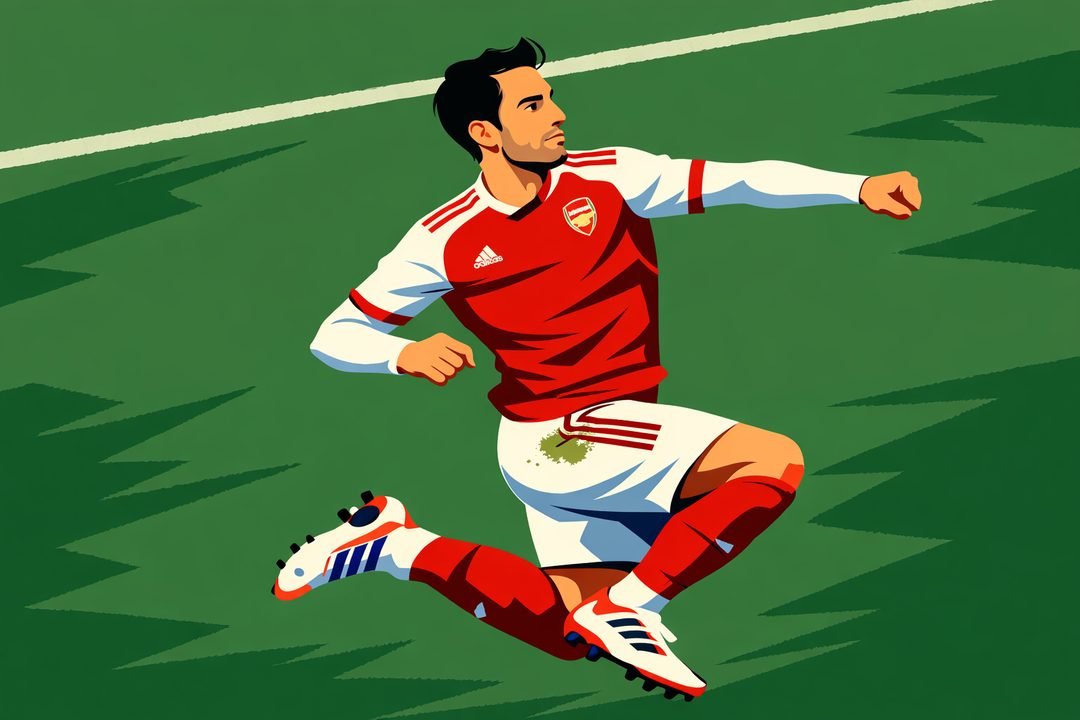
Arsenal’s Authority Shows Again as Gyökeres Double Settles Sunderland
For much of the winter, Arsenal’s title pursuit has been framed as a question of nerve. On Saturday afternoon, it looked more like a question of arithmetic.
Against a Sunderland side that had already shown this season it could unsettle even the league’s most composed teams, Arsenal produced another controlled performance, pulling away late to win 3–0 and extend their advantage at the top of the Premier League. The margin, by the end, felt less like a flourish than a statement of order.
Arsenal entered the match in a familiar position but a newly comfortable one. Three consecutive league victories had restored momentum after a brief wobble, and last weekend’s emphatic win at Leeds had allowed Mikel Arteta’s side to capitalise on dropped points elsewhere. A dramatic midweek Carabao Cup semi-final victory over Chelsea — sealed by a last-gasp goal — only sharpened the sense that the season’s balance was beginning to tilt again in their favour.
Still, Sunderland were not treated as an afterthought. The reverse fixture had ended level, a late equaliser then puncturing Arsenal’s rhythm, and this Sunderland team have made a habit of complicating afternoons for those above them. They arrived in London buoyed by recent form and content, at least initially, to compress space and test Arsenal’s patience.
From the opening exchanges, Arsenal obliged. Possession was steady rather than urgent, circulated with care across the back line and midfield as Sunderland dropped into a compact shape. The game unfolded without drama, but not without direction. Arsenal pushed Sunderland deeper, minute by minute, until the pitch seemed to tilt toward the visiting penalty area.
The breakthrough came just before the interval, the reward for sustained pressure rather than a moment of improvisation. A close-range finish finally separated the sides, sending Arsenal into the break with a lead that felt earned, if not yet decisive.
Sunderland emerged with more intent after halftime, stepping higher and briefly testing Arsenal’s defensive concentration. But the response was telling. Arsenal slowed the game, recycled possession and waited. As the hour mark passed, the spaces appeared.
They were exploited in the 66th minute by Viktor Gyökeres, introduced from the bench and decisive almost immediately. A well-weighted pass found him arriving inside the box, and his finish — guided calmly into the corner — doubled Arsenal’s lead and eased the contest into a familiar rhythm.
From there, the match drifted in Arsenal’s favour. The home side managed the tempo, Sunderland chased, and the gulf between the teams became clearer with each passing phase.
The final punctuation arrived deep into stoppage time. With Sunderland stretched and the outcome no longer in doubt, Gabriel Martinelli carried the ball forward and slipped a pass into Gyökeres’ path. The striker took a touch and finished with the same restraint he had shown earlier, completing his brace and closing the afternoon at 3–0.
The final minutes unfolded without urgency or alarm. Arsenal kept the ball, Sunderland chased it, and the result settled quietly into place. Gyökeres’ second goal felt less like a twist than a footnote — confirmation of control rather than an escalation of it.
With the points secured, Arsenal move further clear at the summit, their lead stretched and their margin for error widened. It is not a title yet. But it is, increasingly, a position of command.
What the Table Suggests Next
If the Premier League season has reached a point where patterns begin to harden into probabilities, Arsenal appear to be entering it from a position of uncommon control.
Their recent run — three straight league wins, a dominant response to dropped points by Manchester City and Aston Villa, and a psychologically important Carabao Cup semifinal victory — suggests not just form, but timing. Teams that win titles often do so by aligning momentum with moments of external weakness elsewhere in the table. Arsenal have begun to do exactly that.
The immediate prediction, then, is not about any single match but about rate. Arsenal do not need perfection; they need consistency at a level slightly below it. Even a modest regression — draws rather than wins in their most demanding fixtures — would still leave pressure firmly on their closest pursuers, particularly Manchester City, who must now chase rather than stalk.
There is also a structural element. Arsenal’s next sequence of matches compresses difficulty into a short window. Navigate it with their lead largely intact, and the league begins to resemble a problem of arithmetic rather than imagination. Fail to do so, and the title race reopens quickly.

The most plausible outcome, based on current evidence, is neither collapse nor procession. It is a narrowing — Arsenal’s cushion shrinking slightly, but not disappearing — followed by a spring run-in where the burden of risk sits increasingly with those behind them.
Titles are rarely won in February. But they are often lost there. Arsenal, at this stage, look more like a team closing doors than opening doubts.